



Public Group
Active 1 year, 3 months ago
Group Type By Special Interest Group
Group Leadership
- Group Administrators
-

Agri-Business Startups Network
Tips for Starting Small-Scale Agribusiness
- This topic is empty.
- AuthorPosts
- July 28, 2026 at 1:49 pm #793744
 Agric4ProfitsModerator
Starting a small-scale agribusiness offers significant opportunity for building sustainable income, but success requires more than agricultural production skill alone, involving business planning, market understanding, and financial management capabilities that many new agribusiness owners underestimate when starting out.
The agricultural sector offers diverse business opportunities beyond basic crop or livestock production, including value addition, input supply, and service provision, each with different capital requirements, skill needs, and profit potential worth considering when planning a new venture.
This article covers essential tips for successfully starting a small-scale agribusiness, from initial planning and market research to financial management and growth strategy, helping new agripreneurs build a solid foundation for sustainable business success.
Whether you are planning your first agricultural venture or looking to formalize and grow existing farming activities into a more structured business, these foundational tips will help you navigate the transition from farming activity to sustainable agribusiness.
1. Conduct Thorough Market Research Before Starting
Understanding actual demand, competition, and pricing for your intended products or services before significant investment prevents the common mistake of building production capacity for a market that does not exist at the scale or price point initially assumed.
Talking directly with potential customers, whether other farmers, consumers, or businesses, about their actual needs and willingness to pay provides more reliable market intelligence than assumptions based purely on personal observation or general market impressions.
2. Start With a Clear, Focused Business Plan
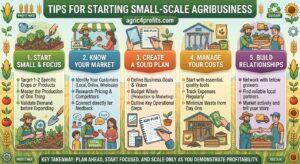
A simple but clear business plan, outlining your specific products or services, target customers, basic financial projections, and key operational steps, provides essential direction and helps identify potential problems before they become costly mistakes in actual operation.
Starting with a focused offering, rather than attempting to serve multiple markets or product lines simultaneously from the beginning, allows new agribusiness owners to build genuine expertise and reputation in a specific area before considering expansion.
Read Also: soil-amendments-to-improve-nutrient-uptake
Small-Scale Agribusiness Opportunity Types
Business Type Typical Capital Need Key Success Factor Value-added processing Moderate Product quality, market access Input supply (seeds, tools) Moderate to high Reliable supplier relationships Agricultural services Low to moderate Skill, reputation, reliability Direct production and sales Variable by scale Production efficiency, market channels 3. Understand and Plan Your Financial Needs
Accurately estimating startup costs, including often underestimated expenses beyond direct production costs like licensing, packaging, or marketing, helps prevent the common problem of running out of capital before a new business reaches sustainable operation.
Planning for adequate working capital to cover the period between initial investment and reliable revenue generation, which is often longer than new business owners initially expect, provides important financial cushion during the vulnerable early operation period.
4. Build Relationships With Key Business Partners
Reliable relationships with suppliers, whether for inputs, equipment, or raw materials, and with buyers or customers, form the operational backbone of a successful agribusiness, making relationship building a priority alongside product or service development itself.
Engaging with local agricultural extension services, farmer associations, or business support organizations early on can provide valuable guidance, potential partnerships, and access to resources that support new agribusiness development.
Common New Agribusiness Startup Mistakes
Mistake Consequence Prevention Insufficient market research Building capacity for non-existent demand Direct customer conversations before investment Underestimating startup costs Running out of capital early Comprehensive cost planning including hidden expenses Overly broad initial focus Diluted effort, slower expertise building Start focused, expand after establishing success Neglecting record keeping Poor financial visibility Simple systems from the very start 5. Establish Simple Record Keeping From the Start
Implementing basic financial record keeping from the very beginning of operations, rather than treating it as an afterthought, provides essential visibility into whether the business is genuinely profitable and supports better decision making as the venture develops.
Even simple tracking of income, expenses, and basic inventory helps new agribusiness owners understand their actual financial position and identify problems early, before they become significant enough to threaten business viability.
6. Plan for Gradual, Sustainable Growth
Expanding operations gradually as the core business proves successful and generates its own growth capital tends to be more sustainable than rapid expansion based primarily on optimism or external funding without proven business fundamentals.
Regularly evaluating actual business performance against initial plans, and being willing to adjust strategy based on real results rather than rigidly following original assumptions, supports more resilient long term agribusiness development.
Frequently Asked Questions
- Why is market research so important before starting an agribusiness?
Understanding actual demand and pricing before significant investment prevents building production capacity for a market that does not exist at the scale or price point initially assumed.
- Should new agribusiness owners start with multiple products or a focused offering?
Starting with a focused offering allows building genuine expertise and reputation in a specific area before considering expansion, rather than diluting effort across multiple markets simultaneously.
- What startup costs do new agribusiness owners commonly underestimate?
Expenses beyond direct production costs, such as licensing, packaging, or marketing, are commonly underestimated, contributing to running out of capital before reaching sustainable operation.
- How important is record keeping for a new agribusiness?
Basic financial record keeping from the very beginning provides essential visibility into actual profitability and supports better decision making as the venture develops.
- What types of agribusiness opportunities exist beyond direct production?
Value-added processing, input supply, and agricultural services all offer diverse opportunities with different capital requirements and skill needs beyond basic crop or livestock production.
- Why is working capital planning important for new agribusinesses?
The period between initial investment and reliable revenue generation is often longer than expected, making adequate working capital planning important for surviving this vulnerable early period.
- How can new agribusiness owners access helpful guidance and resources?
Engaging with local agricultural extension services, farmer associations, or business support organizations early on can provide valuable guidance and access to helpful resources.
- Is rapid expansion recommended for new agribusinesses?
Gradual expansion as the core business proves successful and generates its own growth capital tends to be more sustainable than rapid expansion based primarily on optimism.
- How can farmers validate demand before investing in an agribusiness idea?
Talking directly with potential customers about their actual needs and willingness to pay provides more reliable market intelligence than assumptions based on general observation.
- Should a business plan be complex for a small-scale agribusiness?
No, a simple but clear business plan outlining products, customers, financial projections, and key steps provides essential direction without requiring unnecessary complexity.
Starting a successful small-scale agribusiness requires combining agricultural knowledge with genuine business planning, market research, and financial discipline from the very beginning. This foundational approach significantly improves the odds of building a sustainable, profitable venture. What advice would you give to someone starting a new agribusiness? Share your experience with the Agric4Profits farming community.
Read Also: processes-of-sludge treatment
- AuthorPosts

- You must be logged in to reply to this topic.