



Public Group
Active 1 year, 3 months ago
Group Leadership
- Group Administrators
-

Burundi Farmers Community
Small-Scale Farming Business Ideas in Burundi
- This topic is empty.
- AuthorPosts
- March 11, 2026 at 3:44 pm #742654
 Agric4ProfitsModerator
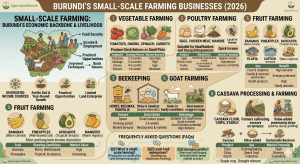
Small-scale farming plays a vital role in Burundi’s economy and rural livelihoods. A large portion of the population depends on agriculture for food, income, and employment. Because most farmers operate on small pieces of land, small-scale farming businesses offer practical opportunities for individuals and families to generate income while supporting local food production.
Burundi’s climate and fertile soils allow farmers to grow a variety of crops and raise livestock throughout the year. With proper planning and management, small-scale farming can become a profitable business even with limited resources. Many farmers combine crop production with livestock rearing, value addition, or market gardening to diversify their income sources.
Starting a small-scale farming business does not always require large capital investments. Many successful farmers begin with simple activities such as vegetable production, poultry farming, or beekeeping. These enterprises require relatively small land areas and can provide quick returns if managed properly.
In addition, increasing demand for fresh food products in local markets presents opportunities for farmers to sell produce such as vegetables, eggs, fruits, and dairy products. With improved farming techniques and better market access, small-scale farmers in Burundi can significantly improve their income and living standards.
This article highlights several profitable small-scale farming business ideas that can be started in Burundi.
1. Vegetable Farming
Vegetable farming is one of the most popular small-scale farming businesses in Burundi. Vegetables such as tomatoes, onions, cabbage, spinach, and carrots are widely consumed and have strong demand in local markets.
Vegetable farming can be done on small plots of land and often produces quick returns because many vegetables mature within a short period. Farmers can also practice irrigation during dry seasons to maintain consistent production and supply markets throughout the year.
Table: Common Vegetables Grown in Burundi
Vegetable Growing Period Market Demand Tomatoes 2–3 months Very high Cabbage 3–4 months High Onions 3–4 months High Spinach 4–6 weeks Moderate Vegetable farming can provide steady income, especially when farmers supply urban markets and local restaurants.
2. Poultry Farming
Poultry farming is another profitable small-scale farming business in Burundi. Chickens are easy to raise and require relatively small space compared to other livestock. Farmers can produce eggs and meat for both household consumption and sale.
Local chicken breeds are commonly raised because they are more resistant to diseases and adapt well to local conditions. Farmers may also raise improved breeds for higher egg and meat production.
Table: Poultry Farming Benefits
Product Market Use Income Potential Eggs Household consumption and sale Regular income Chicken meat Local markets and restaurants High demand Poultry manure Organic fertilizer Improves soil fertility Poultry farming provides quick income and is suitable for smallholder farmers and young entrepreneurs.
Read Also: Land Preparation Techniques in Burundi
3. Beekeeping
Beekeeping is an emerging small-scale farming business in Burundi with good income potential. Honey production requires minimal land and can be integrated with crop farming. Bees also help pollinate crops, improving agricultural productivity.
Farmers can produce honey, beeswax, and other bee products that are sold in local and regional markets. Beekeeping equipment such as hives and protective clothing is relatively affordable, making it accessible for small farmers.
Table: Beekeeping Products
Product Use Market Opportunity Honey Food and medicine High demand Beeswax Candle and cosmetic production Growing market Propolis Health products Emerging demand Beekeeping is environmentally friendly and supports biodiversity while providing income.
4. Fish Farming
Fish farming is becoming increasingly popular in Burundi due to rising demand for fish as a protein source. Farmers can establish small fish ponds to raise species such as tilapia and catfish.
Fish farming allows farmers to produce food efficiently while generating income from fish sales. With proper feeding and water management, fish can grow quickly and reach market size within a few months.
Table: Common Fish Species for Farming
Fish Species Growth Rate Market Demand Tilapia Fast High Catfish Moderate High Carp Moderate Moderate Fish farming can be integrated with crop farming, where pond water and waste are used to fertilize crops.
5. Fruit Farming
Fruit farming offers excellent opportunities for small-scale farmers in Burundi. Fruits such as bananas, pineapples, avocados, and mangoes grow well in many regions of the country.
Fruit production can provide both short-term and long-term income depending on the crop. Some fruits produce harvests within a year, while others provide yields for many years after planting.
Table: Common Fruit Crops
Fruit Growing Conditions Market Value Bananas Warm climate High Pineapples Well-drained soil Moderate Avocados Tropical climate Increasing demand Mangoes Warm regions High seasonal demand Fruit farming also supports local food security and nutrition.
6. Goat Farming
Goat farming is widely practiced in rural areas of Burundi. Goats are hardy animals that adapt well to local conditions and require less feed compared to cattle.
Farmers raise goats for meat, milk, and breeding purposes. Goat manure is also valuable as organic fertilizer for crop production.
Table: Benefits of Goat Farming
Product Use Benefit Goat meat Food consumption High market demand Goat milk Nutrition and sale Additional income Manure Soil fertility improvement Supports crop farming Goat farming is suitable for farmers with limited land and resources.
7. Mushroom Farming
Mushroom farming is a profitable agricultural enterprise that can be carried out on a very small scale. Mushrooms grow quickly and require limited space, making them ideal for farmers in urban and peri-urban areas.
Farmers can grow mushrooms indoors using agricultural waste materials such as straw and sawdust. With proper conditions of humidity and temperature, mushrooms can be harvested within a few weeks.
Table: Mushroom Farming Features
Feature Description Advantage Space requirement Small indoor space Suitable for small farms Growing period 3–6 weeks Quick harvest Market demand Restaurants and markets Good income potential Mushroom farming offers high returns when properly managed.
8. Cassava Processing and Farming
Cassava is a staple crop in Burundi and offers opportunities for both farming and value-added processing. Farmers can grow cassava and process it into products such as cassava flour, chips, and starch for sale.
Processing cassava adds value to the raw product and increases income for farmers and small businesses. Cassava also grows well in various soil conditions and can tolerate drought.
Table: Cassava Products
Product Use Market Potential Cassava flour Cooking and baking High Cassava chips Snack food Growing demand Cassava starch Industrial use Expanding market Cassava farming combined with processing can create sustainable small-scale agricultural businesses.
Frequently Asked Questions (FAQs)
1. What is small-scale farming?
Small-scale farming refers to agricultural production carried out on relatively small plots of land using limited resources.2. Why is small-scale farming important in Burundi?
It provides food, income, and employment for a large portion of the population.3. Which small-scale farming business requires the least land?
Beekeeping and mushroom farming require very little land compared to other enterprises.4. Can vegetable farming be profitable for small farmers?
Yes, vegetables grow quickly and have strong demand in local markets.5. What livestock is suitable for small-scale farmers?
Poultry and goats are common livestock raised by small farmers.6. Is fish farming possible on small farms?
Yes, small fishponds can be established even on limited land.7. What fruits are commonly grown in Burundi?
Bananas, pineapples, mangoes, and avocados are widely grown.8. Does cassava farming provide income opportunities?
Yes, cassava can be processed into flour, chips, and other products for sale.9. Can small-scale farming support rural development?
Yes, it improves income, food security, and employment opportunities in rural areas.10. How can farmers increase profits from small-scale farming?
By adopting improved farming techniques, diversifying enterprises, and accessing better markets.Small-scale farming businesses offer many opportunities for farmers and entrepreneurs in Burundi. With proper planning, farmers can turn simple agricultural activities into profitable ventures that improve livelihoods and support food production.
Which small-scale farming business do you think has the greatest potential in Burundi? Share your ideas, experiences, or suggestions in the comment section below.
Read Also: Human influences on the nitrogen cycle
- AuthorPosts

- You must be logged in to reply to this topic.