



Public Group
Active 1 year, 3 months ago
Group Leadership
- Group Administrators
-

Central African Republic Farmers Community
How to Grow Cassava in Central African Republic
- This topic is empty.
- AuthorPosts
- August 10, 2026 at 9:32 am #555864
 Agric4ProfitsKeymaster
Cassava is one of the most important food crops for smallholder farmers across tropical Africa because it can tolerate relatively poor soils, withstand periods of drought, and provide reliable food when other crops perform poorly. In the Central African Republic (CAR), cassava is widely suited to the country’s warm climate and can play an important role in improving household food security and generating income for farmers.
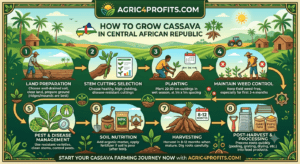
Growing cassava successfully requires proper land preparation, the selection of healthy planting materials, appropriate spacing, timely weed control, and protection against pests and diseases. Farmers who follow good agronomic practices can achieve better root yields and produce cassava suitable for household consumption or commercial processing.
1. Choose a Suitable Location for Cassava Farming
Cassava grows best in warm areas with adequate rainfall and good sunlight. Much of the Central African Republic has conditions suitable for cassava production, particularly areas where temperatures remain warm throughout most of the growing season.
Choose farmland that:
- Receives plenty of sunlight.
- Has good drainage.
- Does not remain waterlogged after rainfall.
- Has fertile or moderately fertile soil.
- Is accessible for transporting harvested cassava.
- Has not recently suffered from serious cassava disease outbreaks.
Avoid low-lying areas where water remains stagnant because excessive moisture around cassava roots can cause rotting and reduce yields.
2. Prepare the Land Properly
Good land preparation helps cassava establish strong roots and makes field management easier.
Clear bushes, weeds and crop residues from the selected field. Depending on the size of the farm and available equipment, farmers can prepare the land manually or use animal traction or machinery where available.
Loosen compacted soil and construct ridges or mounds where necessary. Ridges and mounds are particularly useful in areas with heavy rainfall or poorly drained soils because they improve drainage and provide loose soil for root development.
Avoid unnecessary burning of crop residues because organic materials can contribute to soil fertility when properly incorporated into the soil.
3. Select Healthy Cassava Stem Cuttings
Cassava is normally propagated using stem cuttings rather than seeds. The quality of the planting material has a major effect on plant establishment and final yield.
Select stems from healthy, vigorous cassava plants that show no obvious symptoms of disease or serious pest damage.
Good planting stems should:
- Come from mature, healthy plants.
- Be free from visible disease symptoms.
- Be sufficiently mature and woody.
- Have healthy buds.
- Not be severely damaged or dried out.
Farmers should avoid planting stems taken from diseased fields because infected planting materials can spread cassava diseases to new farms.
Where improved cassava varieties are available through agricultural programmes, research institutions or extension services, farmers should consider using varieties that are adapted to local conditions and have good resistance to important diseases.
4. Plant Cassava at the Right Time
The best planting time depends on the local rainfall pattern.
In rain-fed production, cassava should generally be planted at the beginning of the rainy season when there is enough moisture in the soil to support establishment. Planting too early into extremely dry soil can result in poor sprouting, while planting into excessively waterlogged soil can encourage rotting.
Farmers should monitor the onset of dependable rainfall and prepare their fields and planting materials before the rains begin.
5. Use Proper Spacing
Correct spacing gives cassava plants enough room to develop their stems, leaves and storage roots.
A common spacing recommendation is approximately 1 metre between plants and 1 metre between rows, although spacing can be adjusted according to the variety, soil fertility, planting system and intended use.
Closer spacing may increase the number of plants per hectare but can also increase competition for nutrients, water and sunlight. Wider spacing can encourage individual plants to develop more strongly but may leave more space for weeds.
Farmers should therefore follow recommendations from local agricultural extension officers when available.
Read Also: Crop Production Calculator for Cassava Farming in Seychelles
6. Plant the Cuttings Correctly
Cassava stem cuttings can be planted vertically, diagonally or horizontally depending on local farming practices and soil conditions.
For many smallholder systems, planting cuttings vertically or at an angle provides good establishment.
Insert a substantial portion of the cutting into moist soil while leaving some buds above the ground. Make sure the cutting is planted in firm soil and has sufficient contact with the soil to encourage root development.
Avoid planting extremely short, damaged or dried-out cuttings because they may establish poorly.
7. Control Weeds Early
Weed control is one of the most important management practices in cassava farming.
Young cassava plants grow relatively slowly during the early stages, allowing weeds to compete strongly for sunlight, water and nutrients. Heavy weed competition can significantly reduce cassava yields.
Farmers should regularly inspect their fields and remove weeds before they become established.
Important weed-management practices include:
- Early hand weeding.
- Hoeing between rows.
- Mulching where suitable.
- Maintaining appropriate plant spacing.
- Using approved herbicides where farmers have the knowledge and equipment to apply them safely.
The field should receive particular attention during the first few months after planting, when cassava plants are most vulnerable to weed competition.
8. Maintain Soil Fertility
Cassava can grow in relatively poor soils, but good soil fertility is important for achieving high yields over the long term.
Repeated cassava cultivation without replacing nutrients can gradually reduce soil fertility. Farmers should therefore consider integrating cassava with practices that improve soil health.
These may include:
- Applying well-decomposed organic manure.
- Returning suitable crop residues to the soil.
- Practising crop rotation.
- Using compost.
- Growing legumes in rotation with cassava.
- Applying appropriate fertiliser based on soil-test recommendations.
Farmers should avoid applying fertiliser blindly. Soil testing, where available, can help determine which nutrients are deficient and what type of fertiliser is appropriate.
9. Protect Cassava from Pests and Diseases
Cassava can be affected by several pests and diseases. The importance of individual problems varies according to location, weather conditions and farming practices.
Farmers should regularly inspect cassava plants for unusual symptoms such as leaf distortion, yellowing, severe leaf loss, stem damage, wilting or poor plant growth.
Common cassava production problems can include:
- Cassava mealybugs.
- Cassava green mites.
- Whiteflies.
- Termites.
- Rodents.
- Cassava mosaic disease.
- Cassava brown streak disease in regions where it occurs.
One of the most effective ways to reduce disease spread is to plant healthy, disease-free stem cuttings. Farmers should also remove severely diseased plants when recommended by agricultural extension authorities and avoid moving infected planting materials between farms.
10. Manage Pests Using Integrated Methods
Farmers should avoid relying exclusively on chemical pesticides. Integrated pest management combines several approaches to reduce pest populations while protecting the environment and farm workers.
Useful approaches include:
- Planting healthy and resistant varieties where available.
- Regularly inspecting the field.
- Removing heavily affected plant material where appropriate.
- Maintaining good field sanitation.
- Protecting natural enemies of pests.
- Using pesticides only when necessary and according to approved instructions.
Farmers should seek advice from agricultural extension officers before using unfamiliar pesticides.
11. Consider Intercropping Cassava
Cassava can be grown alone or combined with other crops.
Smallholder farmers may intercrop cassava with crops such as maize, beans, groundnuts or other suitable food crops during the early stages of cassava development.
Intercropping can help farmers make better use of available farmland and produce more than one crop from the same field. However, crops should be properly spaced to prevent excessive competition for sunlight, nutrients and water.
The best combination depends on local conditions, available varieties and the farmer’s production objectives.
12. Monitor the Farm Throughout the Growing Season
Cassava requires less intensive management than some crops, but farmers should not leave the field unattended.
Regular monitoring allows farmers to identify problems before they become severe.
During field inspections, check for:
- Weed growth.
- Pest infestations.
- Disease symptoms.
- Poor plant establishment.
- Soil erosion.
- Waterlogging.
- Animal or rodent damage.
Early intervention can prevent small problems from developing into major yield losses.
13. Harvest Cassava at the Right Time
Cassava maturity varies depending on the variety and environmental conditions. Some varieties can be harvested relatively early, while others require a longer growing period.
Farmers should determine the expected maturity period of their selected variety and inspect the roots before harvesting.
When harvesting, loosen the soil around the plant carefully and pull or lift the roots from the ground. Avoid excessive damage because cassava roots can deteriorate quickly after being harvested.
If cassava is intended for immediate household consumption or processing, harvesting can be organised according to demand.
14. Handle Cassava Properly After Harvest
Fresh cassava roots are highly perishable and should not be left for extended periods without processing or proper handling.
After harvesting:
- Remove excess soil carefully.
- Avoid unnecessary bruising and cuts.
- Transport roots promptly.
- Process or sell them as soon as possible.
- Store processed cassava products under suitable dry conditions.
Cassava can be processed into products such as flour, chips, starch and other food products. Processing can extend shelf life and create additional income opportunities for farmers.
15. Improve Cassava Production Through Good Farm Planning
Successful cassava farming in the Central African Republic requires more than simply planting stems and waiting for harvest. Farmers should plan the entire production cycle before planting.
A good farm plan should consider:
- Land availability.
- Cassava variety.
- Cost of planting materials.
- Labour requirements.
- Fertiliser or manure needs.
- Weed-management costs.
- Expected harvest period.
- Local market demand.
- Transportation costs.
- Processing opportunities.
Farmers who understand their production costs and expected selling prices can make better decisions about the size of their cassava farms and how much they should invest.
Cassava can be an important crop for farmers in the Central African Republic because it is well suited to warm tropical conditions and can contribute to food security and household income. However, good yields depend on proper agricultural practices.
Farmers should select suitable land, use healthy cassava stem cuttings, plant at the beginning of reliable rainfall, maintain appropriate spacing, control weeds early, improve soil fertility and regularly monitor their fields for pests and diseases.
With good planting materials, proper field management, timely harvesting and improved post-harvest handling, cassava farmers in the Central African Republic can increase productivity and develop cassava production into a more reliable source of food and income.
Read Also: procedures-of-water-quality-analysis
- AuthorPosts


- You must be logged in to reply to this topic.