



Public Group
Active 1 year, 3 months ago
Group Leadership
- Group Administrators
-

Central African Republic Farmers Community
Improved Cassava Farming Techniques in Central African Republic
- This topic is empty.
- AuthorPosts
- August 10, 2026 at 10:07 am #569151
 Agric4ProfitsKeymaster
Cassava remains one of the most important food and income crops for farming households across the Central African Republic. It tolerates poor soils, survives long dry spells better than most staples, and can be left in the ground for months after maturity, which makes it a natural buffer against food insecurity in a country where transport and storage infrastructure are still developing. Yet many smallholders in CAR still harvest far below the crop’s potential because they rely on old, disease prone cuttings, plant without proper spacing, and leave fields unweeded for too long during the critical early growth period.
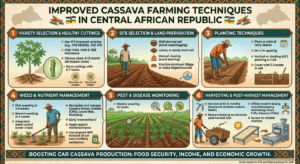
Improved cassava farming techniques do not require expensive machinery or imported inputs. They center on three things that are within reach of most farming households: better planting material, timely land preparation, and disciplined weed and pest management in the first four months after planting. Farmers who switch to improved, disease resistant varieties and combine them with correct spacing and early weeding routinely report yield increases of fifty percent or more compared to traditional practices.
This guide walks through practical, field tested techniques suited to the soils, rainfall patterns, and market realities of Central African Republic. Whether you are farming half a hectare near Bangui or a larger plot in the Ouham or Nana Mambere regions, the same core principles apply. We cover variety selection, land preparation, planting method, pest and disease control, fertility management, and harvest timing, along with a comparison table and answers to the questions farmers ask most often about cassava production in the country.
1. Selecting Disease Resistant Varieties
The single biggest yield gain available to CAR farmers comes from switching away from old local cassava varieties toward improved, disease resistant planting material. Varieties bred for resistance to cassava mosaic disease and cassava bacterial blight, two of the most damaging diseases in Central Africa, can outyield unimproved local stock even under the same growing conditions. Agricultural extension offices and research partners working in the region periodically distribute improved cuttings, and farmer cooperatives are often the fastest route to accessing them.
When selecting planting material, choose stems from healthy, vigorous plants that show no yellowing, mottling, or stunted growth. Cuttings should come from the middle portion of the stem, roughly twenty to twenty five centimeters long, with at least five to seven nodes, since nodes are where new roots and shoots emerge.
2. Land Preparation and Timing
Cassava performs best on well drained, loosely tilled soil, which is why ridging or mounding is standard practice across most of Central Africa. Ridges improve drainage during heavy rains and make it easier for tubers to expand without being blocked by compacted soil. Land should be cleared and ridged before the rains fully set in, so that cuttings can be planted as soon as the soil holds consistent moisture.
Timing matters as much as technique. Planting too early into dry soil leads to poor sprouting, while planting too late shortens the growing window before the next dry season and reduces tuber bulking time. In most parts of CAR, the start of the main rainy season between March and May is the ideal planting window.
3. Correct Spacing and Planting Method
Overcrowding is one of the most common mistakes on smallholder cassava farms in the region. A spacing of one meter by one meter gives each plant enough room to develop a full root system without excessive competition for light, water, and nutrients. Wider spacing may be used on poorer soils to reduce competition further.
Cuttings should be planted at a slight angle rather than fully buried horizontally, with about two thirds of the cutting under the soil and one third above ground. This orientation encourages faster and more even root formation. Planting immediately after cutting, rather than storing stems for long periods, also improves establishment rates.
4. Weed Control in the Critical Early Months
Cassava is a slow starter. For the first three to four months, weeds compete aggressively with young plants for nutrients, water, and sunlight, and this early period accounts for most of the yield loss caused by poor weed management. Two to three rounds of hand weeding or hoe weeding within this window, spaced roughly four to six weeks apart, protect the crop during its most vulnerable stage.
Once the canopy closes, usually around four to five months after planting, cassava largely shades out new weed growth on its own, which reduces the need for continued labor later in the season.
Read Also: Guide to Sowing and Planting Practices of Crops
5. Managing Pests and Diseases
Cassava mosaic disease, spread by whiteflies, remains the most serious threat to cassava production in Central Africa. Farmers should regularly inspect fields for the telltale yellow mottling and leaf distortion, and remove and destroy infected plants promptly to slow spread within the field. Sourcing cuttings only from confirmed healthy plants is the most effective long term prevention strategy.
Cassava mealybug and green mite are the other common pests to watch for, particularly during dry spells. Maintaining field hygiene, avoiding movement of planting material from infested areas, and encouraging natural predators through reduced pesticide use all help keep pest pressure manageable without heavy chemical input costs.
6. Harvest Timing and Post Harvest Handling
Most improved cassava varieties reach harvestable maturity between nine and twelve months after planting, though some varieties bulk earlier. Harvesting too early sacrifices yield and starch content, while leaving roots in the ground too long past maturity in some varieties can increase fiber content and reduce quality.
Because cassava roots deteriorate quickly, within forty eight hours, once removed from the ground, harvesting should be timed closely to processing or sale. Farmers planning to sell into local Bangui markets or process into gari, fufu, or chips should coordinate harvest with buyer demand or processing capacity to minimize post harvest losses.
Traditional vs Improved Cassava Farming Practices
Practice Traditional Approach Improved Approach Planting material Recycled local cuttings, disease status unknown Disease resistant improved varieties from verified healthy stock Spacing Irregular, often overcrowded Consistent 1m by 1m spacing Weeding Delayed or single round Two to three rounds within first four months Disease monitoring Reactive, after visible crop loss Regular inspection and prompt removal of infected plants Typical yield Lower, variable across seasons Fifty percent or more higher under good management Frequently Asked Questions
1. How long does cassava take to mature in Central African Republic?
Most varieties grown in CAR mature between nine and twelve months after planting, though some improved varieties can be harvested slightly earlier depending on local conditions.
2. What is the best spacing for cassava planting?
A spacing of one meter by one meter is generally recommended, giving each plant enough room to develop a strong root system while making efficient use of land.
3. How can I tell if my cassava has mosaic disease?
Look for yellow mottling, leaf distortion, and stunted growth on the leaves. Infected plants should be removed promptly to prevent the disease spreading to healthy plants nearby.
4. Can cassava be grown on poor or sandy soils?
Yes, cassava tolerates poor soils better than most staple crops, though yields improve significantly when organic matter or compost is worked into the soil before planting.
5. When is the best time to plant cassava in CAR?
Planting at the start of the main rainy season, typically between March and May, gives cuttings the best chance of establishing before dry conditions return.
6. How often should cassava fields be weeded?
Two to three rounds of weeding within the first three to four months are usually enough, since the crop’s canopy closes and naturally suppresses weeds after that period.
7. Is it necessary to buy improved cassava cuttings every season?
Not every season, but farmers should periodically refresh their planting material from verified healthy sources to avoid the gradual buildup of disease in recycled cuttings.
Improved cassava farming in Central African Republic is less about costly inputs and more about disciplined practice: starting with healthy planting material, respecting spacing and timing, and staying ahead of weeds and disease during the critical early months. Farmers who adopt these habits consistently see stronger, more reliable harvests season after season, building a more dependable foundation for both household food security and farm income.
Read Also: analysis-of-biodata-relating-to-water-quality-h2o
- AuthorPosts


- You must be logged in to reply to this topic.