



Public Group
Active 1 year, 3 months ago
Group Leadership
- Group Administrators
-

Central African Republic Farmers Community
Maize Farming Guide for Small Farmers in Central African Republic
- This topic is empty.
- AuthorPosts
- August 10, 2026 at 10:20 am #825854
 Agric4ProfitsModerator
Maize is one of the most widely grown cereal crops among smallholder farmers in the Central African Republic, valued both as a staple food and as a cash crop sold into local and regional markets. Despite its importance, average maize yields on smallholder plots in CAR remain well below what improved varieties and better agronomic practice can deliver. Much of this gap comes down to a handful of fixable issues: poor seed selection, inconsistent spacing, delayed fertilization, and weak pest monitoring, particularly against fall armyworm, which has become a serious threat to maize across Central Africa in recent years.
The good news is that meaningful yield improvements do not require a complete overhaul of how smallholders farm. Small, targeted changes, choosing better seed, planting at the right density, applying available fertility inputs at the right growth stages, and scouting fields regularly for pests, can lift maize yields significantly without large new investments. Many of these practices also reduce risk, helping farmers protect the harvest they already have rather than simply chasing higher output.
This guide covers the full maize production cycle as it applies to conditions in Central African Republic, from variety selection and land preparation through planting, fertility management, pest control, and harvest. It also includes a comparison of common practices against improved approaches, and answers to frequently asked questions from farmers working with limited land, labor, and cash for inputs.
1. Choosing the Right Maize Variety
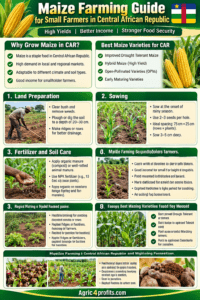
Selecting a variety suited to local rainfall patterns and soil conditions is the foundation of a good maize harvest. Open pollinated varieties remain popular among CAR smallholders because farmers can save seed from one season to the next, but certified hybrid seed, where accessible through cooperatives or agro dealers, generally delivers higher and more consistent yields under good management.
Early to medium maturing varieties are usually the safer choice in areas where the rainy season is shorter or less predictable, since they reduce the risk of the crop being caught by early dry spells before grain fill is complete.
2. Land Preparation and Planting Density
Maize responds strongly to a well prepared seedbed. Land should be cleared and tilled ahead of the rains so that planting can happen as soon as soil moisture is reliable, ideally within the first two weeks of consistent rainfall onset.
Spacing of roughly seventy five centimeters between rows and twenty five to thirty centimeters between plants, with one or two seeds per hole, gives a good balance between plant population and access to light, water, and nutrients. Overly dense planting reduces cob size, while overly sparse planting wastes land and increases weed pressure between plants.
3. Fertility Management and Timing
Where farmers can access fertilizer, applying a basal application at or shortly after planting supports strong early root and shoot development. A nitrogen top dressing applied when plants reach knee height, typically around four to five weeks after planting, supports the rapid vegetative growth phase when maize demands nutrients most heavily.
Where fertilizer is limited or unavailable, well decomposed compost or manure worked into planting holes, combined with legume rotation in prior seasons, can meaningfully improve soil fertility over time at low cost.
Read Also: Crop Production Calculator for Maize (Corn) Farming in Lesotho
4. Weed Management
Maize is particularly vulnerable to weed competition during its first six weeks of growth. A first weeding around two to three weeks after emergence, followed by a second weeding at the time of top dressing, keeps fields clean during the periods when weeds do the most damage to yield potential.
Mulching between rows, where crop residue is available, can help suppress weed regrowth between weeding rounds and also conserves soil moisture during shorter dry spells within the growing season.
5. Protecting Against Fall Armyworm and Stem Borer
Fall armyworm has become one of the most damaging pests to maize across Central Africa, attacking the whorl of young plants and reducing yield significantly if left unmanaged. Regular field scouting, at least twice weekly during the vegetative stage, allows farmers to catch infestations early, when hand removal of egg masses and larvae or targeted treatment is most effective.
Stem borer is another common threat, recognizable by small holes in stems and leaves. Crop rotation, timely planting, and removal of crop residue after harvest all help break the pest cycle between seasons.
6. Harvesting and Post Harvest Drying
Maize is ready for harvest once husks turn brown and dry and kernels have hardened, typically ninety to one hundred twenty days after planting depending on variety. Harvesting at the right time, rather than too early or too late, protects both grain quality and storage life.
Proper drying before storage is essential to prevent mold and aflatoxin contamination. Grain should be dried to a moisture content low enough that kernels are hard and resist denting under thumb pressure before being stored in clean, pest free containers or bags.
Common vs Recommended Maize Farming Practices
Practice Common Approach Recommended Approach Seed source Recycled grain from previous harvest Certified or verified open pollinated seed Spacing Inconsistent, often too dense 75cm x 25-30cm rows Fertilizer timing Single or no application Basal at planting plus top dress at knee height Pest scouting Reactive after visible damage Twice weekly scouting during vegetative stage Post harvest drying Inconsistent drying before storage Full drying to hard kernel stage before bagging Frequently Asked Questions
1. What is the best spacing for maize planting?
A spacing of about seventy five centimeters between rows and twenty five to thirty centimeters between plants is generally recommended for good yield and manageable weed control.
2. When should maize be top dressed with fertilizer?
Top dressing is most effective when applied at the knee high growth stage, roughly four to five weeks after planting, when the plant’s nitrogen demand rises sharply.
3. How can I identify fall armyworm damage early?
Look for ragged holes in young leaves and sawdust like frass in the whorl of the plant. Scouting fields at least twice a week during early growth helps catch infestations before major damage occurs.
4. How long does maize take to mature?
Most varieties grown in Central African Republic mature between ninety and one hundred twenty days after planting, depending on the specific variety and growing conditions.
5. Can maize be grown without chemical fertilizer?
Yes, well decomposed compost or manure, combined with legume rotation in previous seasons, can support reasonable yields, though output is typically lower than with proper fertilizer use.
Maize will likely remain a central crop for smallholder households across Central African Republic for years to come, both as food security and as income. The path to better yields runs through consistent, well timed practice: good seed, correct spacing, timely fertility inputs, and vigilant pest monitoring, particularly against fall armyworm. Farmers who build these habits into every season tend to see steadier harvests and fewer surprises at harvest time.
Read Also: water-quality-survey
- AuthorPosts

- You must be logged in to reply to this topic.