



Public Group
Active 1 year, 3 months ago
Group Leadership
- Group Administrators
-

Central African Republic Farmers Community
Rice Farming in Central African Republic
- This topic is empty.
- AuthorPosts
- August 10, 2026 at 11:08 am #826231
 Agric4ProfitsModerator
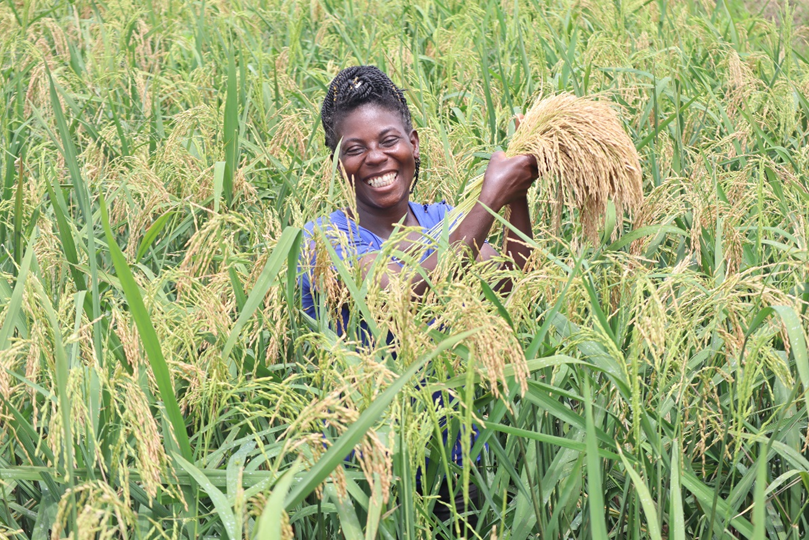
Rice is steadily growing in importance across Central African Republic, both as a staple food crop and as an income source for farmers with access to lowland or floodplain fields suited to its cultivation. Unlike maize or cassava, rice production, especially lowland rice, depends heavily on water management, which means yield outcomes are closely tied to how well farmers control field flooding and drainage through the growing season.
Many smallholder rice farmers in CAR still grow upland rice under rainfed conditions, which is more forgiving of land type but generally yields less than well managed lowland rice. Where suitable lowland or valley bottom land is available, farmers who invest in basic land leveling, timely transplanting, and consistent water management can achieve significantly higher and more reliable yields than upland systems allow.
This guide walks through the essential techniques for both upland and lowland rice production as practiced in Central African Republic, covering variety selection, land preparation, planting method, water and weed management, and post-harvest handling, along with practical answers to common farmer questions about improving rice output on smallholder plots.
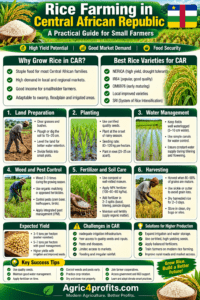
1. Choosing Between Upland and Lowland Rice
The choice between upland and lowland rice depends primarily on the land available. Upland rice is grown under rainfed conditions on well drained soil without standing water, making it accessible to a wider range of farmers but generally producing lower yields than lowland systems.
Lowland rice, grown in valley bottoms, floodplains, or fields that can be flooded, offers substantially higher yield potential because the standing water suppresses weed competition and stabilizes moisture supply through the growing season. Farmers with access to suitable lowland should prioritize it where water can be managed.
2. Land Preparation and Leveling
For lowland rice, field leveling is one of the most important steps, since uneven fields lead to inconsistent water depth, with some areas flooded too deep and others left too dry. A well leveled field allows for uniform water management across the entire plot, which directly supports even crop growth.
For upland rice, land should be cleared and tilled to a fine seedbed ahead of planting, similar to other cereal crops, with attention to removing perennial weeds that compete strongly with rice in its early growth stages.
Read Also: Crop Production Calculator for Paddy Rice (Lowland) Farming in Libya
3. Planting and Transplanting Technique
Lowland rice is commonly established by transplanting seedlings raised in a nursery bed for two to three weeks before being moved to the main field. Transplanting allows better control over plant spacing and gives seedlings a head start over weeds compared to direct seeding.
Upland rice is typically direct seeded, either by dibbling seeds into holes or broadcasting, at the start of reliable rains. Direct seeding requires less labor upfront but demands more careful early weeding since seedlings compete with weeds from germination.
4. Water Management for Lowland Rice
Maintaining a consistent shallow water depth, roughly five to ten centimeters, through the vegetative and reproductive stages supports strong tillering and grain fill while also suppressing weed growth naturally. Water should be drained closer to harvest to allow the field to dry and support easier harvesting.
Inconsistent flooding, alternating between waterlogged and dry conditions, stresses the crop and can significantly reduce both yield and grain quality, making water control one of the highest value skills a lowland rice farmer can develop.
5. Weed Control Strategy
For upland rice, two rounds of weeding, the first around three weeks after emergence and the second around six weeks, are generally needed to protect yield during the crop’s vulnerable early stages.
For lowland rice, the standing water itself suppresses most weed growth once established, but early weeding before the field is fully flooded, along with vigilant control of aquatic weeds that can establish in standing water, remains important for protecting yield potential.
6. Harvest and Post Harvest Drying
Rice is ready for harvest when roughly eighty percent of grains on the panicle have turned golden yellow, typically ninety to one hundred forty days after planting depending on variety and growing system. Harvesting slightly before full grain maturity reduces shattering losses in the field.
After harvest, thorough drying to a safe storage moisture level, where grains are hard and resist crushing under gentle pressure, is essential to prevent mold, pest damage, and quality loss during storage before milling or sale.
Upland vs Lowland Rice Farming
Factor Upland Rice Lowland Rice Water source Rainfed only Standing water, flooded or valley bottom Establishment method Direct seeded Transplanted from nursery Weed pressure Higher, needs two weedings Lower once field is flooded Yield potential Lower Higher under good water management Land requirement Any well drained field Valley bottom or floodplain access needed Frequently Asked Questions
1. What is the difference between upland and lowland rice?
Upland rice is grown under rainfed conditions on well drained land, while lowland rice is grown in fields that can be flooded, which generally produces higher yields but requires water management.
2. How long should rice seedlings stay in the nursery before transplanting?
Rice seedlings are typically ready for transplanting two to three weeks after sowing, once they have developed a few strong leaves and a healthy root system.
3. How deep should water be kept in a lowland rice field?
A shallow depth of about five to ten centimeters is generally recommended through the main growing stages, with the field drained closer to harvest time.
4. How many times should upland rice be weeded?
Two rounds of weeding, roughly three weeks and six weeks after emergence, are generally sufficient to protect yield in upland rice systems.
5. How long does rice take to mature?
Most varieties mature between ninety and one hundred forty days after planting, depending on the variety and whether it is grown as upland or lowland rice.
6. When is the right time to harvest rice?
Rice should be harvested when about eighty percent of the grains on the panicle have turned golden yellow, which helps minimize shattering losses in the field.
7. Why does lowland rice generally yield more than upland rice?
Standing water in lowland rice systems suppresses weed competition and provides a more stable moisture supply throughout the growing season, both of which support higher yields.
8. What causes uneven growth in a lowland rice field?
Uneven field leveling is a common cause, since it leads to inconsistent water depth across the plot, with some areas too flooded and others too dry.
9. How should rice be dried after harvest?
Rice should be dried until grains are hard and resist crushing under gentle pressure, which reduces the risk of mold and pest damage during storage.
10. Can rice be grown without a valley bottom or flooded field?
Yes, upland rice can be grown as a rainfed crop on well drained land, though yields are typically lower than in properly managed lowland systems.
Rice production in Central African Republic offers real opportunity for farmers with access to suitable land, particularly valley bottoms where lowland cultivation can be practiced. Whether farming upland or lowland rice, success comes down to matching technique to land type, managing water and weeds through the critical early stages, and drying grain properly after harvest to protect both quality and price at market.
Read Also: The-impact-of-inefficient-waste-management-on-oceans
- AuthorPosts

- You must be logged in to reply to this topic.