



Public Group
Active 1 year, 3 months ago
Group Leadership
- Group Administrators
-

Chad Farmers Community
Agribusiness in Chad
- This topic is empty.
- AuthorPosts
- September 15, 2026 at 10:13 am #853960
 Agric4ProfitsModerator
Chad’s economy has long been shaped by oil, but agriculture remains the sector that touches the most lives. An estimated eighty percent of Chad’s population relies on agriculture, livestock, or fishing, and the government has made agribusiness a central pillar of its plan to reduce dependence on oil revenue and build a more diversified, resilient economy.
Agribusiness, in this context, covers everything from growing and rearing to processing, packaging, and exporting the country’s farm and livestock products, and it is increasingly seen as one of Chad’s most promising, if still underdeveloped, growth sectors.
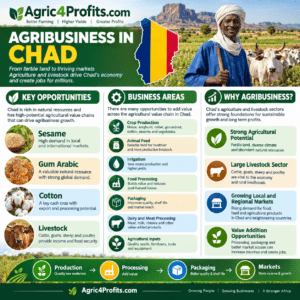
A joint IFC and World Bank report has highlighted livestock, sesame seed, gum arabic, and cotton as the value chains with the greatest potential for development impact in Chad, and it points to private participation in cold-chain infrastructure, industrial-scale breeding, and water management as key areas where investment could unlock growth.
At the same time, there is still very little value-added production of agricultural products in Chad, which means raw or barely processed goods dominate exports, leaving much of the potential profit from processing, packaging, and branding to be captured outside the country. This article looks at five aspects of agribusiness in Chad: its leading value chains, livestock and meat processing, agro-processing gaps, the government’s role in shaping the investment climate, and the challenges holding the sector back.
1. Leading Agribusiness Value Chains
Chad’s non-oil export economy is built around a handful of key crops and products. Cotton, coffee, gum arabic, cattle, and sesame are among the country’s primary non-oil exports, alongside smaller volumes of groundnuts, shea butter, and other natural products. Gum arabic stands out as a particular success story.
Chad is the second largest global producer of premium grade gum arabic, and the product has grown into the country’s third most important export by value, after oil and cotton, with around thirty-point-six million United States dollars worth exported in 2022 to destinations such as China, France, Germany, India, and the United States. Sesame has also become a meaningful earner, with Chad exporting thirty-three-point-eight million dollars worth of sesame seeds in 2019 alone.
2. Livestock and Meat Processing
Livestock is arguably Chad’s most important agribusiness asset by sheer scale, and it offers some of the clearest opportunities for value-addition. Investment opportunities exist in the construction of feedlots and slaughterhouses that meet the standards set by the World Organization for Animal Health, as well as in improving laboratories and rebuilding Chad’s veterinary testing capacity.
At present, most cattle, camels, and goats leave Chad on the hoof rather than as processed meat, which means the country exports live animals instead of higher-value cuts, hides, or packaged meat products, leaving significant income on the table. Building modern slaughterhouses and cold-chain logistics near export corridors would let Chadian agribusinesses capture more of that value locally, rather than ceding it to processors in neighboring countries.
3. Agro-Processing and Value Addition Gaps
Beyond livestock, the same value-addition gap runs through nearly every Chadian crop value chain. Gum arabic, sesame, and cotton mostly leave the country in raw or semi-processed form, with gum arabic farmers typically selling to local agents, who in turn sell to exporters in Chad and Nigeria for shipment overseas, rather than to processors who could turn the raw gum into higher-value finished products before export.
Government and trade bodies have identified this gap as a priority: moving up the value chain in products like shea butter, dates, natron, and sesame has been named a key priority for Chad’s export diversification strategy. Small-scale processing of cassava into gari and flour, groundnuts into oil, and tomatoes into paste already happens at the household and community level, but there is significant room for larger, better-equipped agro-processing facilities that could serve both domestic and export markets.
Read Also: Farm Finance Calculator for Coffee Robusta Farming in Chad
4. Government Policy and the Investment Climate
The Chadian government has repeatedly signaled agribusiness as a strategic priority in its long-term development planning. Diversifying the economy and reducing reliance on oil exports has been articulated as a key goal in Chad’s long-term strategy, Vision 2030: The Chad We Want, and in its National Development Plan.
In practice, this has meant working with partners such as the International Trade Centre, UNIDO, and the United Nations Development Programme to strengthen value chains and branding efforts such as the “Cristal of Chad” gum arabic label aimed at reaching new international buyers.
Chad’s broader development plans point to opportunities for medium and large-scale agribusiness projects, alongside niche markets in gum arabic and natural products like shea butter, spirulina, and moringa, suggesting the government sees agribusiness as sitting alongside oil, mining, and infrastructure as a pillar of future growth.
5. Challenges Facing Agribusiness in Chad
Despite real potential, Chadian agribusiness faces persistent, well-documented constraints. Limited access to capital remains a significant constraint on modernizing agricultural production, and this shortage of financing makes it difficult for small and medium-sized agribusinesses to invest in processing equipment, storage, or cold-chain logistics. Chad’s landlocked geography and weak transport infrastructure add further cost and delay to moving goods from farm to market or port, while
Chad remains a net importer of food, depending heavily on outside sources to meet its domestic food needs, even as it exports raw agricultural commodities elsewhere. Instability in parts of the country, seasonal flooding along the Chari and Logone rivers, and gaps in reliable power and water infrastructure round out the list of obstacles that agribusiness investors and entrepreneurs must navigate.
Frequently Asked Questions
1. What is agribusiness, and how big a role does it play in Chad’s economy?
Agribusiness covers the growing, processing, and marketing of farm and livestock products, and it plays an outsized role in Chad, where roughly eighty percent of the population depends on agriculture, livestock, or fishing for their livelihoods.2. What are Chad’s most valuable agricultural exports?
Gum arabic, sesame, cotton, and livestock lead Chad’s non-oil exports, with gum arabic now ranking as the country’s third most important export by value after oil and cotton.3. Why is Chad known for gum arabic?
Chad is the second-largest global producer of premium grade gum arabic, and its exports of the product have been rising steadily, supported by branding and export-diversification efforts.4. What is the biggest gap in Chad’s agribusiness sector?
Value-addition remains the biggest gap, since most raw commodities such as cotton, sesame, gum arabic, and live cattle leave the country with little or no local processing, meaning much of the potential profit is captured elsewhere.5. What role does the Chadian government play in supporting agribusiness?
The government has made agribusiness a strategic priority under its Vision 2030 development plan, partnering with international bodies to strengthen value chains, improve branding, and attract private investment in processing and infrastructure.6. What are the main challenges facing agribusiness investors in Chad?
Limited access to capital, weak transport and power infrastructure, a landlocked geography, and periodic instability are among the most significant challenges facing agribusiness development in the country.Agribusiness in Chad sits at an interesting crossroads, rich in raw agricultural potential but still largely untapped when it comes to processing and value-addition. As the country pushes to diversify beyond oil, the businesses and investors who figure out how to add value locally, whether in meat processing, gum arabic refining, or sesame oil production, stand to gain the most.
What do you think Chad needs most to unlock its agribusiness potential? Share your thoughts in the comments below, we would love to hear from you.
- AuthorPosts

- You must be logged in to reply to this topic.