



Public Group
Active 1 year, 3 months ago
Group Leadership
- Group Administrators
-

Chad Farmers Community
How to Export Agricultural Produce from Chad
- This topic is empty.
- AuthorPosts
- August 30, 2026 at 7:13 pm #840439
 Agric4ProfitsModerator
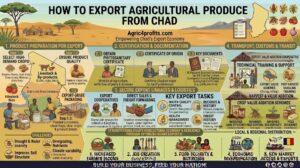
Agriculture plays an important role in Chad’s economy and provides livelihoods for a large number of households. Beyond supplying local markets, agricultural products can also create opportunities for regional and international trade.
Exporting agricultural produce involves selling farm products to buyers in another country. These products may include livestock, grains, oilseeds, sesame, gum arabic, livestock products and other commodities, depending on production capacity, market demand and applicable regulations.
However, exporting is more complex than selling products in a local market. Farmers and agribusinesses need to understand product standards, documentation, customs procedures, transportation, packaging, market requirements and payment arrangements.
For smallholder farmers, exporting directly may not always be practical. Working through cooperatives, aggregators, established traders or export companies can provide a more accessible route into regional and international markets.
1. Understanding Agricultural Export Opportunities in Chad
Chad’s agricultural sector includes crop production, livestock farming and various natural-resource-based agricultural products. The country’s location in Central Africa also provides opportunities for trade with neighbouring countries.
Potential export products can include:
- Sesame.
- Livestock.
- Gum arabic.
- Groundnuts.
- Grains.
- Hides and skins.
- Livestock products.
- Selected processed agricultural products.
The suitability of a product for export depends on factors such as production volume, quality, shelf life, market demand, transportation costs and import requirements in the destination country.
Farmers should not assume that a product that sells well locally will automatically be profitable internationally.
Exporting should begin with identifying a specific market and buyer rather than producing large quantities without knowing where the products will be sold.
2. Researching Foreign Markets Before Exporting
Market research is one of the most important steps in agricultural exporting.
Before attempting to export, farmers or agribusinesses should investigate:
- Countries that import the product.
- Market demand.
- Current prices.
- Product specifications.
- Quality requirements.
- Packaging requirements.
- Import restrictions.
- Taxes and duties.
- Transportation costs.
- Competition.
- Payment conditions.
For example, a buyer may require a particular grade, moisture level, packaging size or certification. Producing a product that does not meet the buyer’s specifications can result in rejected shipments and financial losses.
Exporters should also investigate whether the destination country permits the importation of the specific agricultural product from Chad.
3. Registering the Agricultural Export Business
Farmers intending to export commercially may need to operate through a properly registered business or recognised agricultural organisation.
The exact requirements can depend on the type of product, destination market and applicable Chadian regulations.
An exporter should establish:
- A recognised business identity.
- Appropriate registration.
- A bank or suitable payment arrangement.
- Proper accounting records.
- Tax compliance where applicable.
- Export-related documentation.
- Reliable suppliers.
Smallholder farmers who cannot meet the administrative or volume requirements of direct exporting can consider joining a cooperative or selling to an established exporter.
Working through an experienced exporter may allow farmers to participate in international supply chains without having to manage every export procedure themselves.
4. Meeting Quality and Safety Requirements
International buyers generally expect agricultural products to meet specific quality and safety standards.
Requirements may include:
- Cleanliness.
- Appropriate moisture levels.
- Proper grading.
- Absence of prohibited contaminants.
- Pest-free products.
- Appropriate packaging.
- Traceability.
- Animal health documentation for livestock.
- Phytosanitary documentation for certain plant products.
Farmers should identify the standards required by the destination market before production or harvesting.
Quality control should begin on the farm. Proper harvesting, drying, storage and transportation can help preserve product quality.
For livestock exports, animal health requirements can be particularly important. Exporters should work with the relevant veterinary authorities to understand applicable inspection and certification requirements.
Read Also: Farm Finance Calculator for Date Palm Farming in Chad
5. Preparing Export Documentation
Export transactions require documentation to demonstrate what is being shipped, where it is going and whether the shipment complies with applicable regulations.
Depending on the product and destination, documentation may include:
- Commercial invoice.
- Packing list.
- Certificate of origin.
- Export declaration.
- Customs documents.
- Phytosanitary certificate for applicable plant products.
- Veterinary or health certificates for applicable animal products.
- Transport documents.
- Other permits or certificates required by the destination market.
Requirements can vary significantly between products and countries.
Exporters should confirm the current requirements with the relevant Chadian authorities, customs officials and authorities in the destination country before shipping.
Using an experienced customs broker or freight-forwarding professional may also help reduce documentation errors.
6. Packaging, Storage and Transportation
Agricultural products can lose value during transportation if they are poorly packaged or stored.
Export packaging should protect products from:
- Moisture.
- Contamination.
- Physical damage.
- Pests.
- Excessive heat.
- Poor handling.
The type of packaging required depends on the product.
For example, grains and oilseeds may require strong, clean bags, while other agricultural products may require specialised containers or temperature-controlled transportation.
Transportation planning should also take into account the distance between the farm, collection centre, border crossing, port or destination market.
Exporters should calculate all logistics costs before agreeing to a selling price.
7. Finding International Buyers
Finding a reliable buyer is essential before shipping agricultural products internationally.
Potential buyers may include:
- Importers.
- Wholesalers.
- Food processors.
- Commodity traders.
- Livestock buyers.
- Agricultural distributors.
- International trading companies.
Farmers and agribusinesses can use trade fairs, agricultural associations, business networks, established exporters and professional market platforms to identify potential buyers.
Before entering a transaction, exporters should verify the buyer’s identity and reputation.
Important issues to confirm include:
- Company registration.
- Physical business presence.
- Previous trading experience.
- Product requirements.
- Payment method.
- Contract terms.
- Delivery requirements.
Exporters should be cautious when a potential buyer demands unusual fees or proposes arrangements that are difficult to verify.
8. Calculating Export Costs and Profitability
An export business can appear profitable when only the farm-gate selling price and foreign market price are compared. However, international trade involves many additional expenses.
A basic export cost calculation may include:
Cost Examples Production Seeds, labour, fertiliser and other inputs Collection Gathering products from farmers Processing Cleaning, grading or processing Packaging Bags, cartons or other containers Storage Warehouse and handling costs Transportation Farm-to-market and long-distance transport Documentation Required certificates and administrative costs Customs Applicable charges and procedures Insurance Cargo or transport insurance where appropriate Agent fees Customs, logistics or sales services Buyer price Final agreed selling price The exporter should calculate the expected net profit after all costs.
Currency exchange rates can also affect profitability. A change in exchange rates between the time of agreeing a transaction and receiving payment may affect the final value of the export revenue.
9. Starting Small and Building an Export Business
New exporters should consider starting with manageable volumes rather than immediately attempting large shipments.
A gradual approach can help businesses learn about:
- Documentation.
- Buyer relationships.
- Product standards.
- Transportation.
- Customs procedures.
- Payment systems.
- Packaging.
- Market risks.
Farmers can also work collectively. A cooperative can aggregate products from multiple producers, making it easier to meet minimum volume requirements.
As the business gains experience, the exporter can develop stronger relationships with buyers and improve production and quality-control systems.
The long-term objective should be to establish a reliable supply chain rather than simply complete a single shipment.
Frequently Asked Questions
1. What agricultural products can Chad export?
Potential agricultural and livestock exports can include sesame, livestock, gum arabic, groundnuts, grains, hides and skins and selected processed agricultural products. Actual export opportunities depend on market demand and applicable regulations.
2. Can smallholder farmers export directly?
They can potentially participate in export markets, but direct exporting may involve significant documentation, volume, quality and logistics requirements. Cooperatives and established exporters can provide alternative routes into export markets.
3. What should farmers do before exporting agricultural products?
They should identify a suitable market and buyer, research destination-country requirements, determine product standards, calculate logistics costs and establish the necessary documentation and permits.
4. Do agricultural products require certificates for export?
Some products require specific certificates. Plant products may require phytosanitary documentation, while livestock and animal products may require veterinary or health certification. Requirements vary by product and destination.
5. How can farmers find foreign buyers?
Farmers and agribusinesses can approach importers, wholesalers, processors, commodity traders, agricultural associations, established exporters and trade networks.
6. How can an exporter avoid losing money?
The exporter should calculate the complete cost of production, packaging, storage, transportation, documentation, customs and other expenses before agreeing on a selling price.
7. Can farmer cooperatives help with agricultural exports?
Yes. Cooperatives can aggregate produce, standardise quality, reduce some logistics costs and make it easier to meet the volume requirements of larger buyers.
8. Why is product quality important when exporting?
International buyers may have strict requirements relating to cleanliness, grading, moisture, contamination, packaging and other characteristics. Products that fail to meet specifications may be rejected or sold at a lower price.
9. Is it safe to accept payment from an unknown foreign buyer?
Exporters should verify buyers carefully and use secure, clearly documented payment arrangements. New exporters should seek professional financial or trade advice when dealing with unfamiliar international buyers.
10. Can processed agricultural products be exported from Chad?
Potentially, yes. Processing can create additional value and may improve shelf life, but exporters must comply with the food-safety, labelling, packaging and import requirements of the destination market.
Agricultural exports can create opportunities for Chad’s farmers and agribusinesses to reach larger markets and potentially earn higher revenues. However, successful exporting requires more than simply producing a large quantity of agricultural goods. Quality control, market research, documentation, logistics, reliable buyers and careful financial planning are all essential.
Which agricultural products from Chad do you think have the greatest export potential? Do you believe smallholder farmers should export directly or work through cooperatives and established exporters? Share your thoughts, experiences and ideas in the comments below.
Read Also: the-power-of-metal-recycling-how-to
- AuthorPosts


- You must be logged in to reply to this topic.