



Public Group
Active 1 year, 3 months ago
Group Leadership
- Group Administrators
-

Chad Farmers Community
Organic Farming in Chad
- This topic is empty.
- AuthorPosts
- August 28, 2026 at 1:20 pm #838896
 Agric4ProfitsModerator
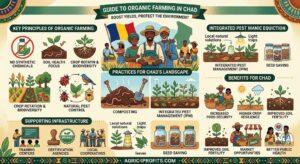
Organic farming is an agricultural production approach that emphasizes the use of natural processes and inputs while reducing reliance on synthetic fertilizers, pesticides and other external inputs that are not permitted under the applicable organic standard.
For farmers in Chad, organic farming can provide opportunities to improve soil management, recycle locally available agricultural resources and potentially access consumers interested in organically produced food. Practices such as composting, animal-manure management, crop rotation, mulching, agroforestry and biological pest management can form important parts of an organic production system.
However, organic farming should not be understood simply as farming without fertilizers or pesticides. Successful organic agriculture requires careful management of soil fertility, pests, diseases, weeds, water and crop production. Farmers must also understand the requirements of any organic certification or market they intend to supply.
Chad’s diverse agricultural environments mean that organic farming practices will need to be adapted to local rainfall, soils, crops, livestock systems and available resources.
This guide explains practical principles for starting and managing an organic farm in Chad while considering productivity, sustainability and market opportunities.
1. Understanding Organic Farming in Chad
Organic farming is based on managing the farm as an interconnected system.
Instead of depending heavily on purchased synthetic inputs, organic farmers seek to improve soil fertility and crop health through biological processes, organic matter, crop diversity and appropriate natural inputs.
Common organic farming practices include:
- Composting
- Use of properly managed animal manure
- Crop rotation
- Mulching
- Cover cropping
- Agroforestry
- Biological pest management
- Mechanical weed control
- Conservation of soil and water
- Integration of crops and livestock
The following table highlights some of the major components of an organic farming system.
Component Main purpose Compost Recycles organic materials and adds soil organic matter Animal manure Provides nutrients and organic matter Crop rotation Diversifies production and supports soil management Mulching Protects soil and conserves moisture Cover crops Protect soil between production periods Biological pest control Helps manage pests using natural processes Agroforestry Integrates trees into agricultural systems Crop-livestock integration Improves resource recycling Organic farming therefore requires active management rather than simply avoiding synthetic inputs.
2. Building Soil Fertility Naturally
Soil fertility is at the heart of organic farming.
Crops continuously remove nutrients from the soil, particularly when harvested crops are taken away from the field. Organic farmers need strategies for replacing nutrients and maintaining soil organic matter.
Animal manure can be an important resource where livestock are available. Farmers can also produce compost from suitable organic materials.
Other soil-management practices include:
- Crop rotation
- Maintaining suitable crop residues
- Growing cover crops
- Mulching
- Incorporating suitable organic materials
- Reducing unnecessary soil disturbance
Legumes can also play an important role in crop rotations because some legumes form associations with microorganisms capable of fixing atmospheric nitrogen.
Farmers should select legumes and other crops that are appropriate for local growing conditions.
Organic soil management can be particularly valuable in areas where maintaining soil moisture and structure is important.
3. Composting and Organic Fertilizers
Composting is one of the most practical methods of producing organic soil amendments from locally available materials.
Suitable compost materials can include crop residues, leaves, grass, vegetable waste and properly managed animal manure.
A compost pile requires appropriate moisture, aeration and a suitable balance of materials. Farmers should protect compost from excessive rainfall and prevent contamination.
Organic fertilizers and amendments can include:
Input Potential contribution Compost Organic matter and nutrients Cattle manure Organic matter and nutrients Goat manure Organic matter and nutrients Sheep manure Organic matter and nutrients Poultry manure Nutrient-rich organic amendment Plant residues Organic matter after appropriate decomposition Farmers should understand that nutrient concentrations vary between materials.
Poultry manure, for example, can be relatively nutrient-rich and therefore should be used appropriately rather than assuming that larger quantities will always produce better results.
Organic materials should also be handled safely to reduce risks associated with pathogens and contamination.
4. Organic Pest and Disease Management
Pest management is one of the major challenges in organic crop production.
Organic farmers generally emphasize prevention and ecological management rather than relying primarily on synthetic pesticides.
Preventive measures can include:
- Crop rotation
- Selecting suitable varieties
- Maintaining healthy soil
- Removing heavily infected plant material where appropriate
- Maintaining field hygiene
- Encouraging beneficial organisms
- Using physical barriers
- Monitoring crops regularly
Biological control can also be considered where suitable organisms or biological products are available.
Farmers should monitor fields frequently rather than waiting until pest populations become severe.
It is also important to understand that not every natural substance is automatically permitted in organic agriculture. Farmers seeking certified organic status must use inputs allowed under the relevant organic standard.
5. Organic Weed Management
Weeds compete with crops for water, nutrients, light and space.
Organic farmers have several options for managing weeds without relying on prohibited herbicides.
These can include:
- Hand weeding
- Mechanical cultivation
- Mulching
- Crop rotation
- Cover crops
- Appropriate planting density
- Timely weed removal
The most effective strategy is often to prevent weeds from becoming established at damaging levels.
Mulching can help suppress some weeds while simultaneously protecting the soil surface.
Farmers should be careful when using crop residues or other materials as mulch to ensure that they do not introduce significant quantities of weed seeds or pests.
The following table compares several weed-management methods.
Method Main advantage Hand weeding Directly removes weeds Mechanical control Useful for larger cultivated areas Mulching Suppresses weeds and protects soil Crop rotation Can disrupt weed patterns Cover crops Occupies growing space and protects soil Timely cultivation Removes weeds before they become established A combination of methods is generally more effective than depending on one technique.
6. Crop Rotation, Diversification and Agroforestry
Crop diversity is an important principle of sustainable organic production.
Growing different crops can reduce dependence on a single crop and may help manage pests, diseases and nutrient requirements.
Crop rotation involves changing the crop grown on a particular field over successive seasons.
A rotation might combine cereals, legumes, vegetables or other locally suitable crops.
Agroforestry can also contribute to diversification by integrating suitable trees into agricultural landscapes.
Trees may provide:
- Fruit
- Fodder
- Fuelwood
- Shade
- Wind protection
- Organic materials
- Other agricultural products
Farmers should carefully select tree species because trees can compete with crops for water, nutrients and sunlight if poorly managed.
Diversification can also create several potential income sources.
Enterprise Potential output Cereals Food and income Legumes Food, income and soil-management benefits Vegetables Fresh produce and potential higher-value sales Fruit trees Fruit and long-term income Livestock Meat, milk or eggs depending on species Poultry Eggs and meat Farmers should choose enterprises according to their resources and local market conditions.
7. Water Conservation and Organic Farm Management
Organic farms still require effective water management.
Soil rich in organic matter can have improved water-holding characteristics, but organic practices alone cannot eliminate the effects of drought or insufficient rainfall.
Farmers can conserve available water through:
- Mulching
- Maintaining soil cover
- Rainwater harvesting
- Appropriate irrigation
- Improving soil structure
- Reducing runoff
- Selecting crops suited to available water
Water conservation becomes particularly important during dry periods.
Where irrigation is available, farmers should use water efficiently and avoid unnecessary application.
Drip irrigation and other efficient irrigation technologies may be useful where their cost, maintenance requirements and water source make them practical.
8. Organic Certification, Marketing and Profitability
Farmers should distinguish between using organic farming practices and selling products as certified organic.
Organic certification normally requires compliance with a defined production standard and may involve documentation, inspections and other requirements.
Farmers who want to target organic markets should investigate the requirements applicable to their intended market before making certification claims.
Marketing opportunities may include:
- Local consumers
- Farmers’ markets
- Retailers
- Restaurants
- Food processors
- Wholesalers
- Specialized organic-food buyers
However, organic production is not automatically more profitable.
Farmers must calculate whether additional labour, certification, transportation, packaging and marketing costs are justified by the selling price.
The basic calculation remains:
Net Profit = Total Revenue − Total Production Costs
The following table identifies some of the major financial factors.
Financial factor Examples Seeds Organic or appropriately sourced planting material Soil amendments Compost and manure Labour Weeding, composting and harvesting Irrigation Water infrastructure and operation Certification Applicable certification expenses Packaging Bags, containers and labels Transportation Moving produce to market Revenue Sale of organic or organically produced crops Farmers should investigate demand before investing heavily in specialized organic production.
9. How to Start an Organic Farm in Chad
Starting an organic farm should begin with a realistic assessment of available resources.
Step 1: Select suitable crops. Choose crops that match the local climate, soil, water availability and market demand.
Step 2: Assess the soil. Determine the condition and fertility of the farmland.
Step 3: Develop a soil-fertility plan. Plan how compost, manure, crop residues and crop rotations will maintain soil productivity.
Step 4: Establish water-management practices. Identify reliable water sources and methods of conserving available moisture.
Step 5: Plan pest management. Develop preventive and biological approaches before planting.
Step 6: Establish crop rotations. Diversify crops and include suitable legumes where appropriate.
Step 7: Manage weeds early. Combine mulching, mechanical methods and timely field operations.
Step 8: Integrate livestock where appropriate. Use properly managed manure as part of the farm nutrient cycle.
Step 9: Keep detailed records. Record inputs, field activities, harvests, sales and other relevant information.
Step 10: Research the market. Identify buyers and determine whether consumers are willing to pay for organically produced products.
Step 11: Investigate certification if required. Understand the relevant organic standard before making certified-organic claims.
Step 12: Start at a manageable scale. Test the production system before expanding significantly.
Organic Farming Quick Reference Table
The following table summarizes the major practices that can form part of an organic farming system in Chad.
Practice Main purpose Composting Recycle organic materials Animal manure Supply organic matter and nutrients Crop rotation Improve crop and soil management Legumes Support biological nitrogen cycling Mulching Conserve moisture and suppress weeds Cover crops Protect soil Biological pest management Reduce pest pressure Mechanical weed control Manage weeds Agroforestry Diversify production and protect resources Water conservation Improve resilience during dry periods Crop diversification Spread production and market risks Record keeping Monitor production and profitability Frequently Asked Questions
1. Is organic farming possible in Chad?
Yes. Organic farming practices can be adapted to suitable agricultural systems in Chad. The specific approach depends on local soil, climate, water availability, crops and available organic resources.
2. What is used as fertilizer in organic farming?
Common organic amendments include properly managed animal manure, compost and suitable plant-based organic materials.
3. Can organic farming be profitable in Chad?
It can be profitable under suitable market and production conditions, but profitability depends on yields, labour costs, input costs, market prices and whether consumers provide a sufficient premium for organically produced products.
4. Does organic farming mean using no pesticides?
Not necessarily. Organic agriculture focuses on prevention and approved pest-management methods. Certain substances may be permitted under particular organic standards, while many conventional synthetic pesticides may not be allowed.
5. How can organic farmers control weeds?
Farmers can combine mulching, hand weeding, mechanical cultivation, crop rotation, cover crops and timely field management.
6. Can animal manure be used on an organic farm?
Yes, properly managed animal manure can be an important soil amendment. However, farmers should follow the requirements of the relevant organic standard if they intend to obtain certification.
7. Do organic products have to be certified?
The requirements for using the term “organic” depend on the market and applicable regulations. Farmers who intend to make certified-organic claims should understand and comply with the relevant certification requirements.
8. What are the main challenges of organic farming?
Challenges can include labour requirements, pest management, access to suitable organic inputs, maintaining fertility, certification requirements, market access and potentially lower yields during the transition to an organic system.
Are you interested in organic farming in Chad, or are you already using organic farming methods?
Which organic practice do you think would be easiest for farmers in your area to adopt — composting, animal manure, crop rotation, mulching, natural pest control or agroforestry?
Share your thoughts, experiences and questions in the comments section below. Your experience could help other farmers discover practical ways to build healthier soils, reduce unnecessary input costs and develop more sustainable agricultural systems in Chad.
Read Also: dumpster-rental-what-you-need-to-know
- AuthorPosts

- You must be logged in to reply to this topic.