



Public Group
Active 1 year, 3 months ago
Group Type By Country
Group Leadership
- Group Administrators
-

Comoros Farmers Community
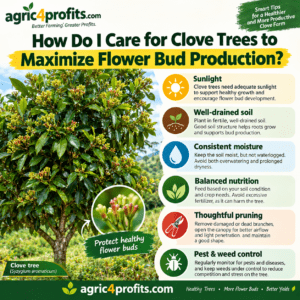
How do I care for clove trees to maximize flower bud production?
- This topic is empty.
- AuthorPosts
- September 17, 2026 at 5:39 am #854646
 Agric4ProfitsModerator
Clove has quietly become one of the most valuable crops a Comorian farmer can grow. Alongside vanilla and ylang ylang, it forms the backbone of the country’s export earnings, and by 2023 Comoros was producing around 7,663 tonnes of cloves a year, placing it among the world’s top four clove-producing nations, behind only Indonesia, Madagascar and Tanzania. That is a remarkable achievement for a small island nation, and it shows just how well suited the volcanic soils and humid climate of Ngazidja, Ndzwani and Mwali are to this crop.
But there is a detail that trips up many new growers: cloves are not a fruit crop in the way mangoes or bananas are. The part that gets harvested, dried and sold is the unopened flower bud itself. This means that everything a farmer does, from soil preparation to pruning to fertilizing, has one real target: getting the tree to produce as many healthy flower buds as possible, season after season. A tree that grows tall and leafy but flowers poorly will disappoint at harvest time no matter how green it looks.
The good news is that clove trees are forgiving once you understand their needs. They are long lived evergreens that, once established, can keep producing for generations, some clove trees in Zanzibar and Indonesia are well over a hundred years old and still flowering. The goal of this article is to walk you through the five practices that make the biggest difference to flower bud output: getting the climate and soil foundation right, feeding the tree properly, pruning with restraint, managing water and spacing, and timing your harvest so it does not rob next season’s buds. Follow these and your clove trees should reward you with heavier, more reliable harvests year after year.
1. Give your clove tree the right climate and soil foundation
Clove trees are true tropical plants, and they will not compromise on climate. They thrive in warm, humid conditions with steady temperatures and consistent rainfall spread through the year. Planting on the right site from the start does more for long term flowering than almost anything you can do afterward, because a stressed tree simply will not put its energy into buds.
Condition Ideal range for clove Temperature 20°C to 30°C, consistently warm Annual rainfall 1,500mm to 2,500mm, spread through the year Humidity 60% to 90% Soil pH Slightly acidic, 5.5 to 6.5 Soil type Deep, fertile, well draining loam rich in organic matter Altitude Sea level up to around 600m works well on Comoros’ slopes Choose sites that are sheltered from strong winds, since clove branches are fairly brittle and constant wind stress can knock buds off before harvest. Deep volcanic soils that drain freely but hold moisture are ideal, and if your land tends to waterlog after heavy rain, raised planting mounds will protect the roots and keep the tree healthy enough to flower well.
2. Feed the tree on a steady fertilization schedule
Flower buds are expensive for a tree to produce, and a poorly fed clove tree will simply produce fewer of them. Nitrogen supports the leafy growth that feeds the whole plant, while potassium in particular is linked to stronger, more abundant flower bud development, so a balanced feeding programme matters more for cloves than for many other tree crops.
Stage What to apply When Young trees, first 3 years Balanced NPK such as 10 10 10, plus compost or well-rotted manure Every two months during the growing season Mature, flowering trees Balanced NPK with slightly higher potassium, applied in shallow trenches around the root zone Twice a year, once before the rainy season and once after All ages Organic compost or manure worked into the topsoil Once or twice a year to build long term soil fertility Apply fertilizer in a ring around the drip line of the canopy rather than right against the trunk, and water it in well. Avoid heavy single doses, since over fertilizing can push a tree toward leafy growth at the expense of flowering, which is the opposite of what you want.
3. Prune with a light hand to protect flower buds
This is where many farmers unintentionally reduce their own harvest. Clove trees respond poorly to heavy pruning, and cutting back too much wood in one go can suppress flowering for an entire season or longer. The aim is light, careful maintenance rather than reshaping the tree.
During the dry season, when the tree is closer to a resting phase, remove dead, diseased or crossing branches so that air and sunlight can move freely through the canopy. Good airflow reduces fungal problems such as leaf spot, which can otherwise weaken a tree and cut into bud production. Trim low basal shoots and suckers so the tree’s energy goes into its main framework instead of unproductive growth at the base. In the early years, gentle formative pruning to establish three to five strong main limbs will pay off for decades, since this shapes a tree that is both productive and easy to harvest. Always sanitize your tools between trees to avoid spreading disease from one plant to another.
4. Manage water, spacing and shade for steady growth
Clove trees dislike both drought stress and waterlogging, and either extreme will show up later as a poor flowering season. Consistency is what these trees reward.
Space trees roughly 6 to 8 metres apart so that mature canopies do not crowd each other, since competition for light and nutrients between closely planted trees reduces flowering across the whole plot. Young trees benefit from partial shade for their first two to three years, many Comorian farmers intercrop new clove seedlings under banana or coconut, which softens direct sun and wind while the young tree establishes its root system. Mature, flowering trees generally prefer full sun.
Mulch around the base of each tree with dried leaves or straw to conserve soil moisture and suppress weeds, keeping the mulch a few centimetres clear of the trunk itself. During dry spells, especially in the first three years, give young trees a deep watering rather than frequent shallow ones, since deep watering encourages the tree to root down into moisture reserves rather than staying shallow and vulnerable.
5. Time your harvest to protect next season’s buds
How and when you harvest directly affects how well the tree flowers the following season, which makes this final step just as important as feeding or pruning.
Cloves are typically harvested twice a year, about six months apart, timed to when the flower buds have turned from green to a pinkish red colour but have not yet opened into flower. Picking too late, once the buds open, produces a lower-quality, lower-value product, so timing matters for both this year’s income and the tree’s condition.
Each cluster should be hand-picked carefully by twisting or snipping it free rather than pulling roughly, since torn stems and damaged branch tips slow the tree’s recovery and can reduce the number of flowering points for the next cycle.
After picking, spread the buds out and dry them in the sun for three to five days until they turn the familiar dark brown colour and shrink to roughly 30% of their fresh weight. Handle the harvested branches gently, and avoid stripping a branch bare of all its buds and leaves in one pass, leave the tree with enough foliage to keep photosynthesizing and building strength for its next flowering round.
A clove tree grown from seed typically needs somewhere between four and eight years before it produces its first meaningful harvest, so patience in the early years is part of the investment. Once established, though, with the right care a healthy tree can keep flowering reliably for many decades.
Frequently asked questions
1. How long does it take for a clove tree to start flowering?
Most clove trees need four to eight years from planting before they produce a worthwhile harvest of flower buds, with yields generally increasing as the tree matures over its first fifteen to twenty years.
2. Why is my clove tree growing well but not flowering?
This is usually a sign of an imbalance rather than a sick tree. Common causes include too much nitrogen relative to potassium, insufficient sunlight reaching the canopy, heavy pruning in a previous season, or a tree that is still too young. Reviewing your fertilizer ratio and pruning history is a good first step.
3. Can clove trees be grown in areas outside Comoros’ coastal lowlands?
Yes, as long as temperature and rainfall stay within the tree’s tolerance. Clove does well up to around 600 metres on Comoros’ volcanic slopes, but it will struggle wherever temperatures drop much below 15°C or where rainfall is unreliable.
4. How often should mature clove trees be fertilized?
Twice a year is typical for mature, flowering trees, timed around the rainy season, with an additional yearly application of compost or manure to maintain soil health over the long term.
5. What is the best time of year to prune clove trees?
The dry season is generally best, since the tree is not pushing new flush growth and pruning wounds have time to heal before the next flowering cycle begins.
6. Does harvesting method really affect the next season’s flowering?
Yes. Careful hand picking that avoids tearing stems and stripping branches bare allows the tree to recover faster and channel energy into forming new flower buds for the following harvest.
7. How can I tell if my clove buds are ready to pick?
Watch the colour. Buds are ready once they shift from green to a pinkish red shade, while they are still tightly closed. Waiting until they open reduces both the quality and the value of the harvest.
If you grow cloves here in Comoros, we would love to hear from you. Share your own experience with flowering, fertilizing or harvesting in the comments below, your tips could help another farmer in the community get a stronger next season.
Read Also: what-i-cannot-recycle-list-of-non-recyclable-items
- AuthorPosts

- You must be logged in to reply to this topic.