



Public Group
Active 1 year, 3 months ago
Group Type By Country
Group Leadership
- Group Administrators
-

Comoros Farmers Community
How do I grow cassava successfully in Comoros’ volcanic soil?
- This topic is empty.
- AuthorPosts
- September 16, 2026 at 4:27 pm #854389
 Agric4ProfitsModerator
If you farm anywhere near Karthala, you already know your soil is different. It’s dark, it’s young, and it doesn’t behave like the tired, overworked ground you might have read about in farming guides written for other countries. Volcanic soil has its own rules, and once you understand them, cassava can become one of the most reliable crops you grow.
Here’s the honest picture: cassava yields in Comoros currently average around 5.7 tonnes per hectare, well below the African average of about 8.6 tonnes per hectare. That gap isn’t because our soil is poor. Volcanic soil is actually mineral-rich and well-draining by nature. The gap comes from a few fixable issues: phosphorus that gets locked up in the soil before roots can use it, traditional cassava varieties that were never bred for high yield, and diseases like cassava mosaic and cassava brown streak that spread quietly through cuttings from field to field.
This article walks you through what actually works on volcanic ground: how to read your soil, which varieties give you the best return, how to plant and space your cuttings, how to feed the soil without wasting money on the wrong fertilizer, and how to time your harvest for the best size and starch content. We’ll also answer the questions farmers ask most often, and tables are included where numbers matter more than words.
Cassava is forgiving. It survives in poor conditions where maize and rice would fail. But “surviving” and “thriving” are two different things, and the difference between a 5-tonne harvest and a 15-tonne harvest often comes down to a handful of decisions made before the first cutting ever goes into the ground.
None of what follows requires expensive equipment or imported inputs. Most of it is about timing, observation, and working with the natural strengths of volcanic ground instead of fighting against assumptions borrowed from flatter, older soils elsewhere. Whether you’re farming half a hectare behind your house or managing a larger plot with your family, the same basic principles apply. Let’s get into it.
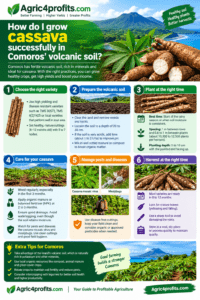
1. Know Your Soil Before You Plant
Volcanic (andosol) soils are young and rich in minerals, but they have one well-known weakness: they trap phosphorus. The same iron and aluminium particles that make the soil dark and crumbly also bind phosphorus so tightly that plant roots struggle to reach it, even when there’s plenty in the ground. This is one of the biggest hidden reasons for weak cassava growth on volcanic land.
The soil is also naturally on the acidic side, which cassava tolerates better than most staple crops — but “tolerates” isn’t “prefers.” A simple soil test (many agricultural extension offices can run one, or basic pH kits work in a pinch) tells you where you stand before you invest in cuttings and labour.
Soil Trait Typical Volcanic Soil Reading What It Means for Cassava pH 5.0–6.5 (slightly acidic) Within cassava’s comfortable range Phosphorus availability Often low despite mineral richness Needs targeted phosphorus placement Drainage Generally good on slopes Reduces root rot risk Organic matter Variable, often thin on steep ground Benefits from added compost/manure 2. Choose a Variety Bred for Yield, Not Just Tradition
Many Comorian farmers still grow landrace cassava passed down through families, and there’s nothing wrong with that heritage — but research collecting cassava varieties across the islands found that farmers who switched to newer cultivars often saw better yields, earlier maturity, improved taste, and stronger resistance to disease. Traditional varieties tend to be lower-yielding and more vulnerable to the viruses spreading through the islands.
If you can access improved planting material through an agricultural cooperative or extension programme, it’s worth trialing a small plot alongside your usual variety before switching entirely. Always start with healthy, disease-free stem cuttings — this single choice does more to protect your harvest than almost anything else you’ll do this season.
Read Also: The Best Time and Methods of Fertilizer Application
3. Prepare the Land and Plant at the Right Time
Cassava does best planted at the start of the rainy season, roughly November through early in the year in Comoros, so the young plant has steady moisture while it establishes roots. On sloped volcanic ground, ridging or mounding before planting isn’t optional — it protects against erosion during heavy rain and keeps the developing tubers from sitting in waterlogged soil.
Planting Factor Recommendation Best planting window Start of rainy season (Nov–early year) Cutting length 20–25 cm, with at least 5 healthy nodes Spacing Roughly 1m x 1m for good tuber development Land preparation Ridges or mounds on sloped ground Planting angle Slightly slanted, 2/3 of cutting buried Clear the land of stones and roots first — volcanic ground can be rocky closer to the surface than it looks, and this slows tuber expansion later.
4. Feed the Soil the Right Way
Because volcanic soil locks up phosphorus, simply adding more general fertilizer isn’t always the answer. What tends to work better is building organic matter — compost, well-rotted manure, or green mulch — which improves how the soil holds and releases nutrients over time, rather than relying only on chemical inputs.
Watch your nitrogen use carefully. Too much nitrogen pushes cassava into producing lush leaves and stems at the expense of the tubers underground, which is the opposite of what you’re farming for.
Deficiency Sign Likely Cause What Helps Pale, yellowing older leaves Nitrogen shortage Balanced compost or manure Stunted growth, purplish leaf tinge Phosphorus lockup Localized phosphorus placement near roots, organic matter Weak stems, poor tuber fill Potassium shortage Wood ash or potassium-rich compost Leaf curling, mosaic patterns Viral disease, not nutrients Remove and destroy infected plants 5. Manage Pests, Disease, and Harvest Timing
This is where Comorian farmers need to stay especially alert. Surveys across the islands found cassava mosaic disease symptoms in the vast majority of fields checked, alongside cassava brown streak disease in a large share as well. Both spread through infected cuttings, so the single best prevention is sourcing clean planting material and never reusing cuttings from a visibly sick plant.
Cassava is typically ready for harvest 8 to 12 months after planting, depending on variety and rainfall. Harvesting too early gives you small, starch-poor roots; leaving it too long in the ground on wet volcanic soil can invite rot. Dig a test plant around month 8 to check root size before committing to a full harvest.
Beyond mosaic and brown streak disease, keep an eye out for cassava mealybug, which thrives in humid conditions and weakens plants by feeding on sap from the stems and leaves. Healthy, well-fed plants tend to resist pest pressure better than stressed ones, which is another reason good soil management pays off twice — once through the roots you harvest, and once through fewer losses along the way.
Frequently Asked Questions
1. How long does cassava take to mature in Comoros?
Most varieties are ready between 8 and 12 months after planting. Improved varieties tend toward the shorter end of that range, while traditional landraces often need the full 12 months or longer.
2. Is volcanic soil actually good for cassava, or is it a disadvantage?
It’s genuinely an advantage in most respects — good drainage, rich minerals, and a pH cassava tolerates well. The one real challenge is phosphorus lockup, which is manageable with organic matter and smart fertilizer placement rather than being a fundamental barrier.
3. What’s the best time of year to plant?
Planting at the beginning of the rainy season gives young cassava the steady moisture it needs to establish strong roots before any dry spells.
4. How do I prevent erosion on sloped volcanic land?
Build ridges or mounds before planting, and keep some ground cover or mulch between rows. Steep, bare volcanic slopes lose topsoil quickly during heavy rain.
5. How can I tell if cassava mosaic disease has reached my field?
Look for leaves with a mottled yellow-and-green pattern, curling, or a generally distorted shape. If you see this, remove the affected plant and avoid taking cuttings from anywhere near it.
6. Do I need chemical fertilizer, or can compost alone work?
Compost and manure alone can carry cassava a long way on volcanic soil, especially for improving phosphorus availability over time. Chemical fertilizer can help but should be used carefully, since volcanic soil doesn’t always release added phosphorus efficiently.
7. How do I know when to harvest instead of guessing?
Dig up one test plant around the 8-month mark. If the roots are a good size and the skin isn’t overly thick or woody, you’re likely ready. If they’re still small, give the field more weeks and check again.
8. Can I keep replanting cuttings from my own field every season?
You can, but only if the parent plants were healthy. Reusing cuttings from a field with any history of mosaic or brown streak symptoms is one of the fastest ways to spread disease across your own land year after year. It’s worth setting aside a small, closely watched section purely for producing clean planting material.
Have you grown cassava on volcanic soil before? We’d love to hear what’s worked for you, what hasn’t, and any questions this article didn’t answer. Share your experience in the comments below — your insight could be exactly what another farmer in the Comoros Farmers Community needs to hear.
Read Also: what-i-cannot-recycle-list-of-non-recyclable-items
- AuthorPosts

- You must be logged in to reply to this topic.