



Public Group
Active 1 year, 3 months ago
Group Type By Country
Group Leadership
- Group Administrators
-

Comoros Farmers Community
How do I raise goats for meat in the Comoros islands?
- This topic is empty.
- AuthorPosts
- September 17, 2026 at 4:51 pm #854877
 Agric4ProfitsModerator
Goat farming for meat can be a practical livestock business in the Comoros Islands when farmers use healthy animals, provide adequate feed, maintain clean housing, and pay close attention to animal health. Goats are well suited to smallholder farming because they can feed on grasses, leaves, shrubs, and other vegetation while requiring less space than larger livestock.
For farmers interested in meat production, the main goal should be to raise healthy goats that grow steadily and reach a desirable market size. Good breeding, nutrition, housing, disease prevention, and marketing all contribute to the success of a goat farming business.
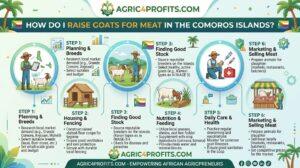
The following guide explains how farmers can raise goats for meat successfully in the Comoros Islands.
1. Choose Healthy Goats for Meat Production
The first step is to select healthy goats with good meat production characteristics. Farmers should look for animals with strong bodies, healthy legs, good body condition, clear eyes, healthy coats, and good appetites.
Local goats can be valuable because animals that have adapted to the Comorian environment may cope better with the local climate, available feed, and farming conditions. Farmers can also consider suitable meat breeds or carefully planned crossbreeding where quality breeding animals are available.
Boer goats are recognized as a meat breed, and Boer genetics have historically been used in parts of the Comoros to improve goat meat production.
Farmers should not choose breeding animals based on size alone. Health, growth history, age, fertility, adaptability, and physical structure should also be considered.
2. Start With a Manageable Herd
Beginners should avoid purchasing too many goats before gaining enough experience to manage them properly.
A small herd allows a new farmer to learn how to feed, breed, house, monitor, and treat goats without taking on unnecessary financial risks. The number of goats should depend on the amount of land, feed, water, housing, labor, and money available.
Overstocking can quickly reduce the amount of vegetation available and increase competition for food. It can also make parasite and disease problems more difficult to control.
Starting small and expanding gradually is often easier to manage than purchasing a large herd immediately.
3. Build a Clean and Well-Ventilated Goat House
Goats need a shelter that protects them from heavy rain, excessive heat, strong winds, theft, and predators.
The goat house does not need to be expensive. Locally available materials can be used if the structure is strong, safe, and suitable for the climate.
A raised floor can be useful in areas where rainfall creates wet ground conditions. Keeping goats above damp surfaces can help improve cleanliness and reduce exposure to moisture.
The shelter should have adequate ventilation without exposing the animals to excessive wind or rain. Remove manure and wet bedding regularly, and keep feeding and watering areas clean.
Overcrowding should also be avoided because it can increase stress and make diseases spread more easily.
4. Provide Enough Feed for Good Growth
Feed is one of the most important factors in meat goat production. Goats can consume a wide variety of grasses, leaves, shrubs, and other vegetation, making them suitable for many smallholder farming systems.
Farmers can provide goats with fresh grasses, suitable tree and shrub leaves, forage legumes, crop residues, hay, and appropriate supplementary feeds.
Young goats intended for meat production need enough nutrients to develop properly. A goat that receives inadequate feed may grow slowly and take longer to reach market size.
Farmers should therefore monitor the body condition and growth of their animals. When changing from one type of feed to another, introduce the new feed gradually to reduce the risk of digestive problems.
Where possible, farmers should also preserve hay or other suitable forage for periods when fresh vegetation becomes less available.
5. Provide Clean Water Every Day
Clean water is essential for digestion, growth, reproduction, and overall health.
Goats should have regular access to fresh drinking water. Water containers should be checked frequently and cleaned when necessary.
The containers should be positioned away from areas where manure can contaminate the water. Dirty water can contribute to health problems and may discourage goats from drinking enough.
Farmers should also plan for dry periods by identifying a dependable source of water before increasing the size of the herd.
6. Establish a Good Breeding Program
Controlled breeding helps farmers produce kids consistently and maintain a productive herd.
Choose breeding females that are healthy, fertile, good mothers, and capable of raising strong kids. The breeding buck should also be healthy, physically sound, and free from obvious defects.
Avoid repeatedly breeding closely related animals because this can increase the risk of undesirable genetic problems.
Farmers interested in improving meat production can consider carefully planned crossbreeding. However, imported or specialized breeds should only be introduced when they are suitable for the local environment and can be properly managed.
The objective should be to produce goats that combine good growth with the ability to perform well under Comorian conditions.
7. Give Pregnant Does Proper Care
Pregnant does require adequate nutrition because their nutritional needs increase as pregnancy progresses.
Provide good quality forage and suitable supplementary feed when necessary. Pregnant females should have access to clean water and a safe, clean area where they can give birth.
After kidding, farmers should monitor both the mother and newborn carefully. The newborn kid should receive colostrum as soon as possible after birth.
Weak or rejected kids require immediate attention. Farmers should also seek veterinary assistance when a doe has difficulty giving birth or when a newborn shows signs of serious illness.
Good care of newborn kids can significantly improve survival rates and increase the number of goats available for future meat production.
8. Prevent Diseases and Control Parasites
Disease prevention should be a major part of goat farming.
Farmers should regularly examine their goats for signs such as loss of appetite, weight loss, diarrhea, coughing, nasal discharge, lameness, pale gums, skin problems, swollen joints, or unusual behavior.
Internal parasites can reduce growth and weaken goats, while external parasites such as ticks can also cause health problems.
Vaccination, deworming, parasite control, and other treatments should be based on the diseases and parasites present in the local area. Farmers should work with qualified veterinary professionals or livestock extension officers when developing a herd health program.
New goats should also be observed carefully before being introduced into an established herd.
9. Choose a Suitable Management System
Farmers can raise goats through grazing, tethering, cut and carry feeding, or a semi intensive system.
In a grazing system, goats obtain much of their feed from pasture and natural vegetation. Farmers must ensure that the grazing area provides enough food and that goats do not damage neighboring crops.
With cut and carry feeding, farmers harvest grasses, leaves, and other suitable forage and take them directly to the goats.
A semi intensive system combines controlled grazing with supplementary feeding. This can be useful for farmers who have limited land but can produce or collect additional forage.
The most suitable system depends on the amount of land available, labor requirements, feed resources, and the farmer’s production goals.
10. Monitor Growth and Market Goats at the Right Time
Farmers should monitor the growth and body condition of goats intended for meat.
Keeping animals for too long can increase feed and management costs without necessarily producing better returns. On the other hand, selling animals too early can mean losing potential weight and income.
Farmers should observe local market preferences and determine what sizes and types of goats buyers are willing to pay for.
Where possible, record the weight or estimated growth of individual animals. This can help identify goats that grow quickly and perform well under the farm’s conditions.
11. Identify Buyers Before Expanding Production
A farmer should understand the market before increasing the size of the goat herd.
Potential buyers can include households, butchers, restaurants, livestock traders, and consumers purchasing goats for celebrations and other occasions.
Farmers should compare prices offered by different buyers and calculate transportation and other selling expenses.
It is also important to keep records of how much was spent on purchasing goats, feed, housing, veterinary care, transportation, and other expenses. These records help determine whether the goat enterprise is generating a profit.
12. Keep Proper Farm Records
Good record keeping allows farmers to make better decisions.
Record the identification of breeding goats, birth dates, number of kids, illnesses, treatments, deaths, feed expenses, purchases, and sales.
Farmers can use these records to identify productive females, fast growing kids, and animals that consistently perform poorly.
Records can also help determine which feeds provide good results at an affordable cost.
Over time, this information can help the farmer improve breeding decisions, reduce unnecessary expenses, and increase meat production.
13. Avoid Common Goat Farming Mistakes
Several mistakes can reduce the productivity of a meat goat farm.
Allowing goats to depend entirely on uncontrolled grazing can result in inadequate nutrition when vegetation becomes scarce. Overstocking can also put excessive pressure on available feed.
Farmers should avoid purchasing animals without checking their health. Poor housing, contaminated water, inadequate feeding, uncontrolled breeding, and failure to monitor parasites can also cause serious losses.
Another common mistake is expanding the herd too quickly. Farmers should first establish reliable sources of feed, water, veterinary support, housing, and markets.
The goal should be to build a sustainable goat production system rather than simply increasing the number of animals.
Frequently Asked Questions
1. Is goat farming profitable in the Comoros?
Goat farming can provide income when farmers control production costs, maintain healthy animals, achieve good growth rates, and have reliable access to buyers. Profitability depends on factors such as feed costs, mortality, veterinary expenses, selling prices, and herd management.
2. Which goats are suitable for meat production in the Comoros?
Healthy local goats can be suitable because they are adapted to local conditions. Farmers can also consider suitable meat breeds and carefully planned crosses. Boer genetics have historically been used in parts of the Comoros for meat production.
3. What should I feed goats raised for meat?
Farmers can provide grasses, browse plants, suitable leaves, legumes, crop residues, hay, and appropriate supplementary feeds. Growing goats need enough nutrients to support steady development. Clean water and suitable mineral supplementation should also be provided.
4. How can I make my goats grow faster for meat production?
Provide adequate nutrition, clean water, good housing, parasite control, disease prevention, and quality breeding stock. Monitoring growth and selecting healthy animals with good growth characteristics for breeding can also improve future production.
5. How can I sell goats in the Comoros?
Farmers can sell goats to households, livestock traders, butchers, restaurants, and other local buyers. It is useful to compare prices from different buyers and understand local demand before deciding when and where to sell.
Raising goats for meat can become a useful livestock enterprise in the Comoros Islands when farmers combine good breeding, proper nutrition, clean housing, disease prevention, and effective marketing.
Farmers starting on a small scale should focus on producing healthy goats and developing reliable management practices before expanding the herd. With careful planning and proper record-keeping, goat farmers can gradually improve productivity and build a more sustainable meat production business.
Read Also: classification-of-solid-waste
- AuthorPosts

- You must be logged in to reply to this topic.