



Public Group
Active 1 year, 3 months ago
Group Type By Country
Group Leadership
- Group Administrators
-

Comoros Farmers Community
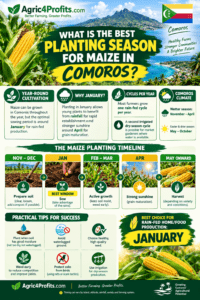
What is the best planting season for maize in Comoros?
- This topic is empty.
- AuthorPosts
- September 16, 2026 at 5:27 pm #854437
 Agric4ProfitsModerator
Maize is an important cereal crop that can contribute to household food supplies and farm income in Comoros. The crop can be cultivated on different islands when farmers select an appropriate planting period, prepare the land properly and choose varieties suited to local conditions.
Because Comoros has a tropical maritime climate, rainfall patterns are particularly important when deciding when to plant maize. The best period is generally linked to the beginning of reliable rains, when the soil has enough moisture to support germination and early growth.
Farmers should also consider the local microclimate, altitude, soil drainage and the expected length of the rainy period. Planting too early can expose seeds to inadequate moisture, while planting too late may reduce the time available for the crop to mature under favourable conditions.
1. Understand the Rainfall Pattern
Rainfall is the most important factor when determining when to plant maize in Comoros. Maize requires adequate moisture during germination, early vegetative growth, flowering and grain formation.
Farmers should aim to plant when rainfall has become sufficiently regular rather than relying on a single early shower. A short period of rain followed by prolonged dryness can cause poor germination and weak establishment.
The precise timing can vary between islands because local weather conditions are not identical. Farmers should therefore observe the onset of dependable seasonal rainfall in their particular area.
Where irrigation is available, growers have more flexibility because water can be supplied when rainfall is insufficient.
2. Plant at the Beginning of Reliable Rains
For most rainfed maize farms, planting near the beginning of the main rainy period is generally the safest approach. The soil should be moist enough to support germination, with additional rainfall expected during the early stages of development.
Planting immediately after the first light rainfall is not always advisable if the soil is likely to dry out again. It is better to wait until the rains become more consistent.
Farmers can prepare their fields before the expected start of the wet period so that planting can take place promptly once suitable moisture conditions arrive.
This approach helps the crop establish before weeds become dominant and allows the plants to take advantage of the available rainfall during their growth cycle.
3. Consider the Differences Between Islands
Comoros consists of several islands with variations in elevation, rainfall, soil conditions and local climate. These differences mean that there is no single planting date that will be equally suitable for every maize farmer.
Growers should pay attention to the rainfall behaviour in their own community. Farmers in wetter areas may be able to establish crops earlier or grow maize during additional periods, while those in areas with shorter rainy periods need to make better use of the available moisture.
Local farming experience is valuable when determining the most dependable planting window. Observing rainfall patterns over several seasons can also help farmers improve their decisions.
4. Prepare the Land Before Planting
Good land preparation should begin before the planting season. Clear unwanted vegetation and remove aggressive weeds that could compete with young maize plants.
The soil should be loosened sufficiently to allow roots to develop and water to penetrate. Avoid excessive cultivation, particularly on sloping land where heavy rainfall can increase erosion.
Organic matter such as well-decomposed manure or compost can improve soil structure and nutrient availability. Where soil fertility is low, appropriate fertilizers can also be used according to the crop’s requirements and local recommendations.
Completing most of the preparation before the rains arrive allows farmers to plant quickly when conditions become favourable.
Read Also: Farm Finance Calculator for Coffee Robusta Farming in Comoros
5. Choose Maize Varieties Suited to Local Conditions
Selecting an appropriate variety is another important part of successful maize production. Farmers should consider maturity period, rainfall availability, disease tolerance, grain characteristics and intended use.
Early maturing varieties can be useful in areas where the rainy period is relatively short. They can reach harvest before soil moisture becomes severely limited.
Longer duration varieties may be appropriate where rainfall remains adequate for an extended period. However, planting a variety with a maturity period that is too long for local conditions can increase the risk of moisture stress near the end of the season.
Farmers should obtain quality seed from reliable sources and avoid planting seed with poor germination capacity.
6. Plant When Soil Moisture Is Adequate
Adequate soil moisture is essential for maize seed germination. Seeds placed in dry soil may remain dormant until sufficient moisture arrives, while excessive moisture can create problems if the field has poor drainage.
Check the soil before planting. It should be moist but not saturated.
Planting at the correct depth is also important. Seeds planted too shallowly can dry out quickly, while excessively deep planting can delay emergence.
Uniform planting allows the crop to develop more evenly and makes later field operations easier.
7. Avoid Delaying Planting Too Long
Although farmers should wait for reliable rainfall, planting too late can also create problems.
Late-planted maize may encounter declining soil moisture during flowering and grain filling. These stages are particularly important because moisture shortages can reduce cob development and final yields.
Delayed planting can also expose the crop to different pest and disease pressures and may interfere with the timing of harvesting.
Once suitable rainfall has been established, farmers should plant promptly rather than waiting unnecessarily.
8. Manage Water During the Growing Season
After planting, maize needs sufficient moisture throughout its development. The crop is particularly sensitive to water shortages around flowering and grain formation.
Rainfed farmers should use practices that conserve moisture in the soil. Mulching with suitable plant materials can reduce evaporation and protect the soil surface.
Good weed management is also important because weeds consume water that maize needs for growth.
Where irrigation is available, supplemental watering can help maintain production during temporary dry periods. However, irrigation should be managed carefully to prevent waterlogging and unnecessary water use.
9. Control Weeds Early
Weeds can compete strongly with young maize plants for sunlight, nutrients and moisture. Early weed control is therefore essential.
Inspect the field regularly after emergence and remove weeds before they become established. Small farms can use hand weeding or simple farm tools, while larger operations may use other appropriate weed management methods.
Keeping the field relatively clean during the early growth stages gives maize plants better access to available resources.
Avoid damaging maize roots while removing weeds close to the plants.
10. Monitor the Crop Until Harvest
Planting at the right time is only the beginning of successful maize production. Farmers should continue monitoring the field throughout the season.
Look for signs of insect damage, disease, nutrient deficiencies, lodging and moisture stress. Problems identified early are usually easier to manage.
Farmers should also monitor the development of the ears and grains as the crop approaches maturity. Harvesting should take place when the maize has reached the appropriate stage for its intended use and storage method.
After harvesting, dry the grain properly before storage to reduce the risk of mould and deterioration.
Frequently Asked Questions
1. What is the best planting season for maize in Comoros?
The best period for rainfed maize is generally near the beginning of the reliable rainy season. Farmers should wait until the soil has sufficient moisture and rainfall is expected to continue rather than planting after an isolated shower.
2. Can maize be planted during the dry season in Comoros?
Maize can be grown during a dry period if reliable irrigation is available. Without irrigation, dry season cultivation is more risky because the crop needs regular moisture, especially during flowering and grain development.
3. Does the planting time vary between the islands of Comoros?
Yes. Rainfall, elevation and local weather conditions can differ between islands and locations. Farmers should therefore base their planting decisions on the rainfall pattern in their specific area.
4. Should I plant maize immediately after the first rain?
Not necessarily. A single rainfall event may not provide enough moisture for successful establishment. It is generally safer to plant once the rains become sufficiently regular to support germination and early growth.
5. What happens if maize is planted too late?
Late planting can expose maize to moisture shortages during flowering and grain filling. This can reduce cob development and grain yield, particularly if the rainy period ends before the crop reaches maturity.
Farmers should avoid relying on a fixed calendar date because rainfall conditions can change from one location and season to another. Paying attention to local weather patterns, soil moisture and the expected duration of rainfall can help growers make better planting decisions.
With suitable seed, proper land preparation, good moisture management and timely weed and pest control, maize can become a useful crop for household food production and agricultural income in Comoros.
Read Also: what-plastics-cannot-be-recycled-list-of-non-recyclable-plastics
- AuthorPosts

- You must be logged in to reply to this topic.