



Public Group
Active 1 year, 3 months ago
Group Type By Country
Group Leadership
- Group Administrators
-

Comoros Farmers Community
What Is the Best Way to Plant Rain Fed Rice in the Comoros Highlands?
- This topic is empty.
- AuthorPosts
- September 16, 2026 at 4:39 pm #854396
 Agric4ProfitsModerator
Rice has become the preferred staple food across the Comoros, yet the country produces only around 1,100 tons a year while national demand is met largely through imports of 30,000 to 40,000 tons annually. That gap represents real money leaving households every season, and it also represents an opportunity for highland farmers who already grow rain-fed rice alongside cassava, bananas, and sweet potatoes on the cooler slopes above the coast.
Unlike the irrigated paddies found in the swampy lowlands of Moheli, highland rice depends entirely on rainfall rather than pumped or channeled water. That sounds risky, and in some seasons it can be, but the highlands are actually well suited to this style of farming. Areas above roughly 400 meters receive far more rain than the coast, with some upland zones on Karthala’s slopes collecting close to 5,000 millimeters a year compared to around 1,000 millimeters in the driest coastal spots. The challenge isn’t a shortage of water. It’s making sure that water falls when your rice actually needs it, and that your field holds onto enough moisture between showers.
This article covers what matters most for growing rain-fed rice successfully on highland ground: reading the seasonal rainfall pattern, preparing land that holds moisture without waterlogging, choosing varieties suited to cooler and wetter slopes, spacing and planting for the conditions you actually have, and protecting the crop through to a good harvest. As with our cassava article, you’ll find tables where the numbers matter, and questions answered plainly at the end.
Growing rice without irrigation takes more attention to timing than growing it in a controlled paddy, but it also costs less to set up and suits family-sized plots well. Once you understand the rhythm of the highland rainy season, rain-fed rice becomes a dependable part of your farm, not a gamble.
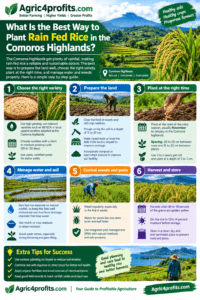
1. Understand the Highland Rainfall Pattern Before You Plant
The Comoros rainy season generally runs from November through April, bringing warm, moist air and the bulk of the year’s rainfall, while the cooler and drier period runs roughly May through October. Highland areas amplify this pattern because moist air rising against the slopes cools and drops even more rain than the coast receives, especially on windward-facing ground.
Rice grows best in temperatures between about 20 and 30 degrees Celsius, a range the cooler highlands sit comfortably within for most of the wet season. The key is timing your planting so that the crop’s most water-hungry growth stages line up with the heart of the rainy season rather than its edges, when rainfall is lighter and less reliable.
Season Typical Months What It Means for Rice Rainy season November to April Main planting and growing window Dry season May to October Avoid planting; risk of crop failure Peak rainfall January to February Best window for water-demanding growth stages Driest months September to November Reserve for land preparation only 2. Prepare Land That Holds Moisture Without Waterlogging
Highland soil on volcanic slopes drains quickly, which is good news for avoiding root rot but means moisture can disappear fast between rains. Building small bunds or low ridges around your plot helps trap rainwater long enough for it to soak in, rather than letting it run straight downhill.
Clear the land early, during the dry months, so organic matter from cleared vegetation has time to break down and enrich the topsoil before planting. Avoid clearing steep slopes completely bare. Leaving some vegetation at field edges reduces erosion during the heaviest rains and protects the topsoil your rice depends on.
A basic soil check for organic matter and drainage tells you a lot before you commit seed to the ground. Fields that dry out visibly within a day or two of rain will need more moisture retention work than fields that stay damp longer.
Read Also: Farm Finance Calculator for Coffee Robusta Farming in Comoros
3. Choose Varieties Suited to Rain-Fed Highland Growing
Not every rice variety performs well without irrigation. Varieties bred for flooded paddies often struggle when water supply is inconsistent, while varieties developed for upland or rain fed conditions tend to tolerate short dry spells between rains far better.
Ask your local agricultural extension office or cooperative about varieties trialed specifically for rain-fed conditions in Comoros, since national programs working with regional rice research partners have been testing improved varieties for smallholder farmers in recent seasons. A short trial plot alongside your usual seed stock is a low-risk way to compare performance before switching your whole field.
Variety Trait Why It Matters for Highland Rain-Fed Rice Drought tolerance Survives short gaps between rainfall events Shorter maturity period Reduces exposure to late season dry spells Strong root system Draws moisture from deeper soil during dry stretches Disease resistance Reduces losses in humid, high rainfall conditions 4. Plant and Space for Rain-Fed Conditions
Plant at the true start of the rainy season rather than the first light shower, since an early false start followed by a dry spell can kill young seedlings before their roots establish. Waiting for consistent rainfall over several days is a safer signal than a single wet afternoon.
Spacing matters more in rain-fed systems than in flooded paddies, because plants spaced too closely compete for limited soil moisture. A spacing of around 20 by 20 centimeters gives each plant enough root room to draw water during drier stretches, while still making efficient use of the field.
Direct seeding is common in rain-fed highland systems and saves labor compared to transplanting seedlings, though transplanting can give slightly more uniform stands if you have the extra hands available at planting time.
5. Protect the Crop and Time the Harvest Well
Weeds compete aggressively for the same limited moisture your rice needs, so early and consistent weeding in the first six to eight weeks after planting matters more in rain-fed fields than in flooded ones, where standing water naturally suppresses many weeds. Two to three weeding rounds during early growth make a noticeable difference by harvest time.
Watch for signs of stress during any mid-season dry spell, such as rolled or curling leaves, and be ready to prioritize weeding and mulching around the roots to conserve whatever moisture remains in the soil.
Rain-fed rice in Comoros typically matures within three to five months depending on variety, with harvest ideally falling as the rains begin to taper rather than in the middle of the wettest weeks, since heavy rain on mature grain heads increases losses from lodging and grain rot.
Frequently Asked Questions
- When should I plant rain-fed rice in the highlands?
Plant once the rainy season is clearly established, typically from November onward, rather than after the first isolated shower. A reliable run of wet days is a much safer signal than a single early rain.
- How much rain does rain-fed rice actually need?
Rice generally needs consistent moisture throughout its growth cycle, and highland areas easily supply this during the wet season, since some upland zones receive close to 5,000 millimeters of rain annually. The challenge is distribution within the season, not total volume.
- Can I grow rain-fed rice on sloped land?
Yes, with proper preparation. Small bunds or ridges that slow water runoff, combined with vegetation left at field edges, make sloped highland ground workable for rain-fed rice while limiting erosion.
- What is the biggest risk to rain-fed rice yields?
Uneven or interrupted rainfall during key growth stages is the main risk, particularly a dry spell during flowering or grain filling. Choosing a variety with good drought tolerance reduces this risk substantially.
- How is rain-fed rice different from the irrigated rice grown in Moheli?
Irrigated rice in Moheli’s lowland paddies receives controlled water through channels and can sometimes be grown multiple times a year. Rain-fed highland rice depends entirely on natural rainfall timing, so careful planting timing matters much more.
- Do I need fertilizer for rain-fed rice in the highlands?
Organic matter worked into the soil during land preparation goes a long way, and many highland fields perform reasonably well without heavy chemical fertilizer use. Where soil is visibly poor, a modest, well-timed application can help, but excess fertilizer offers little benefit if moisture is the limiting factor.
Have you grown rain-fed rice on highland ground before? We would love to hear what worked for you, what didn’t, and any questions this article left unanswered. Share your experience in the comments below. Your insight could be exactly what another farmer in the Comoros Farmers Community needs to hear.
Read Also: how-to-make-compost-from-kitchen-waste
- AuthorPosts

- You must be logged in to reply to this topic.