



Public Group
Active 1 year, 3 months ago
Group Type By Country
Group Leadership
- Group Administrators
-

Comoros Farmers Community
What is the current price of ylang-ylang oil per kilogram?
- This topic is empty.
- AuthorPosts
- September 17, 2026 at 3:53 pm #854851
 Agric4ProfitsModerator
Ask five different buyers what a kilogram of ylang-ylang oil costs and you will likely get five different answers, and all of them could be correct. Unlike a staple commodity such as rice or maize, ylang-ylang oil does not trade at one universal price. It moves through several tiers, from the sum a Comorian farmer or distiller receives for a fresh batch, through the wholesale price paid by international buyers, up to the premium figure a perfumer in Paris or Grasse might pay for the finest grade.
Comoros supplies somewhere between 50 and 70 percent of the world’s ylang-ylang oil, so what happens on these islands genuinely moves the global market, and understanding the different price tiers matters just as much as growing and distilling a good crop.
This matters economically in a very direct way. Ylang-ylang, alongside vanilla and cloves, makes up the large majority of Comoros’ export revenue, and a strong flowering season with good prices can stabilize household incomes across the whole community, while a weak or low-priced season is felt immediately in farming families.
The oil itself is prized for its complex, sweet floral scent and is a well-known base note in famous perfumes, including Chanel No. 5, which keeps demand fairly steady even as prices swing.
This article breaks the pricing question down into five parts: why ylang-ylang oil does not have one single price, what the current price ranges look like at each market tier, what drives the swings from one season to the next, how Comoros’ global market position affects local prices, and what farmers and cooperatives can do to capture a better price for their harvest. Prices in this market move constantly, so treat the figures here as a current snapshot rather than a fixed number, and check with a buyer or cooperative directly before pricing a shipment.
1. Understand why ylang-ylang oil does not have one single price
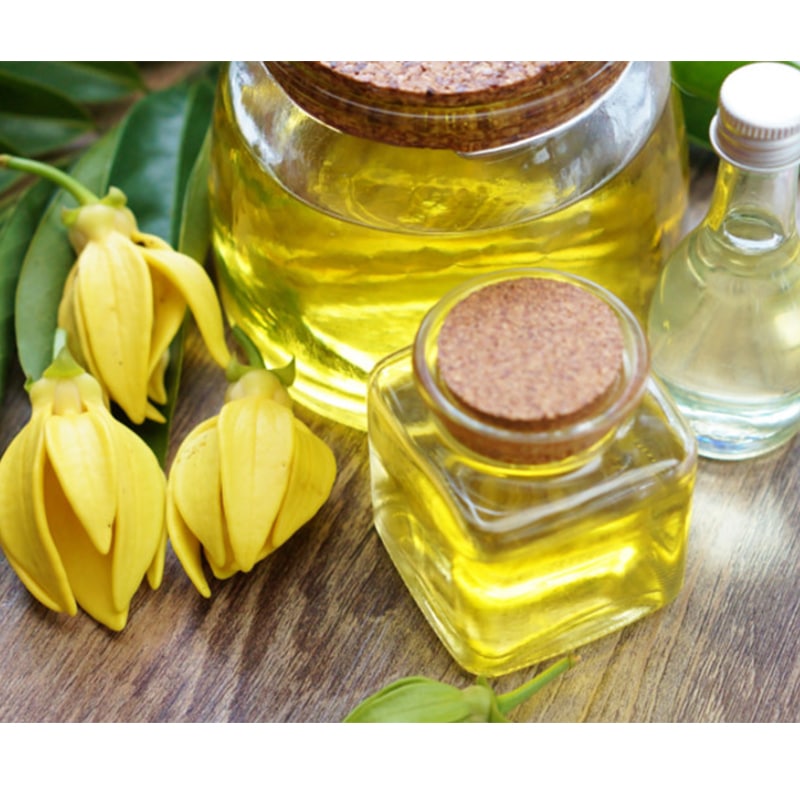
Ylang-ylang oil is distilled from fresh Cananga odorata flowers in a slow steam distillation process that can run for over twenty hours. As the distillation continues, the oil that comes off changes in composition and fragrance quality, and distillers traditionally separate it into distinct fractions rather than collecting one uniform batch.
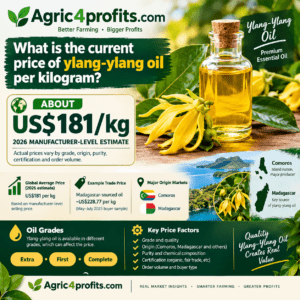
The first fraction to come off, known as Extra, is the lightest and most fragrant, and it commands the highest price because perfumers value it most. As distillation continues, the fractions labelled I, II and III follow, each slightly heavier and less prized than the last, typically used in soap, candles and lower-cost cosmetic blends rather than fine fragrance. A “Complete” oil, made by running the full distillation without separating fractions, sits somewhere in the middle. This grading system is the single biggest reason two sellers can quote very different prices for what both call ylang-ylang oil, since they may simply be selling different fractions of the same harvest.
2. Current price ranges by market tier
Because of the grading system and the number of steps between farm and finished perfume, it helps to think of ylang-ylang pricing as a ladder rather than a single figure.
Market tier Approximate price per kilogram Conventional oil sold to cultivators or cooperatives Around $28 to $42 Fair-Trade certified oil paid to cultivators Around $45 to $65 General cooperative or farm-level sale, mixed grades Over $100 in a typical season Premium or Extra-grade oil in international markets Around $150 to $250 Crisis-level spike pricing, such as after major supply disruption Has reached around $450 in past shortage years These figures shift with the season, the grade being sold, and whether a buyer is paying a conventional or a Fair-Trade-certified rate. A cooperative that aggregates flowers from many small farms and improves its distillation consistency can often negotiate meaningfully better prices than an individual farmer selling a small, inconsistent batch.
Read Also: Farm Finance Calculator for Coffee Robusta Farming in Comoros
3. What drives the price swings from one season to the next
Ylang-ylang pricing is genuinely volatile, more so than many other cash crops, and a handful of recurring factors explain most of the movement.
Weather is the biggest single driver. Cyclones can damage flowering trees and disrupt harvests across an entire season, and a sharp drop in supply pushes prices up quickly, as happened when a cyclone-driven output drop pushed oil prices to a five-year high of around $450 per kilogram. On the other side, a strong flowering season across Comoros, Madagascar and other producing regions can push supply up and prices down.
Global demand from the perfume and cosmetics industry adds another layer of movement, since ylang-ylang has no perfect substitute in fine fragrance, but synthetic alternatives are steadily improving and give buyers an alternative when natural prices climb too high. Currency movements and shipping costs also feed into the final price a Comorian seller receives once international buyers convert and transport the oil.
Consumer trends add a slower, steadier kind of pressure on top of these sharper swings. Demand for organic and Fair-Trade certified natural ingredients has been rising in skincare and aromatherapy, not just fine perfumery, and buyers in these segments are often willing to pay a meaningful premium for verified sourcing. That trend has been part of what keeps Fair-Trade certified oil priced well above the conventional rate, and it is one of the more predictable, longer-term forces in an otherwise volatile market.
4. How Comoros’ global market position affects local prices
Comoros holds an unusually strong position for such a small country, supplying more than half of the world’s ylang-ylang oil. That gives the islands real influence over the global price, but it does not give individual farmers much bargaining power on their own, since the country still competes with lower-cost alternatives if it prices itself out of the market.
Madagascar remains the largest single producer of ylang-ylang oil overall and offers buyers a lower-cost, if generally lower-quality, alternative when Comorian prices rise too far. This means Comorian sellers benefit from a strong reputation for quality, since buyers are often willing to pay a premium for Comorian oil specifically, but that premium has a ceiling. If prices climb too high for too long, buyers can shift toward Madagascan supply, synthetic substitutes, or reformulated fragrances that use less ylang-ylang overall.
Farmers and exporters who understand this dynamic tend to price competitively rather than chase short-term spikes, since a reputation for reliable quality and fair pricing keeps buyers coming back season after season.
5. How farmers and cooperatives can capture a better price
Individual farmers rarely have the volume or the negotiating position to set their own price, but there are practical steps that consistently lead to better outcomes at harvest time.
Joining or forming a cooperative is usually the single most effective step, since aggregating flowers from many small farms gives a group enough volume to negotiate directly with international buyers rather than accepting whatever a middleman offers. Investing in distillation quality matters just as much, since a cooperative that reliably produces a higher share of Extra grade oil earns noticeably more per kilogram than one selling mostly lower fractions.
Picking flowers in the early morning hours, when their oil content is highest, and distilling them promptly afterward, both help maximize both yield and quality. Finally, pursuing Fair-Trade or organic certification, where a cooperative has the resources to do so, opens access to buyers willing to pay guaranteed minimum prices well above the conventional market rate.
Frequently asked questions
- Why do ylang-ylang oil prices vary so much between sellers? Prices differ mainly because of grading. Extra grade, the first and most fragrant fraction from distillation, sells for far more than the later fractions labelled I, II and III, so two sellers quoting different prices may simply be selling different grades of oil.
- How much does a farmer in Comoros typically earn per kilogram of oil? Farm and cooperative level prices vary by grade and certification, but conventional sales often fall in the $28 to $65 per kilogram range, while Fair-Trade certified sales tend to sit toward the higher end of that range or above it.
- Why did ylang-ylang oil prices spike to around $450 per kilogram in past years? A major cyclone disrupted flowering and cut annual output sharply in one recent shortage year, and the resulting supply shortage pushed prices to a five year high before supply gradually recovered.
- Does Comoros compete with other countries for ylang-ylang buyers? Yes, primarily with Madagascar, which produces a larger overall volume at a generally lower price. Comorian oil commands a quality premium, but that premium narrows if Comorian prices rise too far above Madagascan alternatives.
- What is the easiest way for a small farmer to get a better price? Joining a cooperative is usually the most effective step, since it allows small farmers to combine their harvests, improve distillation consistency, and negotiate directly with international buyers instead of relying on middlemen.
What price have you been getting for your ylang-ylang harvest this season? Share your experience in the comments below, comparing notes with other farmers in the community is one of the best ways to know whether you are getting a fair deal.
Read Also: concept-definition-of-solid-wastes
- AuthorPosts

- You must be logged in to reply to this topic.