



Public Group
Active 1 year, 3 months ago
Group Type By Country
Group Leadership
- Group Administrators
-

Comoros Farmers Community
What vaccination schedule should I follow for village poultry?
- This topic is empty.
- AuthorPosts
- September 17, 2026 at 5:09 pm #854882
 Agric4ProfitsModerator
Village poultry farming can provide meat, eggs, income, and food security for rural households. However, chickens raised under village conditions can be exposed to infectious diseases, especially when they mix with other birds, share feeding areas, or come into contact with free-ranging poultry.
Vaccination is one of the most important tools for preventing serious poultry diseases. A good vaccination program can reduce deaths, protect growing birds, and help farmers maintain a more productive flock.
The exact vaccination schedule can vary depending on the disease risks in the area, the type of vaccine available, the age of the birds, and local veterinary recommendations. Farmers should therefore work with a veterinary professional or livestock extension officer when establishing a vaccination program.
For village poultry, Newcastle disease deserves particular attention because it can cause severe losses in chickens. Other vaccines may also be appropriate depending on local disease risks.
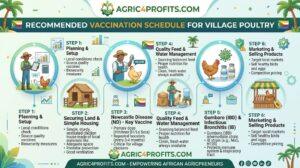
1. Start Vaccination With Healthy Chicks
Vaccination should begin with healthy birds. Farmers should avoid vaccinating chickens that are seriously sick, weak, severely stressed, or suffering from another health problem unless a veterinarian specifically recommends it.
A practical village poultry program may begin with Newcastle disease vaccination when chicks are young, followed by booster doses according to the vaccine manufacturer’s instructions and local veterinary advice.
Some vaccination programs may use an early Newcastle disease vaccination during the first few weeks of life, followed by another dose several weeks later. In areas where Newcastle disease is a major problem, periodic booster vaccination may be necessary to maintain protection.
The exact timing depends on the vaccine being used. Some vaccines are designed for younger birds, while others are used later in the production cycle.
Farmers should always check the label of the specific vaccine because different products can have different administration methods, age recommendations, and intervals between doses.
2. Follow a Newcastle Disease Vaccination Program
Newcastle disease should be a major consideration in village chicken production because outbreaks can spread rapidly through unvaccinated flocks.
A simple example of a Newcastle disease program for village chickens can include an initial vaccination during the early life of the bird, a booster several weeks later, and repeated vaccination at intervals recommended by the local veterinary service or vaccine manufacturer.
For example, a farmer may use a schedule similar to:
Age of chicken Vaccination activity Around 1 to 2 weeks Initial Newcastle disease vaccination where recommended Around 3 to 4 weeks Booster vaccination according to the vaccine program Around 6 to 8 weeks Additional Newcastle disease vaccination where required Every few months Booster vaccination according to local disease risk and veterinary advice This table is only a general guide. Vaccine programs differ, and some village poultry programs use periodic vaccination campaigns rather than individually vaccinating birds at fixed ages.
Farmers should avoid assuming that one vaccination will provide lifelong protection. Booster doses are often needed, particularly where disease pressure remains high.
3. Consider Other Vaccines Based on Local Disease Risks
Newcastle disease is not the only disease that can affect village poultry. Depending on the location and production system, farmers may need to consider vaccines for diseases such as fowl pox, infectious bursal disease, infectious bronchitis, or other locally important diseases.
Fowl pox vaccination may be considered where the disease is common, particularly because mosquitoes and other biting insects can contribute to its spread.
Chickens raised for longer periods may require a different vaccination program from birds that are sold or consumed at a young age.
Farmers should therefore avoid copying another farmer’s vaccination schedule without checking whether the same diseases and vaccines apply to their own area.
A local veterinarian or livestock extension officer can help determine which vaccines are actually necessary.
4. Handle and Store Vaccines Correctly
A good vaccination schedule will not work properly if vaccines are stored or administered incorrectly.
Many poultry vaccines are sensitive to heat and require proper cold storage. Farmers should follow the manufacturer’s storage instructions and avoid exposing vaccines to excessive heat or direct sunlight.
Only prepare vaccines when they are ready to be administered. Follow the manufacturer’s instructions regarding mixing, dosage, drinking water, eye drops, spraying, injection, or other methods of administration.
When vaccines are administered through drinking water, farmers should ensure that birds have adequate access to the prepared vaccine and that the water is suitable for vaccination.
Do not use expired vaccines. Farmers should also avoid keeping leftover prepared vaccine for later use unless the manufacturer specifically states that it can be stored.
Proper handling is particularly important in village poultry production because poor storage or incorrect administration can reduce the effectiveness of vaccination.
5. Combine Vaccination With Good Poultry Management
Vaccination should not be treated as a replacement for good poultry management.
Farmers should provide clean drinking water, adequate feed, suitable shelter, proper ventilation, and protection from predators. New birds should be monitored before being introduced into an existing flock.
Keeping poultry housing clean can reduce exposure to disease causing organisms. Farmers should also avoid unnecessary mixing of chickens from different households, especially during disease outbreaks.
Regularly observe the flock for signs such as sudden deaths, coughing, difficulty breathing, diarrhea, paralysis, reduced feeding, swollen eyes, or unusual behavior.
If several birds become sick or die suddenly, farmers should contact a veterinary professional rather than assuming that vaccination alone will solve the problem.
A vaccination record should also be maintained. Record the date, vaccine used, number of birds vaccinated, age of the birds, and the next scheduled vaccination. Good records make it easier to maintain a consistent poultry health program.
Frequently Asked Questions
1. What is the most important vaccine for village chickens?
Newcastle disease vaccination is particularly important in many village poultry systems because Newcastle disease can cause serious illness and high mortality. However, the most appropriate vaccination program depends on the disease risks in the local area.
2. At what age should village chickens be vaccinated?
The starting age depends on the vaccine and the disease being targeted. Newcastle disease vaccination may begin when chicks are young, with booster doses given later according to the vaccine instructions and local veterinary recommendations.
3. How often should village chickens receive booster vaccinations?
Booster frequency depends on the vaccine, disease risk, and local poultry health program. Some village poultry programs use repeated vaccination campaigns at regular intervals, particularly for Newcastle disease.
4. Can I vaccinate sick chickens?
Vaccination is generally intended for healthy birds. Seriously sick or severely stressed chickens may not respond properly to vaccination. Farmers should seek veterinary advice when birds are already showing significant signs of disease.
5. Is vaccination enough to prevent poultry diseases?
No. Vaccination should be combined with good feeding, clean water, proper housing, hygiene, careful introduction of new birds, parasite control, and early disease detection. These measures work together to protect village poultry and reduce losses.
A well-planned vaccination program can help village poultry farmers reduce disease-related losses and maintain healthier flocks. Newcastle disease should receive particular attention, but other vaccines may also be appropriate depending on local conditions.
Farmers should use vaccines according to the manufacturer’s instructions and seek guidance from veterinary professionals or livestock extension officers when deciding which diseases to vaccinate against and when booster doses are required.
Good vaccination practices combined with proper nutrition, hygiene, housing, and flock management can provide a stronger foundation for successful village poultry production.
Read Also: what-plastics-cannot-be-recycled-list-of-non-recyclable-plastics
- AuthorPosts

- You must be logged in to reply to this topic.