



Public Group
Active 1 year, 3 months ago
Group Leadership
- Group Administrators
-

Pest and Disease Control Community
Managing Crop Residues to Reduce Pests
- This topic is empty.
- AuthorPosts
- July 27, 2026 at 9:36 am #793098
 Agric4ProfitsModerator
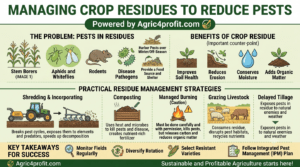
Crop residue left in fields after harvest can serve as a significant reservoir for pest populations, providing food, shelter, and overwintering habitat that allows many pest species to survive between growing seasons and reinfest subsequent plantings with minimal delay.
While crop residue also offers valuable soil health benefits when managed appropriately, farmers need to balance these benefits against the pest management considerations that residue handling decisions significantly influence.
This article covers practical strategies for managing crop residues in ways that reduce pest pressure while still capturing the soil health benefits residue can provide, helping farmers navigate this important but often overlooked aspect of integrated pest management.
Whether you are dealing with a specific pest problem linked to residue or want to build stronger preventive practices into your overall farm management, understanding residue management principles will help you reduce pest carryover between seasons.
1. Understand How Residue Supports Pest Survival
Many pest species, including various insects and disease pathogens, use crop residue as overwintering habitat or a direct food source, allowing them to survive periods when living host plants are not available and quickly reinfest new plantings once conditions become favorable again.
Understanding which specific pests affecting your crops rely on residue for survival helps inform more targeted residue management decisions rather than applying a single blanket approach regardless of the specific pest pressures present on your farm.
2. Remove or Destroy Residue From Heavily Infested Areas
For fields with known significant pest problems during the growing season, removing and properly destroying crop residue after harvest, rather than leaving it in the field, directly reduces the pest population that would otherwise carry over into the following season.
This targeted approach, focused on areas with documented pest pressure, balances pest management benefits against the broader soil health value of residue retention that applies across less problematic areas of the farm.
Residue Management Options and Pest Impact
Method Pest Reduction Effect Soil Health Trade-off Complete removal High Loses organic matter contribution Burning High for surface pests Loses organic matter, air quality concern Incorporation (tillage) Moderate Some organic matter retained, disturbs soil Retention with monitoring Lower, but soil benefits preserved Best for low pest pressure situations Read Also: Reducing pesticide dependency for vegetables
3. Incorporate Residue to Accelerate Decomposition
Where complete removal is not necessary or desirable, incorporating residue into the soil through appropriate tillage accelerates decomposition compared to residue left on the surface, reducing the time window during which pests can use it as habitat.
This approach provides a middle ground between full residue retention and complete removal, capturing some soil health benefit from the decomposing organic matter while still reducing the extended pest habitat that undisturbed surface residue can provide.
4. Time Residue Management to Disrupt Pest Life Cycles
Timing residue destruction or incorporation to coincide with vulnerable points in a pest’s life cycle, where this information is available for specific problem pests, can significantly improve the effectiveness of residue management as a pest control tool.
For pests with well documented life cycles tied to residue, working with local agricultural extension services to identify optimal timing windows helps maximize the pest reduction benefit from residue management efforts.
Residue-Associated Pests and Management Timing
Pest Type Residue Relationship Effective Timing Stem borers Overwinter in residue Destroy residue promptly post-harvest Certain fungal pathogens Survive on infected debris Remove before next susceptible planting Soil dwelling pests Use residue as food source Incorporate to accelerate decomposition Storage pests Can persist in field debris near storage Clear debris near storage structures 5. Balance Residue Management With Soil Health Goals
Since crop residue also provides valuable soil health benefits, including erosion protection and organic matter contribution, residue management decisions should weigh pest control benefits against these soil health considerations rather than defaulting to complete removal in all situations.
For fields without significant residue-associated pest history, retaining residue, potentially combined with incorporation to accelerate decomposition, often provides the best overall balance between soil health and pest management objectives.
6. Monitor Results and Adjust Field-Specific Approaches
Tracking pest pressure in subsequent seasons relative to the residue management approach used provides practical, farm-specific data about whether current practices are achieving the intended pest reduction balance with soil health goals.
Being willing to apply different residue management approaches to different fields based on their specific pest history, rather than a single uniform farm-wide policy, supports more effective, targeted pest management overall.
Frequently Asked Questions
- Why does crop residue matter for pest management?
Many pest species use crop residue as overwintering habitat or a direct food source, allowing them to survive between growing seasons and quickly reinfest new plantings once conditions become favorable.
- Should all crop residue be removed to control pests?
Not necessarily. Residue management decisions should balance pest control benefits against valuable soil health considerations, with complete removal generally reserved for fields with significant documented pest pressure.
- How does incorporating residue differ from leaving it on the surface?
Incorporating residue into soil accelerates decomposition compared to surface residue, reducing the time window during which pests can use it as habitat while still capturing some soil health benefit.
- Does timing matter for residue management as a pest control tool?
Yes, timing residue destruction or incorporation to coincide with vulnerable points in a pest’s life cycle, where known, significantly improves effectiveness as a pest control measure.
- Can residue management alone control all pest problems?
No, residue management works best as one component of a broader integrated pest management approach rather than a standalone solution for all pest pressure.
- How can farmers tell if their pest problems are residue related?
Understanding which specific pests affecting your crops rely on residue for survival, often through local extension guidance, helps identify whether residue management would meaningfully address your specific pest pressure.
- Is burning crop residue an effective pest control method?
Burning can effectively reduce surface pest populations, though it also eliminates organic matter contribution and may raise air quality concerns, making it a trade-off decision like other removal methods.
- Should residue management be uniform across an entire farm?
No, applying different residue management approaches to different fields based on their specific pest history, rather than a single uniform policy, supports more effective, targeted pest management.
- Can residue removal near storage structures help prevent pest problems?
Yes, clearing debris near storage structures can help prevent field pests from persisting close to stored produce, reducing the risk of storage pest problems developing.
- How can farmers evaluate if their residue management approach is working?
Tracking pest pressure in subsequent seasons relative to the residue management approach used provides practical, farm-specific data on whether current practices are achieving intended results.
Managing crop residues thoughtfully, balancing pest reduction benefits against soil health considerations, provides an important and often underutilized tool within a broader integrated pest management strategy. Field-specific approaches based on actual pest history tend to deliver the best overall results. How do you approach residue management for pest control on your farm? Share your experience with the Agric4Profits farming community.
- AuthorPosts


- You must be logged in to reply to this topic.