


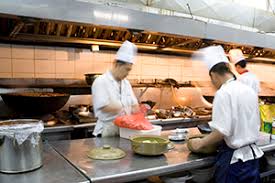
Every year in this country, more than a thousand people are killed at work; a million people suffer injuries; 10 million working days are lost annually because of industrial injury and disease. As catering is one of the largest employers of labor, the industry is seriously concerned with health and safety of workers.
Overview of Health and Safety Regulations
Due to the importance of maintaining good health and ensuring safety of family members and workers, law-making bodies in every country make laws affecting this issue. In 1974, the Health and Safety at Work Act of Parliament was passed.
Nigeria’s National Assembly has also passed a number of bills affecting health, safety of people in their homes and safety of Nigerians travelling by road, sea and air.
Health and Safety Responsibilities at Work
Such law made on health and safety may impose a general duty on an employer to ensure so far as is reasonably practicable, the health, safety and welfare at work of all his employees. The law may be extended to impose a duty on every employee while at work to:
- Take reasonable care for the health and safety of himself/herself and of other persons who may be affected by his acts or omissions at work.
- Co-operate with his employer so far as is necessary to meet or comply with any requirements concerning health and safety.
- Avoid interference with, or misuse of anything provided in the interest of health and safety.
It can be clearly seen that both health and safety at work is everybody’s concern and responsibility. Furthermore, the Law or Act protects the members of the public who may be affected by activities of those at work.
Penalties are provided by the Act which includes, prohibition notices and criminal prosecution. Health and Safety Inspectors are usually mobilized to enforce the law and the Health and Safety Commission issues codes of conduct and acts as regulator.
1. Employer Responsibilities for Workplace Safety
The responsibilities of the employer towards maintaining good health and safety of employees at work include:
- Providing and maintaining premises and equipment that are safe and without risk to health.
- Providing supervision, information and training.
- Issuing a written statement of Safety Policy to employees which may include, general policy with respect to health and safety at work; the organization to ensure the policy is carried out; and how the policy will be made effective.
- Consulting with the employees’ safety representative and establishing Safety Committee.
2. Employee Responsibilities for Safety Compliance
Employees, on the other hand, are subject to the following responsibilities:
- To take reasonable care to avoid injury to themselves or to others by their work activities.
- To co-operate with their employer and others so as to comply with the law.
- To refrain from misusing or interfering with anything provided for health and safety.
Enforcement of Health and Safety Regulations
Health and safety inspectors and local authority inspectors (environmental health officers) have the authority to enforce the requirements of the Act. Specifically, they are empowered to:
- Issue a prohibition notice which immediately prevents further business until remedial action has been taken.
- Issue an improvement notice whereby action must be taken within a stated time, to an employee, employer or supplier.
- Prosecute any person breaking the Act. This can be instead of or in addition to serving a Notice and may lead to a substantial fine or imprisonment.
- Seize, render harmless or destroy anything that the inspector considers to be the cause of imminent danger.
Read Also: The Possible Market Outlet for Table Fishes
Maintaining Hygiene and Safety in Kitchen Premises
1. Ventilation Systems
Adequate ventilation must be provided so that fumes from stoves are taken out of the kitchen, and stale air in the stores and still-room is extracted. This is usually effected by erecting hoods over stoves and using extractor fans.
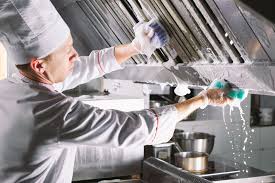
Hoods and fans must be kept clean; grease and dirt are drawn up by the fan and, if they accumulate, can drop on to food. Windows used for ventilation should be screened to prevent entry of dust, insects and birds. Good ventilation facilitates the evaporation of sweat from the body, which keeps one cool.
2. Lighting Requirements
Good lighting is necessary so that people working in the kitchen do not strain their eyes. Natural lighting is preferable to artificial lighting. Good lighting is also necessary to enable staff to see into corners so that the kitchen can be properly cleaned.
3. Plumbing and Water Supply
Adequate supplies of hot and cold water must be available for keeping the kitchen clean, cleaning equipment and for staff use. For certain cleaning hot water is essential, and the means of heating water must be capable of meeting the requirements of the establishment.
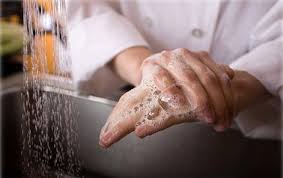
There must be hand washing and drying facilities and suitable provision of toilets, which must not be close to any room in which food is prepared. Hand-washing facilities (separate from food preparation sinks) must also be available in the kitchen with a suitable means of drying the hands.
4. Cleaning Protocols for Toilets and Sinks
Toilets must never be cleaned by food-handlers. Sinks and hand basins should be cleaned and thoroughly rinsed.
5. Floor Specifications
Kitchen floors have to withstand a considerable amount of wear and tear, therefore they must be: Capable of being easily cleaned; smooth, but not slippery; even; without cracks or open joints, and impervious (i.e. non-absorbent).
Quarry tile floors, properly laid, are suitable for kitchens, since they fulfill the above requirements. Cleaning – Floors are swept, washed with hot detergent water and then dried. This can be done by machine or by hand, and should be carried out at least once a day.
6. Wall Maintenance
Walls should be strong, smooth, impervious, washable and light in colour. The joint between the wall and floor should be rounded for ease of cleaning. Tiling is the best wall surface because it is easily cleaned and requires no further maintenance. Cleaning – clean with hot detergent water and dry. This will probably be done monthly, but frequency will depend on circumstances.
7. Ceiling Standards
Ceilings must be free from cracks and flaking. They should not be able to harbor dirt.
8. Doors and Windows
Doors and windows should fit correctly and be clean. The glass should be clean inside and out so as to admit maximum light.
9. Food Lift Hygiene
Lifts should be kept very clean and no particles of food should be allowed to accumulate as lift shafts are ideal places for rats, mice and insects to gain access into kitchens.
Read Also: Importance and Method of Sorting Catfishes
Hygiene Standards for Kitchen Equipment
Neglect in the care and cleaning of any part of the premises and equipment could lead to a risk of food infection. Kitchen hygiene is of great importance to those who work in the kitchen because clean working conditions provide for good health than dirty environment.
Kitchen hygiene is also very important to the owners of the business because patronage will surely increase when the public observes that the kitchen and dining areas are always spick and span. And to the customers too, no one would like to eat food prepared in a dirty environment.
Failure to maintain equipment and utensils hygienically and in good repair may cause food poisoning. Materials used in the construction of equipment must be hard so that it does not absorb food materials.
It must be smooth so that it can be easily cleaned. It must be resistant to dust and chipping. Equipment must not be made from toxic materials, for example lead, or allowed to wear excessively, for example copper pans that need retinning on the inside so exposing harmful copper to food.
Food must be protected from lubricants. Easily cleaned equipment is free from unnecessary ridges, screws, ornamentation, dents, crevices, inside square corners, and has large smooth areas.
Articles of equipment which are difficult to clean for example mincers, sieves and strainers are items where particles of food can lodge so allowing germs to multiply and contaminate food when the utensil is next used.
1. Cleaning Protocols for Kitchen Materials
i. Metals: As a rule all metal equipment should be cleaned immediately after use. Portable items: Remove food particles and grease. Wash by immersion in hot detergent water. Thoroughly clean with a hard bristle brush or soak till this is possible. Rinse in water by immersing in the water in wire racks.
Fixed items: Remove all food and grease with a stiff brush or soak with a wet cloth, using hot detergent water. Clean thoroughly with hot detergent water. Rinse with clean water. Dry with a clean cloth. Abrasives should only be used in moderation as constant scratching of the surface makes it more difficult to clean the article next time.
ii. Marble: Scrub with a bristle brush and hot water and then dry.
iii. Wood: Scrub with a bristle brush and hot detergent water, rinse and dry.
iv. Plastic: Wash in reasonably hot water.
v. China, earthenware: Avoid extremes of heat and do not clean with an abrasive. Wash in hot water and rinse in very hot water.
vi. Copper: Remove as much food as possible. Soak and wash in hot detergent water with the aid of brush. Clean the outside with a paste made of sand, vinegar and flour. Wash well, rinse and dry.
vii. Aluminium: Do not wash in water containing soda as the protective film which prevents corrosion may be damaged. To clean, remove food particles. Soak, wash in hot detergent water. Clean with steel wool or abrasive. Rinse and dry.
viii. Stainless steel: Stainless steel is easy to clean. Soak in hot detergent water. Clean with a brush. Rinse and dry.
ix. Tin: Tin which is used to line pots and pans should be soaked, washed in detergent water, rinsed and dried. Tinned utensils where thin sheet steel has a thin coating of tin must be thoroughly dried; otherwise they are likely to rust.
x. Zinc: This is used to coat storage bins of galvanized iron and it should not be cleaned with a harsh abrasive.
2. Cleaning Procedures for Large Electrical Equipment
For safe and effective cleaning, switch off the machine and remove the electric plug. Remove particles of food with a cloth, needle or brush as appropriate. Thoroughly clean all removable and fixed parts with hot detergent water. Pay particular attention to threads and plates with holes on mincers.
Rinse all the parts thoroughly, dry them and reassemble. While cleaning, see that exposed blades are not left uncovered or unguarded and that the guards are replaced when cleaning is completed. Any specific maker’s instructions should be observed. Carry out a test at the end to make sure that the machine is properly assembled by plugging in and switching on.