


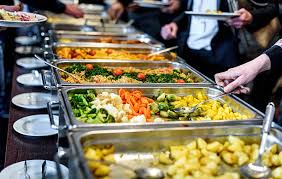
Throughout the world’s cultural and social evolution, several references have been made to the breaking of bread together. Feasts or banquets are one way to show one’s hospitality.
Every now and then, hosts attempted to outdo one another with the extravagance of their feasts. Preparing, supplying, and making food and beverages available to guests at these gatherings of family, friends, acquaintances, colleagues, etc., is what catering is all about.
Catering includes a variety of occasions when people may eat at varying times. For example, catering departments in big hotels may service different events in just one day, such as private luncheons, a wedding or two, a fashion show, a dinner party, etc.
Each of these events requires different and special treatment. Regardless of the kind of special treatment to be meted out to these different events, the guiding principle should always be to implement and maintain a very high level of sanitary conditions at the catering premises, before, during, and after the preparation and service of food to individuals.
Catering may be subdivided into on-premise and off-premise catering. In off-premise catering, the event is carried away from the hotel or the designated catering premises.
The food may be prepared either at the event or the catering premises, hotel, or restaurant. As mentioned earlier, it does not matter who is being catered for or where the catering is done; the key issue here is the implementation of healthy catering services.
Read Also: The Origin of Cultivated Crops
The Role of the Catering Manager in Ensuring Sanitation

To ensure food safety, management has the responsibility and duty of demonstrating knowledge of foodborne disease prevention by developing and implementing healthy catering services. The management’s primary responsibility is to provide safe food to consumers at all times.
There is the need for management to develop policies and procedures on sanitation to be undertaken by the employees. It entails translating policy intentions into practical actions in catering service.
The employees should be involved in giving their reactions to the policies and procedures in the business; this enhances cooperation and the development of a productive organizational climate.
This style of management is referred to as management by objectives. When implemented properly, a philosophy of management by objectives should take care of situations where there is a discrepancy between what employees want relative to clarity, commitment, and standards and what they feel they get.
For a successful implementation of healthy catering practices, the onus lies on the management to carry the staff along and communicate clearly to them policy decisions concerning:
- Personal hygiene of food handlers
- Safety and accident prevention at the catering premises
- Basic rules to be observed when receiving, storing, preparing, cooking, and serving food
- Special rules for dining room waiters/waitresses
- Special rules for bartenders and bar waiters
- Protective display of food, etc.
All of these healthy practices have been discussed in detail in the previous articles (refer to Article 1, Module 1).
Following policy decisions, greater effort should be put into the implementation process, which involves:
- Consideration of training needs
- Development of effective communication
- Establishment of mechanisms for feedback
For these procedures to be effective, the following methods must be adopted:
- Analysis of steps involved in policy formulation
- Identification of ways in which catering staff can be involved in the process
- Promotion of policy through specific training
- Assessment of the monitoring of policy effectiveness
On the other hand, implementation depends on the clarity of these decisions and commitment on the part of the employees.
Commitment indicates how strongly employees feel about achieving the goals of the business, to what extent they accept these goals, see them as realistic, get involved in setting them, and have their performance evaluated against them.
Standards indicate the emphasis that management puts on high quality of performance, and improvement in performance is a result of pressure exerted on the employees by the management.
Read Also: How to Make Money as a Poultry Farmer
Developing Effective Healthy Catering Practices

Since the manager in a food service operation is responsible for serving food that is safe to eat, he or she is also responsible for instructing the staff in safe food handling procedures.
A good manager conducts ongoing inspections to maintain the standards of sanitation required for the production of safe food and monitors the personal hygiene of all people involved in the handling of food. Written regulations, for example, food safety regulations and food hygiene regulations, are available and must by law be followed.
State and local inspections are conducted by appropriate agencies, and these agencies have the power to impose fines and enforce compliance. For example, NAFDAC does not force people to comply; it will simply give orders for the immediate closure of the catering outfit.
Management can build effective employee hygiene habits by addressing such topics as grooming, hair restraints, clean clothes, clean aprons, and overall health. Sometimes, addressing these topics may be uncomfortable for managers, but what has to be done has to be done for the success of the business.
However, the following techniques may help managers talk to their employees about hygiene:
- Have employees wash their hands thoroughly, apply an appropriate chemical, and shine a black (ultraviolet) light that shows how many germs remain.
- Always train a group of workers using light-hearted role-playing illustrations that engage everyone in a specific training program, such as ServSafe’s essentials training class for hourly employees. This group context can be used to address such hard issues as hair and body odor.
- Employees who continually show poor hygiene should be counseled one-on-one.
According to ServSafe Essentials, managers must restrict food handlers from working with or around food if they show signs of fever, diarrhea, vomiting, sore throat, or jaundice.
All wounds, sores, cuts, and skin infections should be well covered with a clean and dry bandage when the food handler is working with or around food.
Employees are to wash their hands after using the restroom, before and after handling raw food, touching parts of their bodies, coughing or sneezing, taking out trash, clearing tables and dirty dishes, handling chemicals that may affect the safety of food, touching dirty work surfaces, etc.
The cleaning and sanitation standards and methods that cover all needs of the restaurant should be developed and provided to employees. For example, in the cleaning of tables, chairs, and booths, the standard should be that tables, booths, and chairs should be free of grease, food particles, soil, and dust buildup. All table decorations and condiments should be clean and free of dust, grease, and food.
The method to be adopted in cleaning is to remove all dirty dishes and clean tables with sanitized towels, checking underneath the tables for chewing gum and removing it.
Where tablecloths are used, they should be replaced with clean ones that are free of wrinkles and stains. Tables, booths, and chairs should be thoroughly cleaned every week with clean water and a towel.
Cleaning and maintenance should be done on a weekly basis rather than a daily basis. Management and kitchen staff should compile a list of items with basic cleaning directions, known as the weekly cleaning and maintenance schedule, and decide the day each task should be completed.
To make sure the tasks are completed, they should be assigned in one of the following ways:
- Every cook must complete the item on the weekly cleaning and maintenance schedule assigned to his/her shift before clocking out.
- Each shift should have the manager or kitchen shift leader personally assign responsibilities, etc.
(Students should be able to develop their own healthy catering services when starting their catering businesses).
Overcoming Constraints to Policy Implementation
In every organization, it is one thing to make rules and regulations, but a different matter to get individuals to comply or abide by these rules and regulations.
However, rules and regulations that border on healthy habits, which are meant for the good of everyone, should not pose a problem for those the rules are meant for. Achieving effective policy implementation requires that:
- The staff or employees should be duly informed about policy intentions (adoption of healthy catering practices for the good of all, both for the health of consumers and for the positive image of the business), thereby securing their cooperation in implementation.
- The timescale should be planned, and actions for implementation should be defined (refer to the previous section on cleaning and maintenance, where the task to be carried out is defined and the time the task is expected to be completed is also stated).
- The policy should be promoted by selling it to the public, and this can be done by providing handwashing facilities with hot and cold running water and permanently installed detergent or soap dispensers and single-use towels within the dining areas, with legible signs posted, directing customers to wash their hands when they come into the restaurant to eat.
- There should be awareness and adequate preparation for the introduction of the policy.
Strategies for Avoiding Difficulties in Policy Implementation
To avoid difficulties in policy implementation, it is necessary to:
1. Define Success Through Goal and Target Setting: Policy statements on food and health should give explicit support for staff implementing the policy by clearly defining overall goals and targets. It may be appropriate to provide a separate document for caterers that gives specific information on expected changes in catering practices.
2. Develop Skills for Success: Relevant in-service and pre-service training for caterers should be recognized. Providing caterers with the skills needed for implementation is essential for successful implementation.
3. Communicate and Involve: Food and health policies must be communicated effectively to all staff. Involvement of staff in the process of policy formulation and implementation is critical for success. It should also be communicated to the public via the customers who patronize the restaurant or food service operation so that they become involved in taking care of their health.
4. Strive for Consistency in Application: Food and health policies should apply to all foods, whether fast foods, full-service, self-service, etc.
5. Review and Modify: The implementation of policy guidelines needs to be carefully planned and regularly reviewed for policies to have a real impact. Target setting and review procedures should be established at the outset so that problems can be swiftly identified and obstacles to progress can be removed.
Do you have any questions, suggestions, or contributions? If so, please feel free to use the comment box below to share your thoughts. We also encourage you to kindly share this information with others who might benefit from it. Since we can’t reach everyone at once, we truly appreciate your help in spreading the word. Thank you so much for your support and for sharing!