


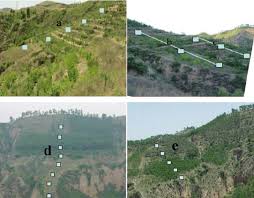
The most appropriate approach to matching land uses with land types in agriculture is to assign land uses that offer the most protection to hazardous or erosion-prone areas, while assigning less protective uses to stable, less hazardous areas.
Agricultural land varies in its ability to support different uses due to differences in environmental conditions, stability, and resistance to erosion.
Two essential systems help guide these decisions: land suitability classification, which evaluates how appropriate land is for different uses, and land capability classification, which assesses its capacity to resist degradation under varying management practices.
Read Also: Causes of Diseases in Farm Animals and How to Prevent Disease OutBreak
Land Capability Classification and Its Agricultural Relevance

Land capability classification allows for ranking natural land units based on their potential erosion hazards. When this is combined with the distribution and characteristics of different soils in an area, it becomes possible to identify specific land units with distinct management needs.
Within each of these distinct units, a consistent management approach can be used to achieve relatively uniform crop yields.
However, in adjacent units with different land characteristics, alternative management practices may be required to achieve similar results. Land uses vary in how well they protect or degrade soil and water resources.
Simply grouping agricultural practices under broad categories such as “annual crops,” “pastures,” or “forests” is not sufficient.
The actual impact of a land use depends on the management practices involved, particularly how much low-level vegetation cover they provide and how they influence soil structure.
For instance, poorly managed pasture on steep slopes with compacted soil and sparse vegetation may be more damaging than well-managed annual crops that use minimum tillage and maintain good ground cover and soil structure on the same terrain.
Read Also: Cutworms: How to Identify and Get Rid of Cutworms
Land Use for Perennial Crops in Agriculture

Perennial crops like citrus, coconut, or apple trees offer limited direct protection to the soil underneath. These trees may be spaced too widely to form a continuous canopy, and their high leaf placement allows raindrops to gain speed before hitting the soil, which increases erosion risk.
Soil protection in well-managed plantations comes not from the trees themselves, but from low-growing grasses, legumes, or mulching materials covering the ground between trees.
Uniform management applied to areas that are actually mosaics of differing land characteristics may suit part of the land but be unsuitable for other parts.
This can lead to reduced yields and higher degradation risks in poorly matched sections, ultimately resulting in inefficient input use and potential land damage.
Land Use Matched with Land Type for Sustainable Agriculture
In many agricultural settings, land use may be poorly aligned with the actual land type. An example is the cultivation of annual crops on steep slopes that are generally considered non-arable, especially in regions with highly erosive rainfall. Due to political or social constraints, shifting land use from crops to forests may not always be practical.
However, better alignment between land use and land type can still be achieved through improved management of existing land use. Enhancing soil fertility, both physically and chemically, can improve crop yields.
This, in turn, leads to better plant canopy coverage and more litter accumulation on the soil surface, which helps to stabilize the land and reduce erosion.
The better the compatibility between the land’s characteristics and the nature of its use, the more productive and sustainable the land remains.
Do you have any questions, suggestions, or contributions? If so, please feel free to use the comment box below to share your thoughts. We also encourage you to kindly share this information with others who might benefit from it. Since we can’t reach everyone at once, we truly appreciate your help in spreading the word. Thank you so much for your support and for sharing!