


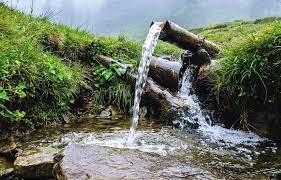
Water in rivers, lakes, oceans, and similar sources is referred to as surface water. It is naturally replenished by precipitation and naturally lost through discharge to evaporation and sub-surface seepage into groundwater.
Groundwater is water that exists in the pore spaces and fractures in rocks and sediments beneath the earth’s surface.
It originates as rainfall, then moves through the soil and rock into the groundwater system, where it eventually makes its way back to surface streams, lakes, or oceans.
Groundwater occurs in the sub-surface in two broad zones: the unsaturated zone and the saturated zone. The unsaturated zone, also known as the vadose zone, consists of soil pores that are filled to a varying degree with air and water. The zone of saturation consists of water-filled pores that are assumed to be at hydrostatic pressure.
Read Also: Poultry External Parasites and Control Measures
Surface Water and Its Role in Agricultural Water Supply
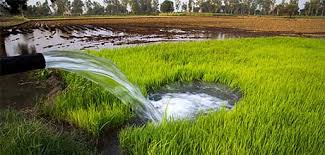
Water in rivers, lakes, oceans, and similar sources is referred to as surface water; it is naturally replenished by precipitation and naturally lost through discharge to evaporation and sub-surface seepage into groundwater.
Water beneath the land surface occurs in two principal zones, the unsaturated zone and the saturated zone.
In the unsaturated zone, the voids that is, the spaces between grains of gravel, sand, silt, clay, and cracks within rocks contain both air and water. In contrast to the unsaturated zone, the voids in the saturated zone are completely filled with water.
🌿 Go Organic on Your Farm: Instead of harmful chemical pesticides and fertilisers, try our organic farming products — including neem oil spray, bio-pesticides, natural plant treatments, organic seeds and seedlings, suckers, and many more organic products that are safe for your health, your family, your soil and your harvest. Shop Now →
Water in the saturated zone is referred to as groundwater. The upper surface of the saturated zone is referred to as the water table.
Water Bodies and Their Agricultural Significance
A water body refers to any stream, river, pond, lake, estuary, or ocean. Water bodies can be flowing (lotic) systems (streams and rivers) or non-flowing (lentic) systems (ponds and lakes).
The flow of water in these systems, particularly in rivers and streams, is greatly affected by the natural features of the watershed, including the topography, slope, soils, and vegetation.
Surface water is exposed to many different contaminants, such as animal wastes, pesticides, insecticides, industrial wastes, algae, and many other organic materials.
🔧 Free Farm Tool Available: Use our free Agric4Profits Farm Tools to calculate your farm profits, formulate feeds, identify pests and diseases on both your crops and animal farms, plan your planting and harvesting season, including many more farm tasks to get free expert advice and recommendations — completely free, no registration required. Access Free Tools →
Read Also: Worm infection among Poultry Birds: Types, Causes and Treatment
Groundwater and Its Relevance to Agricultural Use
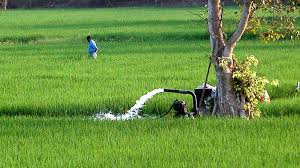
Groundwater refers to water that completely fills pore spaces within the zone of saturation beneath the Earth’s surface. All geologic materials are composed of solids (i.e., actual grains, sediment, or rock matrix) and pore space (i.e., voids).
Most groundwater comes from precipitation, which gradually percolates into the earth. Typically, 10–20% of precipitation eventually enters aquifers.
The amount of available pore space and the interconnectivity of pores govern the storage and transmission of groundwater.
Groundwater, like runoff, flows from a higher to a lower elevation; however, geologic structure and formations also control its flow.
Areas in which the pore spaces are completely filled with water are called the saturated zone. Above the saturated zone is an area in which the pore spaces are filled with air and water, called the unsaturated or vadose zone.
💬 Have a Farming Question? Join thousands of farmers across Africa on the Agric4Profits Community — ask questions, share experiences and connect with agricultural experts. It is completely free. Ask Your Question Now →
The distinction between saturated and unsaturated sub-surface zones is based on the location of the water table, which is found at the top of the saturated zone (Figure 3.1), where the pore water pressure is equal to atmospheric pressure.
Aquifers and Their Agricultural Importance
The water-bearing soil or rock that is capable of yielding usable amounts of water is called an aquifer. There are two major types of aquifers: confined and unconfined.
1. Confined Aquifers in Agricultural Water Management
Confined aquifers (also known as artesian or pressure aquifers) exist where the groundwater system is between layers of clay, dense rock, or other materials with very low permeability.
Water in confined aquifers may be very old, even millions of years old. This water is under more pressure than water in unconfined aquifers. Thus, when tapped by a well, water is forced up, sometimes above the soil surface. This is how a flowing artesian well is formed.
2. Unconfined Aquifers and Their Contribution to Crop Irrigation
More common than confined aquifers, unconfined aquifers have a permeable deposit that leads into the aquifer. Water may have arrived by percolating through the land surface.
This is why water in an unconfined aquifer is often very young in geologic time. The top layer of the aquifer is also the water table. Thus, it is affected by atmospheric pressure and changing hydrologic conditions.
Agricultural Importance of Underground Water
Groundwater contributes to the generation and regulation of stream flow in watersheds, and the sustainability of many wetlands, ponds, and lakes.
Nearly 95% of rural residents rely on groundwater for their drinking supply.
About half of irrigated cropland uses groundwater.
Approximately one-third of industrial water needs are fulfilled by using groundwater.
About 40% of river flow nationwide (on average) depends on groundwater.
📖 Want to Go Deeper on This Topic?
Our expert agricultural ebooks cover poultry, fish farming, different crops production, snail farming, organic farming, mushrooms, sheep, cattle, flowers, pig farming, goat farming, agribusiness, etc. in practical step-by-step detail — written by agricultural professionals for African farmers.
Browse All Farming Ebooks →Surface water is water collecting on the ground or in a stream, river, lake, wetland, or ocean. Groundwater is water that exists in the pore spaces and fractures in rocks and sediments beneath the earth’s surface.
Both sources are essential in agriculture, contributing to irrigation, livestock, aquaculture, and general rural livelihoods.
Do you have any questions, suggestions, or contributions? If so, please feel free to use the comment box below to share your thoughts. We also encourage you to kindly share this information with others who might benefit from it. Since we can’t reach everyone at once, we truly appreciate your help in spreading the word. Thank you so much for your support and for sharing!
🌱 Take Your Farming Further With Agric4Profits
Based on what you just read, here are free resources and products from Agric4Profits that can help your farm right now:
- 🛒 Visit Our Marketplace — Organic neem oil, bio-pesticides, seeds and farming products
- 📚 Read Premium Content — Advanced guides for serious and profitable farming
- 🎓 Join Our Free Academy — Structured free training for farmers across Africa
- 🔧 Use Our Free Farm Tools — Profit calculators, feed formulation, pest identifier and more
- 💬 Join Our Farming Community — Connect with farmers across all 54 African countries
- ❓ Ask a Farming Question — Get answers from experienced farmers and agricultural experts
Please cite this content in academic work, research, or publications.