


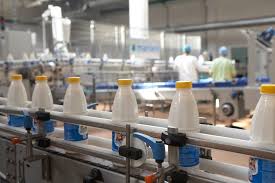
Dairy products are generally defined as foods produced from commercially domesticated cows, goats, or buffalo milk. They are usually high energy-yielding food products.
Raw milk for processing dairy products comes mainly from cows and, to a lesser extent, from other mammals such as goats, sheep, yaks, camels, or horses.
Dairy products are commonly found in European, Middle Eastern, and Indian cuisines, whereas they are almost unknown in Eastern cuisines. Dairy products have been defined as “foodstuffs” made from mammalian milk.
Most dairy products contain large amounts of saturated fat, and most are usually fermented. Examples of dairy products include cheese, kefir, yoghurt, etc.
Definition of Milk
Milk is defined as the secretion of the mammary glands of female mammals, its primary natural function being the nutrition of the young.
As defined by the Milk Ordinance and Code recommended by the US Public Health Service, milk is the lacteal secretion, practically free from colostrum, obtained by complete milking of one or more healthy cows, and contains not less than 8.25% milk-solids-non-fat and not less than 3.25% butterfat.
Milk is a complete food for the young calf and can also provide good nutrition to humans. It contains virtually all nutrients, most in significant quantities. However, it is poor in iron, and the vitamin C content is not high. It contains no anti-nutritional factors but lacks dietary fibre.
Milk of some animals, especially cows, buffaloes, goats, and sheep, is also used for human consumption, either as such or in the form of a range of dairy products. Dairy products such as fermented milk products (yoghurt), butter, cheese, cream, and ice cream are discussed below.
Read Also: 9 Ways to Fatten Up your Pigs the Right Way
Processing Technology for Ice Cream
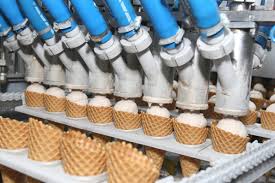
1. Overview of Ice Cream
Ice cream is a sweetened frozen food typically eaten as a snack or dessert. It is usually made from dairy products such as milk and cream and often combined with fruits or other ingredients and flavours.
It is typically sweetened with sucrose, corn syrup, cane sugar, beet sugar, and/or other sweeteners. Typically, flavourings and colourings are added in addition to stabilizers.
The mixture is stirred to incorporate air spaces and cooled below the freezing point of water to prevent detectable ice crystals from forming.
The result is a smooth, semi-solid foam that is solid at very low temperatures (<35°F or 2°C). It becomes malleable as its temperature increases.
Ice cream must contain at least 10% milkfat and at least 20% total milk solids and may contain safe and suitable sweeteners, emulsifiers, stabilizers, and flavouring materials. Ice cream is sold as hard ice cream or soft serve.
After the freezing process, only a portion of the water is actually in a frozen state. Soft ice cream is served directly from the freezer, where only a small amount of the water has been frozen.
Hard ice cream is packaged from the freezer and then goes through a hardening process that freezes more of the water in the mix.
2. Steps in Ice Cream Manufacture
The basic steps in the manufacturing of ice cream are generally as follows:
i. Blending and Pasteurization
1. Blending: Ingredients are selected based on the desired formulation, and the recipe is calculated from the formulation and ingredients chosen. Then, the ingredients are weighed and blended together to produce what is known as the “ice cream mix”.
Blending requires rapid agitation to incorporate powders, and often high-speed blenders are used. The milkfat source, nonfat solids, stabilizers, and emulsifiers are blended to ensure complete mixing of liquid and dry ingredients.
2. Pasteurization: The mix is then pasteurized. Pasteurization is the biological control point in the system, designed for the destruction of pathogenic bacteria. The product is heated in the vat to at least 69°C (155°F) and held for 30 minutes to satisfy legal requirements for pasteurization, necessary for the destruction of pathogenic bacteria. Various time-temperature combinations can be used.
ii. Homogenization and Ageing
a. Homogenization: The mix is also homogenized, which forms the fat emulsion by breaking down or reducing the size of the fat globules found in milk or cream. Homogenization provides the following functions in ice cream manufacture:
- Reduces the size of fat globules
- Increases surface area
- Forms a membrane
- Makes possible the use of butter, frozen cream, etc.
By helping to form the fat structure, it also has the following indirect effects:
- Makes a smoother ice cream
- Gives a greater apparent richness and palatability
- Improves air stability
- Increases resistance to melting
b. Ageing of Mix: The mix is then aged for at least four hours and usually overnight. This allows time for the fat to cool down and crystallize and for the proteins and polysaccharides to fully hydrate. Ageing provides the following functions:
- Improves whipping qualities of the mix and body and texture of ice cream by:
- Providing time for fat crystallization, allowing partial coalescence
- Allowing time for full protein and stabilizer hydration, resulting in a slight viscosity increase
- Allowing time for membrane rearrangement and protein-emulsifier interaction, as emulsifiers displace proteins from the fat globule surface, enabling a reduction in stabilization of fat globules and enhanced partial coalescence
Ageing is performed in insulated or refrigerated storage tanks, silos, etc. Mix temperature should be maintained as low as possible without freezing, at or below 5°C.
An ageing time of overnight is likely to give the best results under average plant conditions. A “green” or unaged mix is usually quickly detected at the freezer.
iii. Freezing/Whipping and Hardening
1. Freezing/Whipping of Ice Cream: After mix processing, the mix is drawn into a flavour tank where any liquid flavours, fruit purees, or colours are added. The mix then enters the dynamic freezing process, which both freezes a portion of the water and whips air into the frozen mix.
2. Hardening: After particulates have been added, the ice cream is packaged and placed into a blast freezer at -30°C to -40°C, where most of the remaining water is frozen. Below about -25°C, ice cream is stable for indefinite periods without danger of ice crystal growth; however, above this temperature, ice crystal growth is possible, and the rate of crystal growth depends on the storage temperature. This limits the shelf life of ice cream.
Processing Technology for Butter

1. Overview of Butter
Butter is a water-in-oil emulsion typically consisting of at least 80% fat, 15–17% water, and 0.5–1% carbohydrate and protein. The two principal types of butter produced are sweet cream butter and ripened cream butter. An outline process for butter manufacture is shown below:
Raw milk
↓
Warmed, separated cream blended/standardized to desired fat content
↓
Cream Pasteurization
↓
Sweet cream butter or Ripened cream butter
↓
Cooling and ageing
↓
Churning
↓
Salting and working
↓
Packaging
“`
i. Pasteurization and Cooling
The cream used for butter production is generally pasteurized after separation, and heat treatments of 85–95°C for 15–30 seconds are commonly used. After the heat treatment, the cream should be cooled rapidly to 10–11°C and then held for at least 4 hours.
This allows the completely liquefied butterfat to crystallize into large numbers of small crystals. This process, known as ageing, allows a stable matrix of fat crystals to develop, which is important for the physical properties of the final product.
ii. Ripening for Ripened Cream Butter and Churning
a. Ripened Cream Butter: Ripened cream butter has traditionally been made by inoculating the pasteurized cream with pure or mixed strains of lactic acid bacteria (LAB), then maintaining the temperature at 19–21°C until the required level of acidity is reached (usually 4–6 hours).
The starter cultures consist of a mixture of acid producers (Lactococcus lactis subsp. lactis and Lactococcus lactis subsp. cremoris) and diacetyl-producing species (Leuconostoc mesenteroides subsp. cremoris and Lactococcus lactis biovar diacetylactis).
Cooling the soured butter to 3–5°C stops fermentation, and the butter is then aged. The purpose of ripening is to sour the cream and crystallize the fat. Without solid fat, churning is impossible, and too little solid fat results in excessive fat loss in the buttermilk.
b. Churning: Churning involves agitation of the cream at low temperature, which produces fat granules that separate from the aqueous phase of the cream to leave buttermilk. The buttermilk is drained off, doubling the fat content of the cream.
Most microorganisms present in the cream are retained in the aqueous phase and are removed in the buttermilk. In traditional processes, butter granules are then washed to remove off-flavours.
iii. Salting, Working, and Packaging
a. Salting and Working: If butter is to be salted, salt is added to give a concentration of about 2% in the butter. The butter is then worked mechanically to disperse the salt and water and to obtain the correct physical structure.
b. Packaging: Butter may be packaged either in bulk or in retail-size containers. Parchment wrappers are the traditional packaging material, but plastic tubs and laminated foil packs are also common.
2. Properties of Butter
Butter must contain at least 80% milkfat. Water and milk solids make up the other 20%. Salt and colouring may be added if desired. Some unsalted butter is sold as sweet butter, but most people prefer the salted product.
Butter also naturally contains vitamins A and D. The colour of butter varies with the content of carotenoids, which make up from 11 to 50% of the total vitamin A activity of milk. Butter should be dense and taste fresh.
The water content should be dispersed in fine droplets so that the butter looks dry. The consistency should be smooth, so the butter is easy to spread and melts readily in the mouth. Sour cream butter should smell of diacetyl, while sweet butter should taste of cream.
Butter made from sour cream has certain advantages over the sweet cream variety. The aroma is richer, the butter yield is higher, and there is less risk of reinfection after temperature treatment as the bacterial culture suppresses undesirable microorganisms.
Do you have any questions, suggestions, or contributions? If so, please feel free to use the comment box below to share your thoughts. We also encourage you to kindly share this information with others who might benefit from it. Since we can’t reach everyone at once, we truly appreciate your help in spreading the word. Thank you so much for your support and for sharing!