


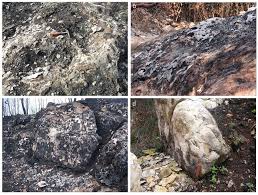
As one drives, rides in a car, takes a train or plane, rides a bike, or goes for a nature walk, spectacular and varied landscapes on Earth’s surface come into view.
As Earth’s crust is built up by volcanic and tectonic forces (thrusting and deformation of Earth’s crust), weathering forces simultaneously reduce landforms and release minerals from rocks.
Natural weathering processes occur daily, continually rearranging and building landforms on Earth’s surface, impacting soil formation critical for agriculture.
Read Also: Cold Weather Poultry Diseases and How to Manage them
Understanding Weathering Processes for Agricultural Soils
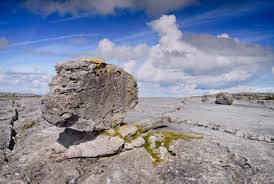
Weathering is the process of breaking down rocks. There are two distinct types of weathering: physical weathering and chemical weathering. In physical weathering, rocks break down, but their composition remains unchanged.
In chemical weathering, rocks break down, and their composition may change. For instance, a hard material may transform into a softer material after chemical weathering, influencing soil characteristics for farming.
Chemical Weathering Processes Affecting Soil Fertility
Chemical weathering occurs as minerals in rocks are chemically altered, subsequently decomposing and decaying. Increased precipitation (rain) accelerates the chemical weathering of minerals in rocks, as observed on tombstones and monuments made of limestone and marble.
Water is an essential factor in chemical weathering. Rising temperatures also speed up the chemical reactions that cause minerals to degrade. This explains why humid, tropical climates exhibit highly weathered landforms, soils, and buildings, impacting agricultural productivity.
1. Carbonation and Solution in Agricultural Soils
This weathering process occurs when precipitation (H₂O) combines with carbon dioxide (CO₂) to form carbonic acid (H₂CO₃). When carbonic acid contacts rocks containing lime, soda, and potash, the minerals calcium, magnesium, and potassium chemically transform into carbonates and dissolve in rainwater.
Karst topography, originally named after the Krs Plateau in Yugoslavia where it was first studied, results from this type of chemical weathering, characterized by sinkholes, caves, and caverns, which can affect agricultural land use.
2. Hydrolysis and Its Impact on Soil Formation
This chemical weathering process occurs when water (H₂O), usually as precipitation, disrupts the chemical composition and size of a mineral, creating less stable minerals and, thus, less stable rocks that weather more readily, influencing soil structure for crop growth.
Read Also: Layers or Broilers which One is More Profitable in Poultry Farming? Find Out!
3. Hydration Processes in Soil Development
Water (H₂O) combines with compounds in rocks, causing a chemical change in a mineral’s structure, though it is more likely to physically alter a mineral’s grain surface and edges. An example is the mineral Anhydrite (CaSO₄), which chemically changes to Gypsum (CaSO₄·2H₂O) when water is added. Gypsum is used in the construction industry to build buildings and houses and can improve soil structure in agriculture.
4. Oxidation and Its Effects on Agricultural Soils
This process occurs when oxygen combines with compound elements in rocks to form oxides. When an object is chemically altered in this manner, it weakens and appears “oxidized.”
A common example is a rusting signpost, where the iron in the metal post oxidizes. Increased temperatures and precipitation accelerate the oxidation process, affecting soil mineral availability for plants.
5. Spheroidal Weathering in Agricultural Landscapes
Water penetrates through cracks in rocks, dissolves the cement that binds particles together, and erodes sharp edges and corners, making a rock appear spheroidal. Physical weathering processes, such as frost wedging, can then act upon the enlarged cracks in rocks, influencing soil texture for farming.
6. Physical Weathering Processes Shaping Agricultural Soils
Rocks that are broken and degrade by processes other than chemical alteration are physically or mechanically weathered. A rock broken into smaller pieces exposes more surface area, increasing its weathering potential and contributing to soil formation for agriculture.
7. Role of Animals and Plants in Soil Weathering
Animals burrow into Earth’s substrate, moving rock fragments and sediment, thereby aiding in the disintegration of rocks and rock fragments. Fungi and lichens, acid-producing microorganisms that live on rocks, dissolve nutrients (phosphorus, calcium) within rocks. These microorganisms assist in the breakdown and weathering of rocks, enhancing soil fertility.
8. Crystallization in Arid Agricultural Soils
As water evaporates moisture from rocks in arid climates, mineral salts develop from mineral crystals. The crystals grow, spreading apart mineral grains and eventually breaking apart rocks, affecting soil structure in dryland farming.
9. Temperature Variation and Its Impact on Soil
Minerals in rocks expand and contract in climates with extreme temperature ranges, such as glacial regions or during forest fires. Crystal structures of minerals become stressed during contraction and expansion, causing mineral crystals to separate. Repeated cycles of freezing and thawing (known as Freeze-Thaw) of water in rock cracks widen cracks and split rocks apart, contributing to soil formation in agricultural regions.
10. Unloading and Exfoliation in Soil Formation
Cracks in rocks appear when pressure is released as overlying rocks or sediment are removed, allowing the expansion of the newly exposed rock. Exfoliation occurs as sheets or slabs of the cracked rock slip off and become further eroded.
Domes form as unloading and exfoliation weathering processes continue. Half Dome at Yosemite National Park, California, is a result of unloading (pressure-release jointing) and exfoliation, shaping landscapes relevant to agriculture.
Saprolite and Erosion in Agricultural Contexts
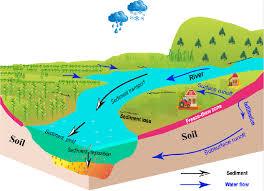
A rock that is weathered into new minerals but still resembles the parent rock is called a saprolite. If saprolite fragments are subsequently removed by water, wind, gravity, or ice, erosion has taken place, influencing soil distribution and agricultural land management.
Do you have any questions, suggestions, or contributions? If so, please feel free to use the comment box below to share your thoughts. We also encourage you to kindly share this information with others who might benefit from it. Since we can’t reach everyone at once, we truly appreciate your help in spreading the word. Thank you so much for your support and for sharing!