



Public Group
Active 1 year, 3 months ago
Group Type By Special Interest Group
Group Leadership
- Group Administrators
-

African Youths in Agribusiness Community
How Do Youth Start Farming With Little Capital?
- This topic is empty.
- AuthorPosts
- May 20, 2026 at 11:54 am #757822
 Agric4ProfitsModerator
Starting a farming business is often seen as expensive, especially for young people who may not have access to land, equipment, or large financial support. Many youths are interested in agriculture because of the growing demand for food, rising unemployment, and the opportunities farming creates for income generation and self-employment. However, lack of capital remains one of the biggest challenges preventing many young people from entering agriculture successfully.
The good news is that farming does not always require huge investments at the beginning. Many successful farmers today started with very small resources and gradually expanded over time. With proper planning, smart decision-making, and a willingness to learn, young people can begin farming on a small scale and grow steadily into profitable agricultural businesses.
Modern agriculture also provides more opportunities than traditional farming alone. Youths can engage in crop farming, livestock production, vegetable gardening, fish farming, poultry, agribusiness services, food processing, or even digital agriculture. Some of these areas require very little startup capital and can generate income quickly when managed properly.
One important factor for young farmers is starting small and avoiding unnecessary expenses. Instead of focusing on large farms immediately, beginners can start with manageable projects that match their available resources. This reduces financial risk while allowing them to gain experience and build confidence gradually.
Access to knowledge is also very important. Many youths succeed in farming because they take time to learn production techniques, market trends, and business management skills. Free information from experienced farmers, agricultural extension officers, online platforms, and training programs can help young farmers avoid costly mistakes.
Another advantage young people have is their ability to adopt modern technology and innovative farming methods more easily. Digital marketing, mobile applications, social media promotion, and climate-smart farming techniques can help improve productivity and profitability even with limited resources.
In this article, we explore practical ways youths can start farming with little capital, the strategies that help reduce costs, and how young farmers can build sustainable agricultural businesses step by step.
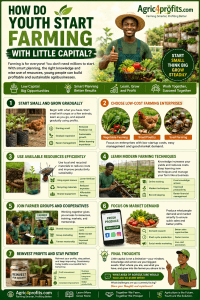
1. Start Small and Grow Gradually
One of the most important lessons for young farmers is to start small instead of trying to invest heavily at the beginning. Many beginners fail because they attempt large projects without enough experience or financial stability.
Starting with a small piece of land or a few animals allows youths to learn farming practices gradually while minimizing risk. For example, a young person can begin with vegetable production in sacks, backyard poultry, or small fish ponds before expanding operations later.
Small-scale farming also makes management easier. Young farmers can monitor crops and livestock more closely, identify problems early, and improve production skills without becoming overwhelmed by high costs.
As profits begin to grow, the business can gradually expand using reinvested income rather than depending entirely on loans or outside funding. This approach builds financial discipline and reduces the pressure associated with large startup investments.
Many successful agribusinesses today started as small projects that expanded steadily through proper management and patience.
Small-Scale Strategy Benefit Starting small Reduced financial risk Gradual expansion Sustainable growth Easier management Better learning experience 2. Choose Low-Cost Farming Enterprises
Some farming activities require far less capital than others. Youths with limited resources should focus on agricultural enterprises that have low startup costs but good market demand.
Vegetable farming is one of the easiest areas to start because it requires little land and produces income relatively quickly. Crops such as spinach, tomatoes, peppers, and okra can be grown in small spaces and sold locally.
Poultry farming on a small scale is another popular option. A few chickens can generate income through egg or meat production without requiring large investments. Snail farming, mushroom production, rabbit farming, and beekeeping are also low-capital enterprises that many youths are exploring successfully.
Urban farming techniques such as container gardening and vertical farming can also reduce land and setup costs. These methods are especially useful for youths living in cities or areas with limited farmland.
Choosing the right enterprise helps reduce financial pressure while creating opportunities for steady income generation.
Low-Cost Enterprise Advantage Vegetable farming Quick income Small poultry Affordable startup Snail farming Low maintenance 3. Use Available Resources Efficiently
Young farmers can reduce production costs significantly by making use of locally available resources instead of purchasing everything new. Many farming materials can be improvised or sourced at little cost.
Organic manure from livestock farms can replace expensive fertilizers. Recycled containers can be used for seedling production or urban gardening. Crop residues and kitchen waste can also be converted into compost for improving soil fertility naturally.
Family land, borrowed plots, or community farming spaces may provide temporary farming locations without the high cost of purchasing land immediately. Sharing equipment with other farmers can also reduce expenses.
Efficient resource use is important because it allows young farmers to maximize productivity even with limited capital. It also encourages innovation and sustainable farming practices.
Resource Strategy Benefit Using organic manure Lower fertilizer cost Recycling materials Reduced expenses Shared equipment Affordable farming 4. Learn Modern Farming Techniques
Knowledge is one of the most valuable assets for young farmers. Even with little money, youths who understand good farming practices often achieve better results than poorly informed farmers with larger budgets.
Modern farming methods such as drip irrigation, mulching, greenhouse gardening, and integrated pest management can improve productivity while reducing costs. Climate-smart agriculture also helps farmers adapt to changing weather conditions and use resources more efficiently.
Many free learning opportunities are available through agricultural extension services, YouTube videos, social media platforms, online courses, and local training programs. Youths who actively seek information and improve their skills are more likely to succeed in farming.
Good record keeping and basic business management are also important. Understanding expenses, profits, and market demand helps farmers make better decisions and avoid unnecessary losses.
Learning Method Benefit Online training Free knowledge access Modern techniques Improved productivity Record keeping Better financial management 5. Join Farmer Groups and Cooperatives
Farmer groups and cooperatives can provide major support for youths entering agriculture. Joining a group allows young farmers to access shared resources, training opportunities, and market connections that may be difficult to obtain individually.
Cooperatives often help members purchase inputs such as seeds and fertilizers at lower prices through bulk buying. They may also provide access to credit facilities, grants, or government support programs.
Networking with experienced farmers is another important advantage. Young people can learn practical skills, receive mentorship, and gain advice that helps them avoid common mistakes.
Farmer groups also improve market access because products can be sold collectively in larger quantities, attracting better buyers and prices.
Cooperative Benefit Impact Shared resources Lower production costs Group marketing Better market access Farmer mentorship Improved learning 6. Focus on Market Demand
Many young farmers fail because they produce crops or livestock without understanding market demand. Starting with little capital means every investment must be planned carefully to avoid losses.
Before beginning production, youths should research which products are in high demand locally. Producing what people already buy regularly increases the chances of making profit quickly.
Farmers should also consider crops or livestock with shorter production cycles so they can recover their investment faster. Vegetables, eggs, mushrooms, and broiler chickens are examples of enterprises that generate income relatively quickly.
Marketing through social media and direct sales can also help young farmers attract customers without spending heavily on advertising.
Market Strategy Benefit Demand research better sales opportunities Short-cycle production Faster income Social media marketing Low-cost promotion 7. Reinvest Profits and Stay Patient
One of the biggest mistakes young farmers make is spending profits too quickly instead of reinvesting them into the business. Sustainable growth often depends on gradually expanding production using profits from earlier harvests or sales.
Reinvesting income into better seeds, improved housing, irrigation systems, or additional livestock helps the business grow steadily over time. Patience is important because farming success rarely happens instantly.
Young farmers should also expect challenges such as pests, diseases, market fluctuations, or weather problems. Learning from these experiences and improving gradually is part of building a successful farming business.
Consistency, discipline, and proper planning are often more important than starting with large amounts of money.
Growth Strategy Result Profit reinvestment Business expansion Patience Long-term success Consistent improvement Better productivity Youths can successfully start farming even with little capital when they focus on smart planning, low-cost enterprises, continuous learning, and gradual growth. Agriculture offers many opportunities for income generation, food production, and long-term business development.
Starting small, using available resources wisely, and understanding market demand can help young farmers build profitable and sustainable farming systems over time.
If you are a young person interested in farming, what area of agriculture would you like to start with, and what challenges are you currently facing? Share your thoughts and experiences.
Read Also: Industrial waste and their impact on the environment
- AuthorPosts


- You must be logged in to reply to this topic.