



Public Group
Active 1 year, 3 months ago
Group Type By Special Interest Group
Group Leadership
- Group Administrators
-

Agri-Business Startups Network
How to Manage Farm Operating Expenses
- This topic is empty.
- AuthorPosts
- August 3, 2026 at 2:53 pm #799613
 Agric4ProfitsModerator
Effective operating expense management directly determines farm profitability, since even strong production and sales performance can be undermined by poorly controlled costs that quietly erode margins throughout the production cycle.
Many farmers focus primarily on increasing revenue through better yields or pricing while giving less systematic attention to the expense side of the profitability equation, missing significant opportunities for improved financial performance through better cost management.
This article covers practical strategies for managing farm operating expenses effectively, from tracking and categorizing costs to identifying specific opportunities for cost reduction without compromising production quality or long term farm sustainability.
Whether you are looking to improve overall farm profitability or simply want better visibility into where your money is actually going, these expense management strategies will help you build a more financially disciplined and profitable operation.
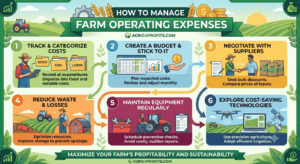
1. Track All Expenses Systematically
Recording all farm expenses, even seemingly minor ones, in a consistent system provides the foundational visibility needed to understand true operating costs rather than relying on general impressions that often significantly understate actual expense levels.
Categorizing expenses by type, such as inputs, labor, equipment, and transport, allows for more detailed analysis of where money is actually being spent and which categories might offer the greatest opportunities for cost management attention.
2. Identify Your Largest Cost Categories
Analyzing your expense records to identify which categories represent the largest portion of total operating costs helps focus cost management attention where it can have the greatest overall financial impact, rather than spreading effort evenly across all expense types regardless of their actual significance.
For most farming operations, feed, fertilizer, and labor represent significant cost categories worth particular scrutiny, though the specific breakdown varies by farm type and should be verified against your actual expense data rather than assumed.
Common Major Farm Expense Categories
Category Typical Significance Cost Management Approach Feed or crop inputs Often largest single category Bulk purchasing, local sourcing, efficiency Labor Significant, especially hired labor Efficient scheduling, task optimization Equipment and maintenance Variable, can be significant Preventive maintenance, appropriate scale Transport and logistics Often underestimated Route optimization, shared transport 3. Negotiate Better Terms With Suppliers
Building relationships with input suppliers and negotiating for better pricing, particularly for larger or repeat purchases, can meaningfully reduce costs without requiring any change to your actual production practices or quality standards.
Comparing prices across multiple suppliers periodically, rather than defaulting to habitual purchasing from a single source, ensures you continue receiving competitive pricing as market conditions and supplier offerings change over time.
4. Improve Efficiency to Reduce Waste-Related Costs
Reducing waste across inputs, whether feed spillage, fertilizer over-application, or post-harvest losses, directly reduces effective costs per unit of production without requiring any reduction in actual production output or quality.
Regular review of efficiency metrics, such as feed conversion ratios or input use per unit of yield, helps identify waste related cost opportunities that might otherwise go unnoticed within overall expense tracking.
Expense Reduction Strategies
Strategy Cost Impact Mechanism Implementation Effort Supplier negotiation Direct price reduction Low to moderate Waste reduction Lower effective cost per unit Moderate, requires monitoring Bulk purchasing timing Lower per-unit input costs Moderate, requires planning and storage Preventive equipment maintenance Avoids costly breakdowns and repairs Low to moderate, ongoing 5. Time Purchases Strategically
Purchasing inputs during periods of lower pricing, such as immediately after harvest for grain based feed inputs, rather than buying reactively when supplies happen to run low, can meaningfully reduce input costs when storage capacity allows.
This strategic timing requires some advance planning and working capital availability, making it more accessible for farms with adequate cash flow and storage infrastructure to take advantage of these periodic pricing opportunities.
6. Review Expenses Regularly and Adjust Strategy
Regularly reviewing expense trends, ideally monthly or seasonally, helps identify emerging cost problems early and confirms whether cost management strategies are actually delivering the expected financial improvement.
Being willing to adjust your approach based on this ongoing review, rather than implementing cost management measures once and assuming they remain effective indefinitely, supports continuous improvement in overall expense management.
Frequently Asked Questions
- Why does expense management matter as much as revenue for farm profitability?
Even strong production and sales performance can be undermined by poorly controlled costs that quietly erode margins, making expense management equally important to the profitability equation.
- How can farmers identify their largest cost categories?
Analyzing expense records to identify which categories represent the largest portion of total operating costs helps focus cost management attention where it can have the greatest financial impact.
- Does negotiating with suppliers really reduce costs meaningfully?
Yes, building relationships with input suppliers and negotiating better pricing, particularly for larger or repeat purchases, can meaningfully reduce costs without changing production practices.
- How does waste reduction affect farm operating costs?
Reducing waste across inputs directly reduces effective costs per unit of production without requiring any reduction in actual production output or quality.
- Is timing input purchases strategically worth the effort?
Yes, purchasing during periods of lower pricing rather than buying reactively can meaningfully reduce costs, though it requires advance planning and adequate storage capacity.
- How often should farm expenses be reviewed?
Regular review, ideally monthly or seasonally, helps identify emerging cost problems early and confirms whether cost management strategies are delivering expected financial improvement.
- What are commonly the largest expense categories on farms?
Feed or crop inputs, labor, and equipment maintenance typically represent significant cost categories, though the specific breakdown varies by farm type and should be verified against actual data.
- Should farmers always purchase from the same supplier for consistency?
Comparing prices across multiple suppliers periodically, rather than defaulting to habitual purchasing, ensures continued competitive pricing as market conditions and offerings change.
- Can preventive equipment maintenance reduce overall costs?
Yes, preventive maintenance helps avoid costly breakdowns and repairs, representing a lower effort, ongoing strategy for managing equipment related expenses.
- Does expense categorization actually help with cost management?
Yes, categorizing expenses by type allows for more detailed analysis of where money is being spent and which categories offer the greatest opportunities for cost management attention.
Managing farm operating expenses effectively requires systematic tracking, identifying your largest cost categories, and applying targeted strategies like supplier negotiation and waste reduction. This disciplined approach to the expense side of profitability complements revenue focused efforts for stronger overall farm financial performance. What expense management strategies have improved profitability on your farm? Share your experience with the Agric4Profits farming community.
Read Also: Efficiency-and-maintenance-of-waste-water-treatment-units
- AuthorPosts

- You must be logged in to reply to this topic.