


Public Group
Active 1 year, 3 months ago
Group Type By Topic
Group Leadership
- Group Administrators
-

Agricultural Marketing Community
How to Negotiate Better Prices at Markets
- This topic is empty.
- AuthorPosts
- July 30, 2026 at 1:25 pm #794837
 Agric4ProfitsModerator
Price negotiation skills directly affect farm income, yet many farmers accept whatever initial offer buyers present, leaving meaningful money on the table that could have been captured through more confident, informed negotiation approaches.
Effective negotiation is not about aggressive haggling but rather understanding your product’s genuine value, knowing market conditions, and communicating confidently, all skills that can be developed and improved with practice and preparation.
This article covers practical negotiation strategies specifically suited to agricultural market selling, from preparation before market day to specific techniques for handling common negotiation situations farmers encounter.
Whether you sell at local markets, to wholesale buyers, or through other negotiated sales arrangements, these strategies will help you capture more of the value your produce genuinely represents rather than consistently accepting the first offer presented.
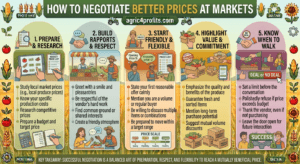
1. Know Your True Costs and Minimum Acceptable Price
Entering any negotiation with clear knowledge of your actual production costs and the minimum price you can accept while remaining profitable provides essential confidence and prevents accepting prices that ultimately result in a loss despite feeling like a completed sale.
This cost knowledge also helps you recognize genuinely good offers when they arise, since without this baseline understanding, farmers sometimes reject reasonable prices out of uncertainty or, conversely, accept inadequate prices without realizing the shortfall.
2. Research Current Market Conditions Before Negotiating
Understanding current market prices for your specific product and quality grade, gathered from multiple sources before arriving at a negotiation, provides important context that strengthens your negotiating position compared to relying purely on buyer provided information.
Being aware of factors currently affecting market conditions, such as seasonal supply patterns or recent weather events affecting regional production, helps you anticipate and respond effectively to arguments buyers might present for lower pricing.
Negotiation Preparation Checklist
Preparation Item Purpose Timing True cost calculation Establishes minimum acceptable price Before market day Current market price research Provides negotiation context Before market day Quality assessment of your product Supports value-based arguments Before market day Alternative buyer options Provides negotiation leverage Ongoing relationship building 3. Highlight Your Product’s Specific Value
Being prepared to specifically articulate what distinguishes your produce, whether superior quality, particular growing methods, or exceptional freshness, provides concrete justification for pricing above generic commodity rates that buyers might initially propose.
Rather than simply stating a price and hoping the buyer accepts, explaining the reasoning behind your pricing, grounded in specific value points, tends to result in more successful negotiation outcomes than price statements alone.
4. Maintain Confident, Professional Communication
Approaching negotiation with calm confidence, rather than appearing desperate to sell or apologetic about your pricing, significantly affects how buyers respond, since perceived desperation often invites more aggressive price pushing from buyers.
Being willing to politely decline an inadequate offer and communicate this clearly, rather than accepting out of social pressure or fear of losing the sale entirely, demonstrates the confidence that often leads to improved offers rather than lost sales.
Effective Negotiation Techniques
Technique When to Use Expected Outcome Stating price with clear reasoning Initial price presentation Establishes credible baseline Politely declining low offers When offer is below minimum acceptable Signals firmness, may improve offer Highlighting specific value points When buyer questions pricing Justifies premium over generic rates Referencing alternative buyer options When appropriate and true Demonstrates you have other options Read Also: mulch-management-to-suppress-weeds-and-pests
5. Build Relationships That Support Better Long-Term Pricing
Developing ongoing relationships with reliable buyers, built on consistent quality delivery and professional dealing over time, often leads to better pricing than one time transactional negotiations with unfamiliar buyers each market visit.
Buyers who trust your reliability and quality consistency are often willing to offer better pricing to maintain that reliable supply relationship, recognizing the value of a dependable seller relationship beyond just the immediate transaction.
6. Learn From Each Negotiation Experience
Reflecting on what worked and what did not in previous negotiations, including which value points resonated with specific buyers and what pricing ultimately proved acceptable, builds practical negotiation skill and confidence over successive market experiences.
Tracking actual prices achieved over time also provides valuable data for future cost and pricing planning, helping you understand realistic pricing expectations based on genuine market experience rather than assumption alone.
Frequently Asked Questions
- Why is knowing your true costs important for market negotiation?
Clear knowledge of production costs and minimum acceptable price provides essential confidence and prevents accepting prices that ultimately result in a loss despite feeling like a completed sale.
- How can farmers research market conditions before negotiating?
Gathering current market prices from multiple sources before arriving at a negotiation provides important context that strengthens negotiating position compared to relying purely on buyer information.
- Does simply stating a price work as well as explaining the reasoning behind it?
Explaining the reasoning behind pricing, grounded in specific value points, tends to result in more successful negotiation outcomes than price statements without supporting justification.
- Should farmers accept low offers to avoid losing a sale entirely?
Being willing to politely decline an inadequate offer, rather than accepting out of social pressure, often demonstrates the confidence that leads to improved offers rather than lost sales.
- How does confident communication affect negotiation outcomes?
Approaching negotiation with calm confidence, rather than appearing desperate, significantly affects buyer response, since perceived desperation often invites more aggressive price pushing.
- Can ongoing buyer relationships lead to better pricing than one time negotiations?
Yes, buyers who trust your reliability and quality consistency are often willing to offer better pricing to maintain that reliable supply relationship over time.
- What value points can farmers use to justify pricing above generic rates?
Superior quality, particular growing methods, or exceptional freshness all provide concrete justification for pricing above generic commodity rates that buyers might initially propose.
- How can farmers improve their negotiation skills over time?
Reflecting on what worked and what did not in previous negotiations builds practical skill and confidence, while tracking actual prices achieved provides valuable data for future planning.
- Is it helpful to have alternative buyer options during negotiation?
Yes, referencing genuine alternative buyer options, when appropriate and true, demonstrates that you have other options and can strengthen your negotiating position.
- Does negotiation require aggressive haggling to be effective?
No, effective negotiation is about understanding your product’s genuine value, knowing market conditions, and communicating confidently, not aggressive haggling.
Effective price negotiation combines thorough preparation, confident communication, and genuine value articulation to help farmers capture more of the value their produce represents. These skills develop and improve with practice, making each negotiation experience valuable for building future confidence. What negotiation strategies have helped you achieve better prices at markets? Share your experience with the Agric4Profits farming community.
Read Also: How-to-convert organic waste composting into compost for gardening and agriculture
- AuthorPosts


- You must be logged in to reply to this topic.