



Public Group
Active 1 year, 3 months ago
Group Leadership
- Group Administrators
-

Central African Republic Farmers Community
Climate-Smart Agriculture in Central African Republic
- This topic is empty.
- AuthorPosts
- August 12, 2026 at 9:36 am #827407
 Agric4ProfitsModerator
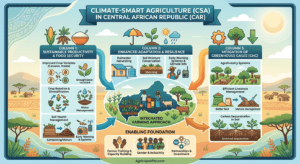
Climate-smart agriculture refers to farming practices that help farmers adapt to changing and increasingly unpredictable weather patterns while also protecting or improving productivity over time. In Central African Republic, where farmers already contend with variable rainfall onset, occasional drought stress, and the general uncertainty that comes with heavy reliance on rainfed farming, climate-smart approaches offer practical ways to build resilience without requiring major new resources.
Rather than a single technique, climate-smart agriculture is best understood as a set of complementary practices that together reduce a farm’s vulnerability to weather shocks: diversifying crops so that a single bad season for one crop does not devastate the entire farm, building soil organic matter that helps land retain moisture during dry spells, and using available weather information, however basic, to guide planting decisions rather than relying purely on traditional calendar dates that may no longer align reliably with actual rainfall patterns.
This guide covers the practical climate-smart techniques most relevant to smallholder farmers in Central African Republic, from crop diversification and variety selection through water conservation, soil health, and the integration of trees into farming systems, along with guidance on applying these approaches within the realistic constraints most households face.
1. Diversifying Crops to Spread Risk
Planting a mix of crops with different water needs, growing cycles, and market values reduces a household’s exposure to any single weather event or market shock. If rains fail early, a drought tolerant crop like sorghum or cassava may still produce a reasonable harvest even as a more water demanding crop struggles.
Diversification also spreads labor demand across the season and provides multiple potential income sources, reducing the financial risk that comes with dependence on a single crop’s market price and yield outcome in any given year.
2. Selecting Climate Resilient Varieties
Where available, crop varieties bred or locally adapted for drought tolerance, heat tolerance, or shorter growing cycles offer a direct way to reduce climate related risk. Shorter cycle varieties in particular reduce exposure to the possibility of rains ending earlier than expected before the crop reaches maturity.
Farmers should also pay attention to which local varieties have historically performed well during difficult seasons in their specific area, since this practical, locally observed knowledge often identifies resilience traits that are not always captured in formal variety descriptions.
3. Water Harvesting and Moisture Conservation
Techniques that capture and retain rainfall within the field, such as tied ridging, planting basins, and contour farming on sloped land, help buffer crops against short dry spells within the growing season, which have become an increasingly common feature of variable rainfall patterns.
Mulching and reduced tillage further support moisture conservation by protecting the soil surface from excessive evaporation and maintaining the soil structure needed for good water infiltration and retention during and between rain events.
4. Building Soil Organic Matter
Soils rich in organic matter, built through compost application, crop rotation with legumes, and residue retention, hold significantly more water than depleted soils, providing a buffer against short dry periods that would otherwise stress crops more severely on poorer soil.
This connection between soil health and climate resilience means that many of the natural soil fertility practices already valuable for yield also serve a direct climate adaptation function, making them a particularly efficient investment of farmer time and effort.
Read Also: Best Crops for Tropical Climate in Central African Republic
5. Using Available Weather Information
Where accessible, seasonal forecasts and rainfall information from national meteorological services, agricultural extension offices, or mobile based advisory services can help farmers make more informed decisions about planting timing rather than relying purely on traditional calendar dates that may no longer align consistently with actual rainfall onset.
Even simple, informal weather tracking, noting rainfall patterns and timing from season to season, helps farmers build their own localized understanding of how conditions are shifting over time in their specific area.
6. Integrating Trees into Farming Systems
Agroforestry, incorporating trees and shrubs into farming systems alongside crops, provides multiple climate resilience benefits: trees help moderate local microclimate, reduce wind and water erosion, and, in the case of nitrogen fixing species, contribute to soil fertility while also providing additional products like fruit, fodder, or fuelwood.
Even modest tree planting along field boundaries or interspersed at low density within cropping areas can meaningfully improve a farm’s resilience over the years it takes trees to mature, making this a longer term but valuable component of a climate-smart farming strategy.
Conventional vs Climate-Smart Farming Approaches
Factor Conventional Approach Climate-Smart Approach Crop choice Single dominant crop Diversified mix of crops with different needs Variety selection Traditional seed regardless of conditions Drought/heat tolerant, shorter cycle varieties Water management Reliant purely on rainfall Water harvesting and moisture conservation Soil management Minimal organic matter building Active compost and residue based fertility building Planting decisions Fixed calendar dates Informed by available weather information Frequently Asked Questions
1. What does climate-smart agriculture mean in practice?
It refers to a set of complementary farming practices, like crop diversification, resilient varieties, and water conservation, that together help farmers adapt to variable and changing weather patterns.
2. How does crop diversification help farmers manage climate risk?
Growing a mix of crops with different water needs and growing cycles reduces the chance that a single weather event or market shock will devastate an entire farm’s income and food supply.
3. Why are shorter cycle crop varieties valuable for climate adaptation?
Shorter cycle varieties reduce the risk of crop failure from rains ending earlier than expected, since the crop reaches maturity before the growing window closes.
4. How does soil organic matter help with climate resilience?
Soils rich in organic matter hold more water than depleted soils, providing a buffer that helps crops withstand short dry spells better than they would on poorer soil.
5. What is agroforestry and how does it support climate-smart farming?
Agroforestry integrates trees and shrubs into farming systems, helping moderate microclimate, reduce erosion, and, with certain species, contribute to soil fertility while providing additional farm products.
Climate-smart agriculture is less about adopting entirely new farming systems and more about layering resilience building practices onto the farming approaches Central African Republic farmers already know, diversifying crops, strengthening soil, conserving water, and staying attentive to changing weather patterns. Farmers who build these habits progressively tend to weather difficult seasons with less severe losses than those relying on a single crop and fixed traditional timing alone.
Read Also: analysis-of-biodata-relating-to-water-quality-h2o
- AuthorPosts

- You must be logged in to reply to this topic.