



Public Group
Active 1 year, 3 months ago
Group Leadership
- Group Administrators
-

Chad Farmers Community
Irrigation Farming Systems in Chad
- This topic is empty.
- AuthorPosts
- August 28, 2026 at 1:31 pm #838904
 Agric4ProfitsModerator
Irrigation farming can play an important role in agricultural production in Chad, particularly where rainfall is seasonal, irregular or insufficient for year-round crop production. By supplying crops with water when natural rainfall is inadequate, irrigation can allow farmers to extend growing seasons, produce crops during dry periods and potentially increase agricultural productivity.
Irrigation is particularly valuable for farmers producing vegetables and other crops that require reliable water supplies. However, installing an irrigation system does not automatically guarantee higher profits. Farmers must consider water availability, soil type, crop requirements, equipment costs, energy requirements and maintenance.
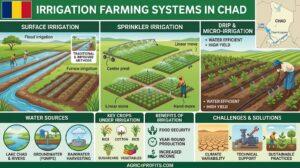
Different irrigation systems distribute water in different ways. Surface irrigation allows water to flow across the soil, sprinkler systems apply water above the crop, while drip irrigation delivers water more directly to the root zone.
The most suitable system depends on the farm’s physical conditions and financial resources.
For farmers in Chad, successful irrigation farming requires more than simply obtaining a pump or digging a water source. It requires proper planning, efficient water use, regular maintenance and careful crop management.
1. Understanding Irrigation Farming in Chad
Irrigation farming involves supplying crops with water through artificial means when rainfall alone is insufficient.
It can complement rainfall rather than completely replacing it.
Irrigation can provide farmers with greater control over crop water availability and may allow production during periods when rain-fed farming is difficult.
Potential benefits include:
- Extending the growing season
- Supporting dry-season farming
- Improving crop establishment
- Increasing production reliability
- Supporting vegetable production
- Reducing dependence on unpredictable rainfall
- Creating opportunities for multiple cropping
However, irrigation also creates additional expenses and management responsibilities.
The following table summarizes the main benefits and considerations.
Benefit Consideration Reliable water supply Requires dependable water source Dry-season production Increases water-management needs Higher production potential May increase input costs Multiple cropping Requires careful soil and nutrient management Vegetable production Requires frequent irrigation Reduced rainfall dependence Requires equipment and maintenance Farmers should therefore assess the economics of irrigation before investing.
2. Choosing a Suitable Water Source
The success of an irrigation farm depends heavily on the availability of a reliable water source.
Potential sources can include surface water and groundwater, depending on local conditions and legal access.
Before developing an irrigation system, farmers should determine whether the available water is sufficient in both quantity and quality.
Important questions include:
- How much water is available?
- Does the source remain available during the dry season?
- Is the water suitable for the intended crops?
- How far must water be transported?
- What pumping equipment is required?
- What is the cost of obtaining the water?
- Are there restrictions on water use?
Water quality should not be ignored. Salinity or contamination can affect crop production and soil health.
Where significant investment is planned, farmers should obtain appropriate technical advice and, where necessary, have water quality assessed.
Read Also: Organic Farming in Chad
3. Types of Irrigation Systems for Farmers in Chad
There is no single irrigation system suitable for every farm.
The major systems include surface irrigation, sprinkler irrigation and drip irrigation.
Surface irrigation distributes water across the field or through channels. It can have relatively simple infrastructure but may result in uneven water distribution or losses if poorly designed.
Sprinkler irrigation distributes water through pipes and sprinklers. It can provide more controlled application but generally requires equipment and pressure.
Drip irrigation delivers water through emitters close to plant roots. It can be highly efficient when properly designed and maintained, although the initial investment and maintenance requirements may be higher than for simple surface systems.
The following table provides a comparison.
Irrigation system Main advantage Main consideration Surface irrigation Relatively simple in suitable locations Can have water losses and uneven distribution Sprinkler Can distribute water more uniformly Requires pressure and equipment Drip Delivers water close to roots Requires careful maintenance Manual watering Low initial equipment requirements Labour intensive Pump-based irrigation Can provide reliable water delivery Requires energy and maintenance Farmers should select a system based on their actual needs rather than choosing the most technologically advanced option automatically.
4. Selecting Crops for Irrigated Farming
Crop selection is an important part of irrigation planning.
Not every crop provides the same economic return from irrigated production.
Farmers should consider:
- Water requirements
- Growing period
- Local climate
- Soil conditions
- Market demand
- Expected selling price
- Labour requirements
- Availability of seeds
- Storage and transportation
Vegetables can be attractive for irrigated farming because they may have relatively short production cycles and can be harvested when market supply is limited.
Depending on local conditions, farmers may consider crops such as onions, tomatoes, peppers, leafy vegetables and other suitable horticultural crops.
However, crop selection should be based on local agronomic suitability and market research.
A profitable irrigation system should produce crops that farmers can sell at prices sufficient to cover water and production costs.
5. Designing and Installing an Irrigation System
Proper system design is essential.
Farmers should determine the amount of water required by their crops and how that water will be transported from the source to the field.
Important components can include:
- Water source
- Pump where required
- Pipes
- Main lines
- Valves
- Filters where appropriate
- Storage tanks where needed
- Distribution lines
- Emitters or sprinklers depending on the system
A poorly designed system can waste water and energy.
For example, pipes that are too small can restrict water flow, while poorly positioned outlets can create uneven irrigation.
Farmers should also consider future maintenance when choosing equipment.
The following table highlights some key components.
Component Function Water source Provides irrigation water Pump Moves water where pumping is required Pipes Transport water Valves Control water flow Filters Help remove particles where required Storage tank Stores water where appropriate Emitters Deliver water in drip systems Sprinklers Distribute water in sprinkler systems Where possible, farmers should work with qualified irrigation technicians when designing larger systems.
6. Irrigation Scheduling and Efficient Water Management
Applying water at the wrong time can waste resources and reduce crop performance.
Irrigation should be based on crop requirements, soil conditions, weather and the development stage of the plants.
Farmers should avoid simply irrigating according to a fixed schedule without observing field conditions.
Factors affecting irrigation requirements include:
- Crop type
- Crop growth stage
- Soil type
- Temperature
- Wind
- Rainfall
- Irrigation method
- Water-holding capacity of the soil
Mulching can help reduce evaporation and improve the efficiency of irrigation.
Farmers should also regularly inspect their systems for leaks, blocked outlets and damaged pipes.
The following table summarizes several water-saving practices.
Practice Potential benefit Irrigate according to crop needs Reduces unnecessary watering Mulching Reduces evaporation Repair leaks Prevents water loss Maintain pipes Improves distribution Use suitable irrigation technology Can improve efficiency Monitor soil moisture Helps determine irrigation needs Irrigate during appropriate periods Can reduce evaporation losses Efficient irrigation is particularly important where water supplies are limited.
7. Soil Fertility and Irrigated Crop Production
Irrigation can increase crop production, but higher production can also increase nutrient removal from the soil.
Farmers should therefore manage soil fertility alongside water.
Useful practices include:
- Crop rotation
- Compost application
- Properly managed animal manure
- Soil testing
- Appropriate fertilizer use
- Mulching
- Maintaining soil organic matter
Repeated irrigation can also create soil-management challenges in some environments, particularly where drainage is poor or irrigation water contains significant salts.
Farmers should monitor soil conditions and avoid excessive irrigation.
The relationship between water and nutrients is important: supplying more water does not compensate for inadequate nutrition, and applying more fertilizer does not compensate for poor water management.
Successful irrigation farming requires both to be managed together.
8. Maintenance, Energy Costs and Common Irrigation Problems
Irrigation systems require regular maintenance.
Pumps, pipes, filters, valves, sprinklers and drip lines can deteriorate or become blocked.
Farmers should inspect equipment regularly rather than waiting for a complete system failure.
Common problems include:
- Blocked emitters
- Damaged pipes
- Pump failure
- Water leakage
- Uneven water distribution
- Excessive energy consumption
- Poor drainage
- Sediment accumulation
Energy costs can also significantly affect profitability where irrigation depends on fuel-powered or electric pumps.
Farmers should therefore include energy costs in their business calculations.
Solar-powered pumping may be an option in some locations, but the initial investment, system sizing, maintenance and water-storage requirements should be carefully evaluated before installation.
9. Economics and Profitability of Irrigation Farming
Irrigation farming can increase production opportunities, but farmers need to determine whether the additional income will justify the additional costs.
The major costs can include:
Cost category Examples Water infrastructure Wells, pumps, tanks and other infrastructure Irrigation equipment Pipes, valves, sprinklers or drip lines Energy Fuel or electricity Seeds Crop planting materials Fertilizer Nutrient inputs Labour Land preparation, irrigation and harvesting Pest management Crop-protection expenses Transport Moving inputs and produce Maintenance Repair and replacement of equipment The basic profitability formula is:
Net Profit = Total Revenue − Total Production Costs
Farmers should calculate expected revenue before installing the system.
For example, if irrigation allows a farmer to produce during a period when market prices are higher, the additional revenue may help justify the investment.
However, market prices can change. Farmers should therefore avoid basing an investment decision on unusually high prices from only one season.
10. How to Start an Irrigation Farm in Chad
Farmers can follow a systematic approach when establishing an irrigation operation.
Step 1: Assess the land. Determine soil characteristics, drainage and suitability for the intended crops.
Step 2: Identify the water source. Confirm that sufficient water is available throughout the production period.
Step 3: Assess water quality. Determine whether the water is appropriate for agricultural use.
Step 4: Research the market. Identify crops with reliable demand and suitable selling opportunities.
Step 5: Choose the irrigation system. Compare surface, sprinkler, drip and other suitable options.
Step 6: Calculate the investment. Include water infrastructure, pumps, pipes, energy, labour and maintenance.
Step 7: Install the system. Ensure water can be distributed efficiently throughout the cultivated area.
Step 8: Prepare the soil. Incorporate appropriate soil-fertility practices.
Step 9: Plant suitable crops. Select crops according to local conditions and market demand.
Step 10: Establish an irrigation schedule. Apply water according to crop and soil requirements.
Step 11: Monitor the farm. Check crops, soil moisture, water use and equipment regularly.
Step 12: Maintain the system. Repair leaks, clean equipment and address blockages promptly.
Step 13: Harvest and market efficiently. Reduce post-harvest losses and sell through appropriate channels.
Step 14: Review profitability. Calculate total revenue and costs before expanding.
Irrigation Farming Quick Reference Table
The following table summarizes the major factors farmers should consider when establishing an irrigated farming operation.
Area Key consideration Water source Must be sufficiently reliable Water quality Should be suitable for intended crops Soil Must support the chosen crops and irrigation system Irrigation method Choose according to farm conditions and budget Crops Select based on climate, water and market demand Equipment Match system components to water requirements Energy Include fuel or electricity costs Soil fertility Maintain nutrients and organic matter Maintenance Inspect and repair equipment regularly Marketing Identify buyers before production Profitability Calculate revenue against all costs Sustainability Avoid unnecessary water use and soil degradation Frequently Asked Questions
1. What is irrigation farming?
Irrigation farming is the production of crops using artificially supplied water in addition to or instead of natural rainfall.
2. Why is irrigation important in Chad?
Irrigation can help farmers produce crops during periods when rainfall is insufficient and can provide greater control over water availability.
3. What is the best irrigation system for Chad?
There is no single best system for every farm. The appropriate system depends on water availability, soil, crops, farm size, available capital and maintenance capacity.
4. Is drip irrigation better than surface irrigation?
Drip irrigation can use water efficiently when properly designed and maintained, while surface irrigation can be simpler and less expensive in suitable conditions. The better option depends on the farm.
5. What crops can be grown using irrigation?
Many crops can be irrigated, including vegetables, cereals, legumes and other crops. The appropriate choice depends on local climate, soil, water availability and market demand.
6. How can farmers reduce irrigation costs?
Farmers can reduce costs by minimizing water losses, maintaining equipment, choosing appropriate irrigation technology, improving irrigation scheduling and managing energy use efficiently.
7. Can irrigation farming be profitable?
Yes, irrigation can create profitable opportunities when the crop has adequate market demand and the additional revenue exceeds water, energy, infrastructure and production costs.
8. Does irrigation improve soil fertility?
Irrigation primarily supplies water rather than nutrients. Soil fertility must still be managed through appropriate organic matter, crop rotation, soil testing and fertilizer practices.
Are you involved in irrigation farming in Chad, or are you considering starting an irrigated farm?
Which irrigation method do you think would work best in your area — surface irrigation, sprinkler irrigation or drip irrigation? What is the biggest challenge: water availability, equipment costs, energy, maintenance or finding a profitable market?
Share your thoughts, experiences and questions in the comments section below. Your experience could help other farmers understand the practical realities of irrigation farming in Chad and identify better ways to use water efficiently.
Read Also: locating-the-nearest-landfill-for-your-needs
- AuthorPosts

- You must be logged in to reply to this topic.