



Public Group
Active 1 year, 3 months ago
Group Leadership
- Group Administrators
-

Pest and Disease Control Community
Pest-Resistant Crop Variety Recommendations
- This topic is empty.
- AuthorPosts
- July 24, 2026 at 1:04 pm #791597
 Agric4ProfitsModerator
Selecting pest-resistant crop varieties offers farmers one of the most effective, low maintenance tools available for reducing pest damage, providing built-in genetic protection that works continuously throughout the growing season without requiring ongoing application or intervention.
While no variety offers complete immunity to all pests, resistant and tolerant varieties can significantly reduce both the severity of pest damage and the frequency of treatment needed, making them a valuable foundation for an integrated pest management approach.
This article covers guidance for understanding and selecting pest-resistant crop varieties, from recognizing what resistance actually means in practice to identifying which resistant options are available for common crops facing significant pest pressure.
Whether you are planning next season’s plantings or looking to improve pest management on an ongoing basis, understanding how to evaluate and select resistant varieties will help you build stronger, more naturally protected crops from the very start.
1. Understand What Pest Resistance Actually Means
Resistance in crop varieties can range from complete immunity to a specific pest, which is relatively rare, to more common partial resistance or tolerance that reduces damage severity without eliminating pest presence entirely.
Understanding this distinction helps farmers set realistic expectations, recognizing that resistant varieties are a valuable tool for reducing overall pest pressure and management burden rather than a complete replacement for all other pest management practices.
2. Identify Which Pests Are Most Problematic in Your Region
Variety selection should be informed by the specific pest pressures most significant in your particular growing region, since a variety resistant to one pest may offer no particular advantage against a different pest that happens to be more problematic locally.
Consulting with local agricultural extension services or experienced farmers in your area about which pests cause the most significant damage helps focus variety selection on resistance traits that will actually provide meaningful benefit for your specific conditions.
Common Pest-Resistant Traits by Crop
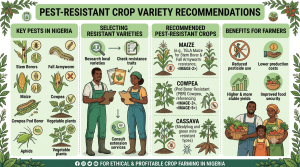
Crop Common Resistance Trait Target Pest Maize Stem borer tolerance Stem borers Beans Bean fly resistance Bean fly Tomato Nematode resistance Root knot nematodes Cassava Mosaic disease tolerance Whitefly vectored virus 3. Source Resistant Varieties From Reliable SuppliersCertified seed suppliers and agricultural research institutions typically provide the most reliable information about actual resistance performance, since resistance claims can vary in accuracy and applicability across different sources and marketing materials.
Where possible, seeking out varieties that have been tested and recommended specifically for your growing region provides more confidence in expected resistance performance than relying on general claims without local validation.
4. Combine Resistant Varieties With Other Management Practices
Even highly resistant varieties benefit from being combined with other integrated pest management practices, including monitoring, cultural controls, and biological management, rather than being treated as a standalone solution that eliminates the need for other precautions.
This combined approach provides more comprehensive and reliable protection than resistant varieties alone, particularly important since pest populations can sometimes adapt over time to overcome specific resistance mechanisms if relied upon exclusively.
Resistant Variety Selection Considerations
Consideration Why It Matters Recommended Approach Local pest pressure Resistance must match actual threats Consult local extension services Yield and quality traits Resistance alone is not enough Balance resistance with productivity Source reliability Claims vary in accuracy Use certified, tested seed sources Complementary practices No variety offers complete protection Combine with IPM strategies Read Also: How-to-detect early signs of livestock disease
5. Balance Resistance With Other Important Traits
Pest resistance should be evaluated alongside other important variety characteristics, including yield potential, market acceptability, and adaptation to local growing conditions, since a highly resistant variety with poor yield or quality may not represent the best overall choice.
Trial planting new resistant varieties on a small scale before full farm adoption allows farmers to evaluate how a variety performs under their specific conditions before committing significant land and resources to a larger planting.
6. Monitor Resistant Variety Performance Over Time
Tracking how resistant varieties actually perform against pest pressure on your specific farm, rather than relying solely on general claims, provides valuable practical data for informing future variety selection decisions.
Staying informed about new resistant variety releases and updated performance information from agricultural research institutions helps farmers continue improving their variety selection choices as breeding programs develop new and improved options over time.
Frequently Asked Questions
- Does pest-resistant mean a variety is completely immune to pest damage?
Not necessarily. Resistance ranges from complete immunity, which is relatively rare, to more common partial resistance or tolerance that reduces damage severity without eliminating pest presence entirely.
- How should farmers choose which resistant traits matter most?
Variety selection should be informed by the specific pest pressures most significant in your particular growing region, since resistance to one pest may not help against a different local problem.
- Where can farmers get reliable information about variety resistance?
Certified seed suppliers and agricultural research institutions typically provide the most reliable resistance performance information, especially varieties tested and recommended for your specific region.
- Can resistant varieties fully replace other pest management practices?
No, even highly resistant varieties benefit from being combined with monitoring, cultural controls, and other integrated pest management practices rather than being used as a standalone solution.
- Should yield potential be considered alongside pest resistance?
Yes, pest resistance should be evaluated alongside yield potential, market acceptability, and local adaptation, since a highly resistant variety with poor yield may not be the best overall choice.
- Is it wise to fully switch to a new resistant variety immediately?
Trial planting new resistant varieties on a small scale before full adoption allows farmers to evaluate performance under their specific conditions before committing significant resources.
- Can pest populations eventually overcome resistant varieties?
Yes, pest populations can sometimes adapt over time to overcome specific resistance mechanisms, particularly if resistant varieties are relied upon exclusively without other management practices.
- How can farmers track whether a resistant variety is performing well?
Tracking actual pest damage and yield performance on your specific farm, rather than relying solely on general claims, provides valuable practical data for future variety decisions.
- Are pest-resistant varieties available for most major crops?
Many major crops have resistant or tolerant varieties available for common regional pests, though availability and specific resistance traits vary significantly by crop and growing region.
- Should farmers stay updated on new resistant variety releases?
Yes, staying informed about new releases and performance information from agricultural research institutions helps farmers continue improving their variety selection as breeding programs develop new options.
Selecting pest-resistant crop varieties provides a valuable, low maintenance foundation for pest management, though the strongest results come from combining resistant varieties with other integrated pest management practices. Careful attention to local pest pressure and variety sourcing maximizes the benefit this approach provides. What resistant varieties have worked well for you? Share your experience with the Agric4Profits farming community.
Read Also: The easiest way-to-fix garbage disposal jam
- AuthorPosts

 3. Source Resistant Varieties From Reliable Suppliers
- You must be logged in to reply to this topic.