


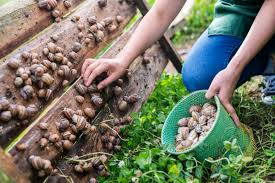
Lately, we have been discussing more about snail farming (heliculture) as a lucrative business and how you can also partake in the snail farming business by going into commercial snail farming and make huge amount of profit through there.
Now let us discuss more on the different predators that eats, destroys and affects snails and how to control them:
Predators & Defenses in a Snail Farm (Snail Business)
A variety of predators eats land snails and slugs, as they are small and slow-moving invertebrates. Abundant and nutritious prey, land snails might be considered “low” on the food chain. In response to this predation, land snails have evolved an array of sophisticated defenses.
Invertebrate predators of land snails include beetles and their larvae, millipedes, flies, mites, nematodes, and other snails. Vertebrate predators of snails and slugs include shrews, mice, squirrels, and other small mammals; salamanders, toads and turtles, including the uncommon Blandings Turtle Emydoidea blandingii; and birds, especially ground-foragers such as thrushes, grouse, blackbirds, and wild turkey.
By far the most comprehensive account of these land snail predators is found in Natural Enemies of Terrestrial Molluscs, edited by G.M. Barker (2004).
Land snail defenses against predators include cryptic coloration and texture; thickened shells and aperture barriers; defense mucus production including irritating smells and tastes; hiding behaviors, and rapid withdrawal or dislodging movements.
How predators eat land snails differs according to their size and capabilities. For shelled land snails, beetle larvae may enter the aperture of a snail’s shell, while larger beetles can crush small snails. Predatory snails can rasp a hole in a victim’s shell, then insert their head to feed. Small mammals will break a hole in the shell to pull out the snail’s body, sometimes leaving the empty shell on a rock or log. Larger predators such as wild turkey can swallow even big snails whole.
While most land snails are herbivores or detritivores, some are specialized predators themselves. The Gray-foot Lancetooth Haplotrema concavum is a large predatory land snail that attacks nematodes and other snails, and is a widespread native in Pennsylvania. This predator will insert its head into the aperture of a prey snail’s shell, or can drill a hole in the shell to gain access.
Pearce and Gaertner (1996) were able to predict which snail prey were most preferred by the lancetooth using information about how well-armed those prey were.
The Oval Ambersnail Succinea ovalis has a large aperture and thin shell, and was attacked most often, but the small Maze Pinecone Strobilops labyrinthica with its thick shell and narrow aperture, was least preferred.
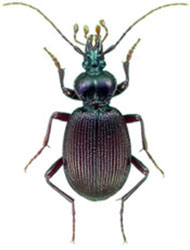
Another predator and prey relationship of note is an apparent “arms race” between land snails and Cychrine beetles (Carabidae), which feed mostly on land snails (Symondson, 2004) – while the beetles have evolved narrower heads to extract snails from their shell aperture, the snails have evolved more obstructed apertures (which would also help in defense against the lancetooth).
Cychrine beetles have an elongated head, thorax, and mouthparts that help them gain entry through the aperture of snail shells, while less-specialized beetles may simply crush snail shells when possible (e.g., Digweed, 1993). Mouthparts of the Cychrini have been described as having “hooks” or “spoons” that help extract mollusk flesh. Some snails in turn, have barriers of shell calcium, called denticles or lamellae, which partially obstruct their aperture (e.g. Solem, 1972).
The plasticity of the land snail head and foot allow their protrusion through the aperture despite the obstacles. However, these “teeth” obviously thwart the entry of beetles and other small predators having hard exoskeletons. Some snails in the slitmouth genus (Stenotrema: Polygyridae) are so well armed – with a hard round shell, covered by hair-like processes, and a slit-shaped aperture blocked by lamellae – as to appear impervious to attack.
Further research is needed to demonstrate whether barrier adaptations have evolved specifically for defense purposes. Other hypothesized functions for barriers include storing calcium for other physiological needs, trapping air if the animal becomes immersed in water (Emberton, 1995); or providing leverage “handles” on the shell so it can be moved and balanced by the animal (Suvorov 1993, 1999).
Other land snail defenses include cryptic coloration, which hides them from predators that search by sight. Few land snails in North America are brightly colored, most are brown or tan, and many have finely-textured shells that do not reflect light. For example, the tiny pinecone snails (genus Strobilops) are almost indistinguishable from the fruiting bodies of fungi on rotten logs.
Some species such as the velvet wedge Xolotrema denotata have hairlike processes on their periostracum that hold onto dust and spider webs, making an effective camouflage.

Related: Recommended Methods of Selecting Snail Breeding Stock
Another typical land snail defense mechanism is the production of mucus. Although mucus normally aids in maintaining a snail’s skin and promoting locomotion, a defensive version is exuded in large amounts when a snail is attacked.
The smothering or confusing effect of the sticky secretions can help to stop predators (e.g., Eisner and Wilson, 1970; Parkarinen, 1994). Many slugs have even more copious and stickier defense mucus, suggesting an anti-predator function compensating for the lack of a shell.
Defense mucus likely contains chemicals repellent to predators, but this is not well studied in terrestrial gastropods (this phenomenon has been established for marine snails).
Domestic dogs and cats avoid slugs, and a pet lizard fed the introduced European slug Arion subfuscus was rendered comatose for several days. Some color forms of A. subfuscus are quite orange, suggesting that they may be advertising their toxicity to would-be predators.
Defense mucus of several snails is visible under ultraviolet light, suggesting their toxicity is being advertised to insect predators that see in that portion of the light spectrum (D. Dourson, pers comm).
Some snails and slugs are attacked by ants, while others are ignored, so there may be ant-specific defense chemicals that have evolved only in some snails (Hotopp, pers obs).
For defense against much smaller attackers, land snail mucus is known for its antibacterial properties, with some constituents used to treat acne.
During periods of inactivity land snails appear to hide from potential predators. Land snails that live among rock talus or cliffs tend to remain immobile on ceilings, vertical surfaces and within cracks, rather than in locations that might be more accessible to small mammals.
In the Northeast during summer months, the land snail Neohelix albolabris is typically found singly upon woody debris and snags above ground level. For aestivation, some larger land snails move from leaf litter to sticks, logs or rocks, though in addition to predator avoidance, this behavior may also aid in retaining moisture, avoid pooling water, or other functions.
Many shelled land snails will rapidly withdraw into their shell when attacked, or sometimes when merely sensing wind or movement. For example, the land snail Webbhelix multilineata frequently drops from low vegetation when disturbed.
Large Neohelix sp. land snails kept in a terrarium will sometimes be seen rapidly twisting their shell when another snail is crawling upon it. This behavior appears to be an attempt to dislodge the attached snail.
Finally, if a land snail does survive a predator’s attack, it has impressive powers of regeneration. Damage to shells can be repaired by the snail’s shell-building mantle, although it often appears that repairs are most complete when the break is in the final “body” whorl of the shell.
Field collectors are familiar with this phenomenon, as recovered shells often show irregularities where “patches” have been made. Land snails are also able to regenerate some tissue that has been lost, including parts of the foot and tentacles (e.g., Bobkova, et al., 2004).
Frequently Asked Questions: Preventing Predators in a Snail Farm
1. What are some common predators of snails in a snail farm?
Common predators include invertebrates like beetles, millipedes, flies, mites, nematodes, and other snails, as well as vertebrates such as shrews, mice, squirrels, salamanders, toads, turtles, and birds like thrushes, grouse, blackbirds, and wild turkeys. Some snails, like the Gray-foot Lancetooth (Haplotrema concavum), are also predatory.
2. How do land snails defend themselves against predators?
Land snails use defenses such as cryptic coloration and texture to blend into their surroundings, thickened shells and aperture barriers to deter attacks, defense mucus with irritating smells or tastes, hiding behaviors, and rapid withdrawal or dislodging movements. Some snails also have calcium barriers (denticles or lamellae) to block predator entry.
3. What specific measures can be taken to protect snails from predators like lizards, rats, and snakes?
To protect snails, reinforce wire netting with mosquito nets, keep doors to pens and cages closed, and thoroughly inspect materials brought into the snailery to prevent predator entry.
4. How do predatory snails like the Gray-foot Lancetooth attack their prey?
The Gray-foot Lancetooth inserts its head into the aperture of a prey snail’s shell or drills a hole to access the snail’s body, feeding on nematodes and other snails. Prey preference depends on the prey’s shell thickness and aperture size, with snails like the Oval Ambersnail being more vulnerable due to their thin shells and large apertures.
5. What role does mucus play in snail defense against predators?
Snails produce defensive mucus in large amounts when attacked, which can smother or confuse predators. This mucus may contain repellent chemicals, and in some species, it’s visible under ultraviolet light, possibly advertising toxicity to predators like insects.
6. Why is it important to maintain hygiene in a snail farm to prevent predator attacks?
Maintaining hygiene, such as washing dried leaves in hot water before mulching, cleaning fresh leaves and vegetables, and removing leftovers daily, prevents attracting predators like ants and rodents. Good hygiene reduces the presence of insect eggs and other attractants that could harm the snail farm.
Read Also: The Different Types of Fertilizers and How they Work
Below are some of the predators that affects snail rearing and how to prevent them in your snail farming business.
They include:
Lizard, Rats, Rodents, Snake, etc:
- The wire netting should be reinforced with mosquito nets.
- The doors to the pens and cages should be shut every time.
- Materials brought to the snailery must be well inspected.
- Life span: snails can live up to 7-8 years
Related: Predators, Parasites and Diseases of Snail
Related: Basic Snail Farming Tools and Equipment’s
Related: The Different Types of Manure and How they Work
Read Also: Comprehensive Guide on How to start Cockerel Farming Business
Related: Effect of Tropical Climate on Animal Parasites, Vectors and Diseases
Read Also: Systems of Crop Production
Read Also: Brief History and Roles of Animal Production in Nigeria
Read Also: Strategies for Improving Cattle Production
Read Also: Complete List of Animals Feed Raw Materials and Their Uses
Read Also: 21 Amazing Importance of Water (H2O) to the Body
Read Also: 10 Amazing Health Benefits of Cucumber Fruit
Read Also: Recommended Equipment‘s and Tools Needed in Snail Farming Business
Read Also: Mechanism of Animal Body Defense against Stress
Read Also: 7 Amazing Health Benefits of Cherries
Read Also: 22 High Fiber Foods we have and their Contents
Read Also: 21 Amazing Nutritional and Health Benefits of Orange Juice