


Animal feedstuffs for livestock feedstuffs include forages and grain-based and coproduce feeds. Grazed forages generally make up the bulk of livestock diets in Mississippi, but stored forages and grain-based feeds are also used, particularly during winter.
Feedstuff storage, handling, and feeding characteristics affect which feedstuff is the best choice for an operation.
Animal Feedstuff Handling Considerations
Handling capabilities and producer preferences for feedstuff handling may determine whether or not a particular feedstuff is a good choice for a particular beef cattle operation.
Not all commodity feeds flow through auger systems effectively. Some feeds require special handling. For example, fuzzy whole cottonseed does not flow easily.
Whole cottonseed coated in cornstarch flows better but typically costs more. One often overlooked characteristic of feedstuffs is percent moisture. Some high-moisture feeds, such as wet distiller‘s grains and silages, are attractive on a cost per ton basis, but they have handling limitations.
High-moisture products tend to bridge up and not flow as smoothly as drier products. These products can also corrode handling systems and storage facilities. Be sure to factor in the cost of hauling large proportions of water in high-moisture feedstuffs.
🌿 Go Organic on Your Farm: Instead of harmful chemical pesticides and fertilisers, try our organic farming products — including neem oil spray, bio-pesticides, natural plant treatments, organic seeds and seedlings, suckers, and many more organic products that are safe for your health, your family, your soil and your harvest. Shop Now →
Excess moisture effectively adds to the cost of other feed nutrients, including energy and protein. The type of truck necessary for hauling a specific feedstuff depends on whether auger transport is possible and the type of storage facilities to be loaded.
Common feed delivery truck types are hopper bottom, dump, and walking floor trailer. The type of storage facility receiving delivery may prohibit or require the use of a specific delivery vehicle type. Truck auger height must be able to reach the openings in top-loading feed storage bins.
Additional equipment, such as a tractor with front-end loader bucket or portable auger system, may be needed to move feedstuffs to a storage destination. Feed delivery vehicles also vary in capacity and number of separate storage compartments on a single trailer.
Read Also: Method of Animal Feed Evaluation and its Relevance
🔧 Free Farm Tool Available: Use our free Agric4Profits Farm Tools to calculate your farm profits, formulate feeds, identify pests and diseases on both your crops and animal farms, plan your planting and harvesting season, including many more farm tasks to get free expert advice and recommendations — completely free, no registration required. Access Free Tools →
On-farm facilities impact feedstuff-handling capabilities. Feedstuff delivery vehicles must be able to navigate to and from on-farm delivery sites easily. Narrow gates, poor road surfaces, and driving obstructions can limit on-farm feed- receiving capabilities.
Animal Feedstuff Storage and Management Methods
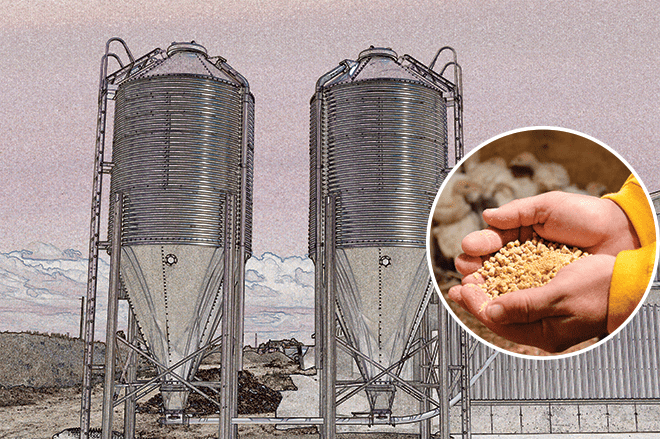
Facilities for the bulk storage and handling of feed commodities are needed when the ration is processed on site.
The required type of storage ranges from dry feed commodity storage, fermented feeds (including silage and high moisture corn), by- products, processed roughage, liquid feedstuffs (such as molasses) and liquid supplements.
The bulk storage and handling of these feed commodities depends on many factors, including the range of commodities to be stored, the storage volume, the length of time the commodity is to be stored, the processing systems, the loading systems, the capital investment and the operational and maintenance costs of the facilities and equipment.
Silage Storage and Management Methods
Roughage, or fibre, is essential in the diet of lot fed cattle to enable normal rumen activity and may be provided as silage, hay or straw.
💬 Have a Farming Question? Join thousands of farmers across Africa on the Agric4Profits Community — ask questions, share experiences and connect with agricultural experts. It is completely free. Ask Your Question Now →
Silage typically contains higher levels of ME and CP than hay and is\ considered more palatable and digestible.
The silage making process, design and management of storage are critical to ensure the highest quality product, while minimizing losses during storage and feeding.
Good quality silage, correctly harvested and stored, maintains its quality for a long time. Where the local environment or feed processing equipment is not suited to growing and/or handling silage, a feedlot may feed hay instead
Read Also: How to Make a Balanced Fish Feed Formulation for Fishes
Hay and Straw Storage and Management
Hay or straw is best fed in a chopped form when mixed with the grain and other commodities to ensure even intake of the concentrate and roughage.
In an onsite feed processing facility, the relatively high percentage of roughage in a typical ration requires significant amounts of hay (and/or silage) to be stored on site.
Proper Methods of Storage and Handling of Liquid Animal Feedstuffs
Liquid feedstuffs are used for conditioning rations, improving palatability, reducing dustiness and providing vitamin and mineral nutrients to cattle.
Many liquid by- product materials are available, along with commercial liquid supplement products that incorporate minerals, vitamins and enzymes.
When liquid feeds are used in rations that are prepared on site, these need special equipment. This includes tanks and pumps designed to handle liquids.
📖 Want to Go Deeper on This Topic?
Our expert agricultural ebooks cover poultry, fish farming, different crops production, snail farming, organic farming, mushrooms, sheep, cattle, flowers, pig farming, goat farming, agribusiness, etc. in practical step-by-step detail — written by agricultural professionals for African farmers.
Browse All Farming Ebooks →Read Also: 6 Major Ways to Grow Your Business Within a Short Time
🌱 Take Your Farming Further With Agric4Profits
Based on what you just read, here are free resources and products from Agric4Profits that can help your farm right now:
- 🛒 Visit Our Marketplace — Organic neem oil, bio-pesticides, seeds and farming products
- 📚 Read Premium Content — Advanced guides for serious and profitable farming
- 🎓 Join Our Free Academy — Structured free training for farmers across Africa
- 🔧 Use Our Free Farm Tools — Profit calculators, feed formulation, pest identifier and more
- 💬 Join Our Farming Community — Connect with farmers across all 54 African countries
- ❓ Ask a Farming Question — Get answers from experienced farmers and agricultural experts
Please cite this content in academic work, research, or publications.