


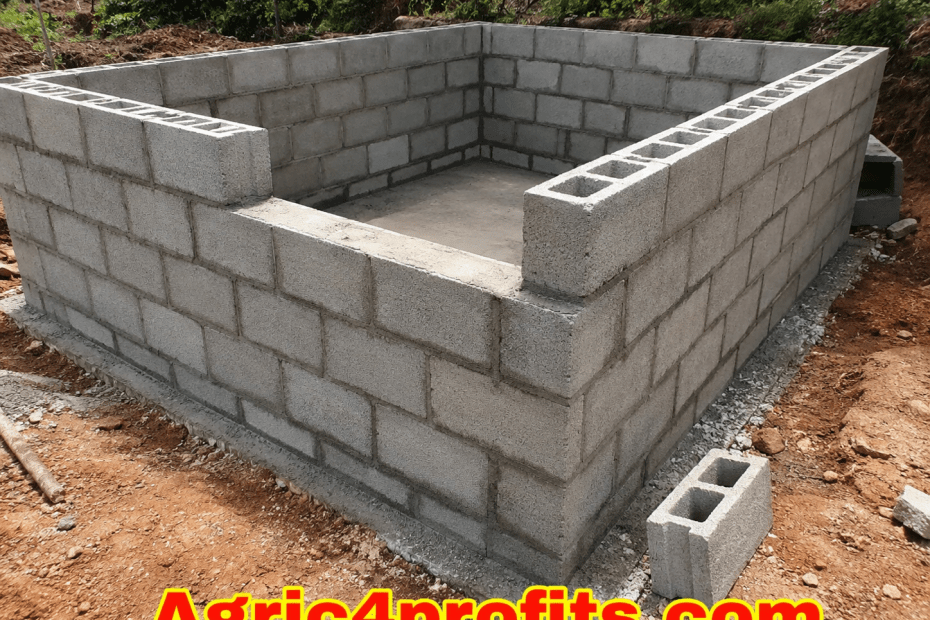
Farmers often ask how many block courses should rise above ground level when they build a concrete pond. Ideally, four courses give a practical balance between predator control, ease of feeding, and day-to-day access.
At four courses, toads and frogs find it harder to jump into the pond, while the farmer can still reach the fish without strain. That height also supports safer routine cleaning and observation.
If the wall rises too high, feeding becomes awkward and labour increases. If it sits too low, predators gain easier entry, and the pond becomes less secure, especially during rainy periods and nights.
A concrete pond can be built with blocks, cement, gravel, stone, metal supports, inlets, and outlets, depending on the site and the budget. The main aim is to create a strong, watertight, and manageable structure.
Good pond construction starts with clear thinking about durability, strength, imperviousness, permeability, workability, and dimensional stability. These qualities determine how well the pond will hold water and withstand regular fish farming pressure.
Farmers should also think about feeding access, water exchange, drainage, and how easily the pond can be repaired later. A convenient layout reduces stress during stocking, harvesting, inspection, and daily management.
🌿 Go Organic on Your Farm: Instead of harmful chemical pesticides and fertilisers, try our organic farming products — including neem oil spray, bio-pesticides, natural plant treatments, organic seeds and seedlings, suckers, and many more organic products that are safe for your health, your family, your soil and your harvest. Shop Now →
Choosing the right height and design also makes future management easier, because workers can monitor fish behaviour, remove waste, and respond quickly when water quality changes or predators appear around the structure.
Once these basics are clear, the farmer can move into the practical stages of construction with confidence. Careful planning at this point saves money later and helps the pond perform reliably for years.
A. Factors to Consider Before Building a Concrete Pond
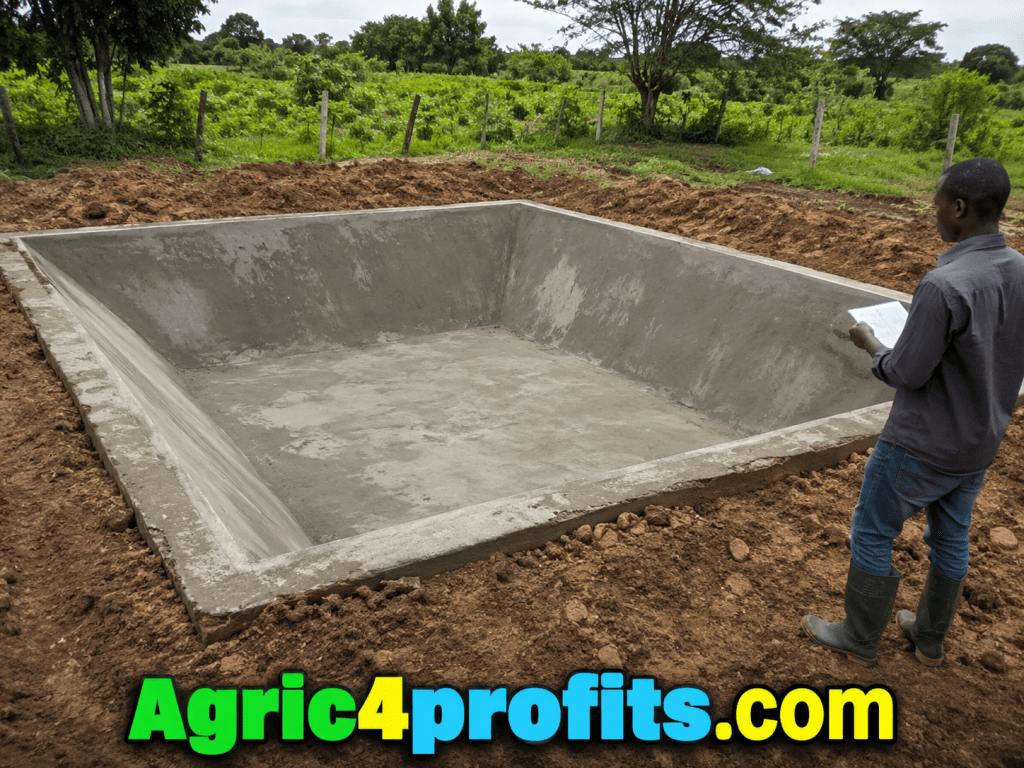
i. Durability: A durable pond resists water pressure, weather, and daily use, so the farmer spends less on repairs. That matters because a pond that keeps its shape supports stable production for many cycles.
ii. Strength: Strength protects the walls and floor from cracks, shifting soil, and sudden impact. A strong structure reduces leaks, improves safety, and allows the pond to handle regular water movement without constant patching.
🔧 Free Farm Tool Available: Use our free Agric4Profits Farm Tools to calculate your farm profits, formulate feeds, identify pests and diseases on both your crops and animal farms, plan your planting and harvesting season, including many more farm tasks to get free expert advice and recommendations — completely free, no registration required. Access Free Tools →
iii. Imperviousness: Impervious walls prevent seepage, which helps the farmer save water and maintain proper depth. Good sealing is essential in concrete systems because hidden loss can weaken growth conditions and increase operating cost.
iv. Permeability: Farmers must control permeability carefully, because a pond should not allow water to escape through the body of the structure. At the same time, it must not trap moisture in harmful places.
v. Workability: Workability describes how easily the construction materials can be mixed, placed, and finished. When the mix behaves well, workers can compact it properly, smooth the surface, and produce a cleaner pond wall.
vi. Dimensional stability: Dimensional stability helps the pond keep its shape after curing and during use. This quality reduces distortion, supports proper drainage, and keeps pipes, corners, and joints aligned for easier management.
vii. Planning flexibility: Many farmers compare concrete ponds with other systems before building, and that is wise. A quick review of pond choice and management helps align the structure with available land, water, and labour.
💬 Have a Farming Question? Join thousands of farmers across Africa on the Agric4Profits Community — ask questions, share experiences and connect with agricultural experts. It is completely free. Ask Your Question Now →
viii. Budget discipline: Construction should also follow realistic budgeting, because the best design is one the farmer can finish and maintain. Tools such as the pond sizing tool help estimate materials before work begins.
B. Concrete Materials, Mixture, and Structural Choice
i. Cement: Cement acts as the binding agent that holds the mixture together, so its quality matters. A reliable cement grade helps the pond achieve proper hardness, reduces surface weakness, and supports longer service life.
ii. Sand: Fine aggregate fills the spaces between larger particles and gives the mix a smoother finish. Clean sand improves workability, supports plastering, and helps the pond walls settle into a more uniform surface.
iii. Gravel: Gravel or granite provides bulk and strength, which helps the structure carry pressure from stored water. A balanced mix of gravel and sand reduces cracking risk and supports better load-bearing performance.
iv. Water: Water activates the cement and allows the mixture to become workable. However, too much water weakens the finished concrete, so the builder should measure it carefully for a firm and compact structure.
v. Plain concrete: Plain concrete contains no steel reinforcement, yet it can still serve smaller ponds well when the design remains modest. Farmers usually choose it when loads are manageable and the site conditions are stable.
vi. Reinforced concrete: Reinforced concrete includes steel bars that improve tensile strength and reduce structural failure. This option suits larger ponds or places where soil movement, water pressure, or long-term stress may become more serious.
vii. Reinforcement bars: Steel bars should be properly cut, positioned, and tied before pouring, because misplacement weakens the whole frame. Farmers who need extra guidance can consult floor finishing advice before the pour begins.
viii. Structure selection: The choice between plain and reinforced concrete depends on expected use, pond size, soil stability, and budget. A farmer who studies durable pond practice can avoid costly mistakes later.
📖 Want to Go Deeper on This Topic?
Our expert agricultural ebooks cover poultry, fish farming, different crops production, snail farming, organic farming, mushrooms, sheep, cattle, flowers, pig farming, goat farming, agribusiness, etc. in practical step-by-step detail — written by agricultural professionals for African farmers.
Browse All Farming Ebooks →C. Procedure for Constructing a Concrete Pond
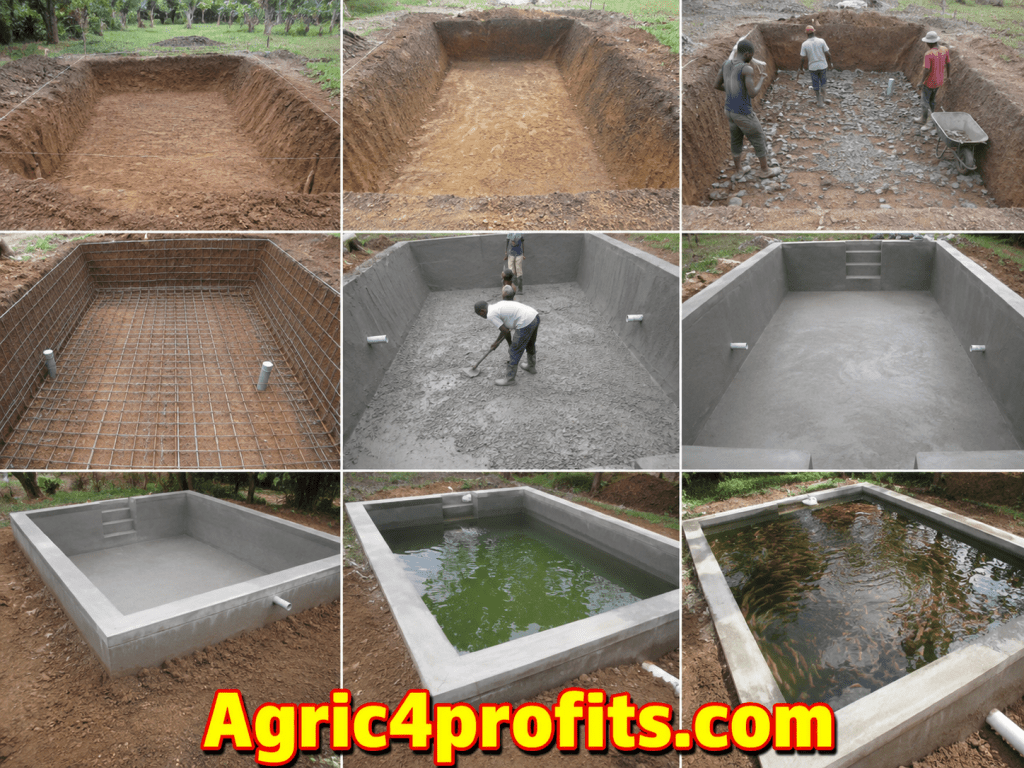
i. Site clearing: Start by clearing weeds, roots, and loose debris from the planned area, because a clean site helps the pond sit properly. Good preparation also makes measurement, excavation, and later maintenance much easier.
ii. Pegging and layout: Peg out the required dimensions carefully, then confirm levels before digging. Accurate layout keeps the pond square, supports good drainage, and prevents avoidable correction work during construction.
iii. Excavation: Remove the topsoil until a firm lateritic base appears, because a stable foundation reduces settlement and future cracking. Farmers who need a wider practical frame can study pond preparation routines.
iv. Base casting: After excavation, place the framework around the perimeter and pour fresh concrete in the correct ratio. Careful compaction at this stage helps the pond resist pressure and remain watertight.
v. Block courses: Raise the wall in four or five block courses, depending on the design and feeding convenience. This height limits predator entry while still allowing the farmer to reach the fish comfortably.
vi. Inlet and outlet installation: Insert the flush pipe at the base of the tank and confirm that the inlet and outlet line up properly. Good pipe placement supports water exchange, drainage, and future cleaning.
vii. Plastering and filling: Plaster the inside surface smoothly, then allow the structure to cure before adding water. Once the pond is ready, compare your routine with pre-stocking checks for extra confidence.
viii. Leak testing: Fill the pond to the brim after curing, observe the walls carefully, and correct any linkage or seepage immediately. Before you stock, verify the water with clean water source guidance.
Read Also: Unknown Amazing Benefits of Planting Cassava
D. Curing, Testing, and Finishing the Pond
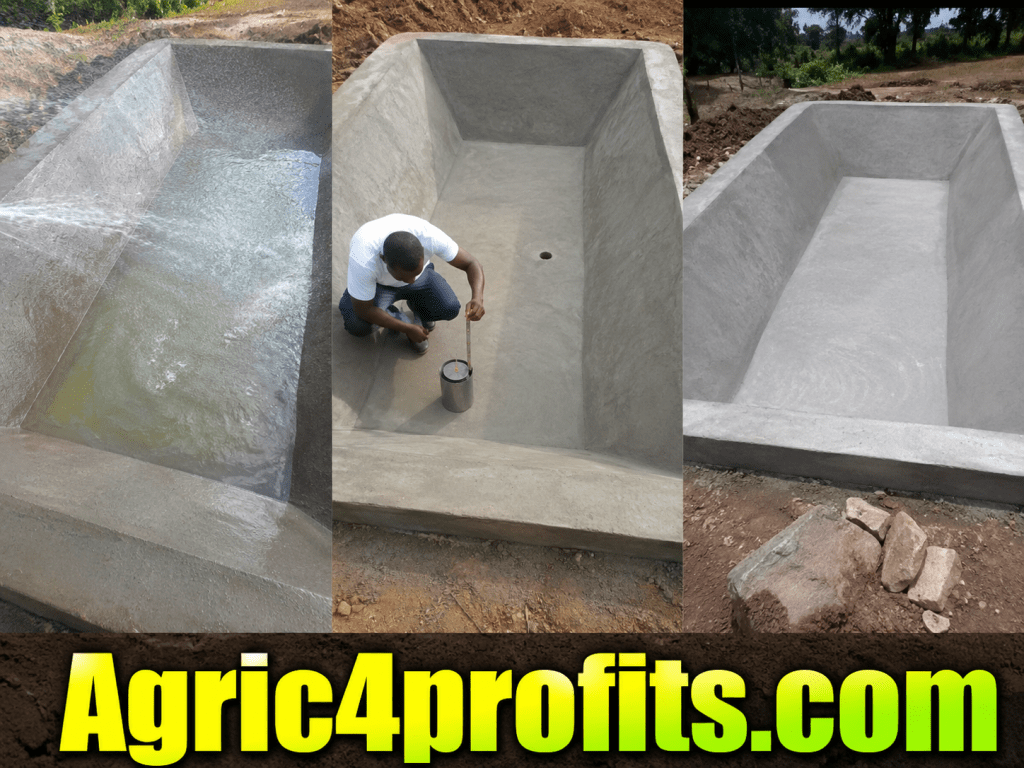
Concrete ponds can last a very long time when the builder follows the correct curing process and avoids rushing the job. Proper curing strengthens the structure, closes weak points, and supports better service under farm conditions.
A farmer should not stock fish immediately after construction, because fresh concrete can alter water chemistry. Allowing the pond to rest and testing the water first reduces stress on fish and protects the investment.
The surface finish also matters, because rough or uneven areas can injure fish and collect waste. Smooth, well-plastered walls are easier to clean and help the farmer monitor water quality more accurately.
Where plastered walls are exposed, sealing or painting may help improve appearance and reduce unwanted chemical interaction. A neat finish also makes the pond easier to inspect, especially when the farmer checks for cracks.
Good curing works best when the site remains protected from rain, contamination, and unnecessary disturbance. A farmer who understands public-health risk control will also manage hygiene more responsibly.
Water quality should be checked several times before stocking, because invisible problems often appear only after the pond fills. Regular observation and water-quality routine habits help the farmer catch trouble early.
When the pond smells normal, holds depth properly, and shows no leakage, the builder can move to final adjustments. That stage is also the right time to review regular testing before fish enter the system.
If the pond remains stable after filling, the farmer can proceed with confidence. A careful finish now prevents many future failures, because cracks, leaks, and poor surface treatment are expensive to fix after stocking.
E. Stocking Readiness and Long-Term Management
Before stocking, the farmer should confirm that the pond has enough depth, clean water, and safe access around the edges. A sensible stocking plan begins with calm observation, not haste, because mistakes at this point last for months.
The first weeks after stocking demand close attention, because young fish adjust quickly to poor handling, low oxygen, or hidden stress. Good feeding, careful monitoring, and clean water reduce mortality and encourage steady growth.
Stocking density should match the pond size, the species, and the farmer's management capacity. Overcrowding creates waste, raises stress, and reduces growth rate, while reasonable density supports healthier fish and easier supervision.
A practical farmer also keeps the pond free from predators and unnecessary disturbance. Nets, proper wall height, and timely inspection all help protect the fish, especially when the farm houses juveniles or fingerlings.
Feeding routines should remain consistent, because irregular feeding can produce waste and make behaviour difficult to predict. Farmers who study stocking discipline usually manage size differences more effectively.
Planning ahead also improves profit, because a pond that is well built still needs a sales strategy, feed budget, and harvest target. The logic behind commercial planning protects the farmer from avoidable losses.
As fish grow, the farmer may need to sort them by size to reduce competition and improve feeding response. That habit links naturally with the right stocking stage for each production goal.
With steady monitoring, proper records, and timely adjustments, a concrete pond becomes a reliable production unit. Good management turns a strong structure into a profitable fish enterprise rather than a costly building.
Summary on Number of Blocks Required to Rise above Ground Level in Constructing a Concrete Pond
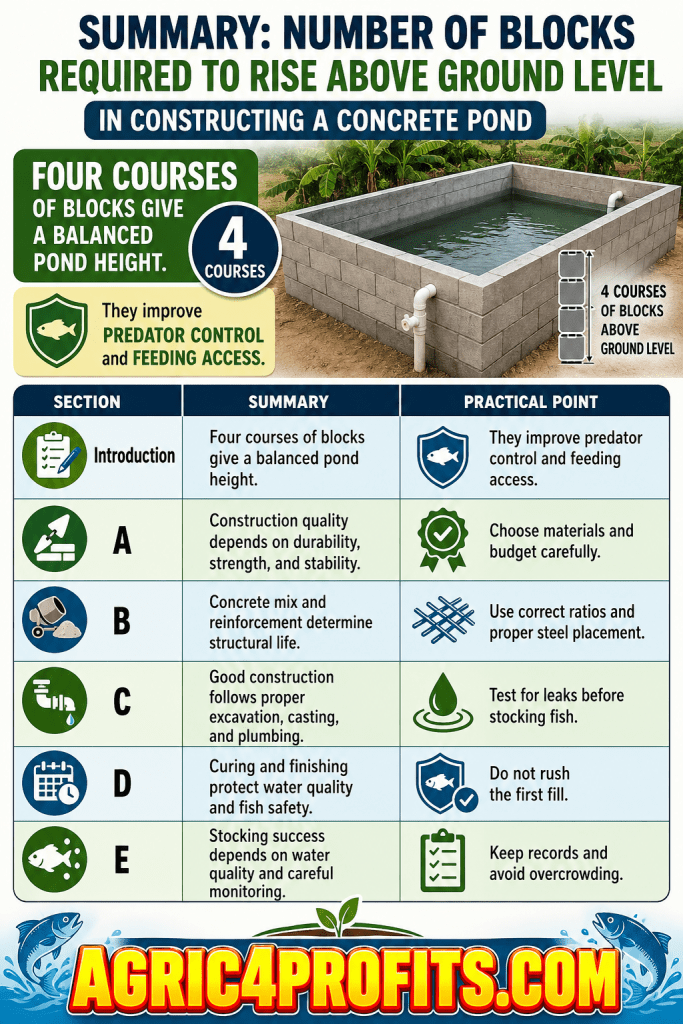
| Section | Summary | Practical Point |
|---|---|---|
| Introduction | Four courses of blocks give a balanced pond height. | They improve predator control and feeding access. |
| A | Construction quality depends on durability, strength, and stability. | Choose materials and budget carefully. |
| B | Concrete mix and reinforcement determine structural life. | Use correct ratios and proper steel placement. |
| C | Good construction follows proper excavation, casting, and plumbing. | Test for leaks before stocking fish. |
| D | Curing and finishing protect water quality and fish safety. | Do not rush the first fill. |
| E | Stocking success depends on water quality and careful monitoring. | Keep records and avoid overcrowding. |
Frequently Asked Questions About Number of Blocks Required to Rise above Ground Level in Constructing a Concrete Pond
1. Why is four courses of blocks often recommended?
Four courses give a useful balance between predator protection, easy feeding, and safe access for routine pond work, while still keeping the wall manageable for daily supervision and maintenance.
2. Can a pond work with more than four courses?
Yes, but the farmer should consider feeding convenience, labour, and overall management. Higher walls can make everyday work harder, especially where the pond has no raised walkway or platform.
3. Why must concrete ponds be tested for leakage?
Leak testing reveals hidden weak points before fish are stocked. Early correction prevents waste, protects water quality, and saves the farmer from costly repairs after the pond begins production.
4. What is the difference between plain and reinforced concrete?
Plain concrete has no steel bars, while reinforced concrete includes steel reinforcement. Reinforcement improves structural strength and suits larger ponds or locations where pressure and movement are greater.
5. How long should a new concrete pond cure before stocking?
The pond should cure long enough for the structure to harden properly and for the water chemistry to stabilise. Rushing this stage can expose fish to stress and poor water conditions.
6. Why does pond height affect predator control?
Higher walls make it harder for frogs, toads, and similar predators to enter the pond. At the same time, the wall must remain low enough for feeding and observation.
7. What should the farmer check before stocking fish?
The farmer should confirm that the pond holds water well, the surface is safe, the water looks clean, and no leakage remains. These checks improve survival and reduce early losses.
8. How does good construction improve profits?
A well-built pond reduces repairs, saves water, improves fish health, and makes management easier. Those savings strengthen productivity and support a more reliable farming business over time.
Do you have any questions, suggestions, or contributions? If so, please feel free to use the comment box below to share your thoughts. We also encourage you to kindly share this information with others who might benefit from it. Since we can’t reach everyone at once, we truly appreciate your help in spreading the word. Thank you very much for your support and for sharing!
Read Also: The Ultimate Step-by-Step Guide to Vegetable Gardening
🌱 Take Your Farming Further With Agric4Profits
Based on what you just read, here are free resources and products from Agric4Profits that can help your farm right now:
- 🛒 Visit Our Marketplace — Organic neem oil, bio-pesticides, seeds and farming products
- 📚 Read Premium Content — Advanced guides for serious and profitable farming
- 🎓 Join Our Free Academy — Structured free training for farmers across Africa
- 🔧 Use Our Free Farm Tools — Profit calculators, feed formulation, pest identifier and more
- 💬 Join Our Farming Community — Connect with farmers across all 54 African countries
- ❓ Ask a Farming Question — Get answers from experienced farmers and agricultural experts
Please cite this content in academic work, research, or publications.