



Sloes, scientifically known as Prunus spinosa, are small dark purple stone fruits produced by blackthorn, a hardy deciduous shrub native mainly to Europe and parts of western Asia, for practical household use.
The fruits are usually round, about one centimetre across, and develop blue purple skin covered by a natural waxy bloom that gives them a distinctive dusty appearance, for practical household use.
When ripe, sloes have firm flesh with a strongly tart, astringent character, making them different from sweet dessert fruits commonly eaten immediately after picking by consumers, for practical household use.
Traditionally, cooks transform sloes into preserves, syrups, desserts, sauces, and especially sloe gin, because freezing, cooking, or soaking can soften their harsh astringency considerably, for practical household use, for practical household use.
Beyond food, blackthorn has a long place in European folklore, traditional hedgerows, and rural landscapes, while modern interest increasingly focuses on the fruit's nutritional compounds, for practical household use, for practical household use.
This guide examines sloe history, nutrition, potential health contributions, cultivation requirements, harvesting, handling, and practical considerations for people interested in growing or using blackthorn, for practical household use, for practical household use.
🌿 Go Organic on Your Farm: Instead of harmful chemical pesticides and fertilisers, try our organic farming products — including neem oil spray, bio-pesticides, natural plant treatments, organic seeds and seedlings, suckers, and many more organic products that are safe for your health, your family, your soil and your harvest. Shop Now →
Read Also: Best Age to Buy Ruminants for Raising
The History of Sloes
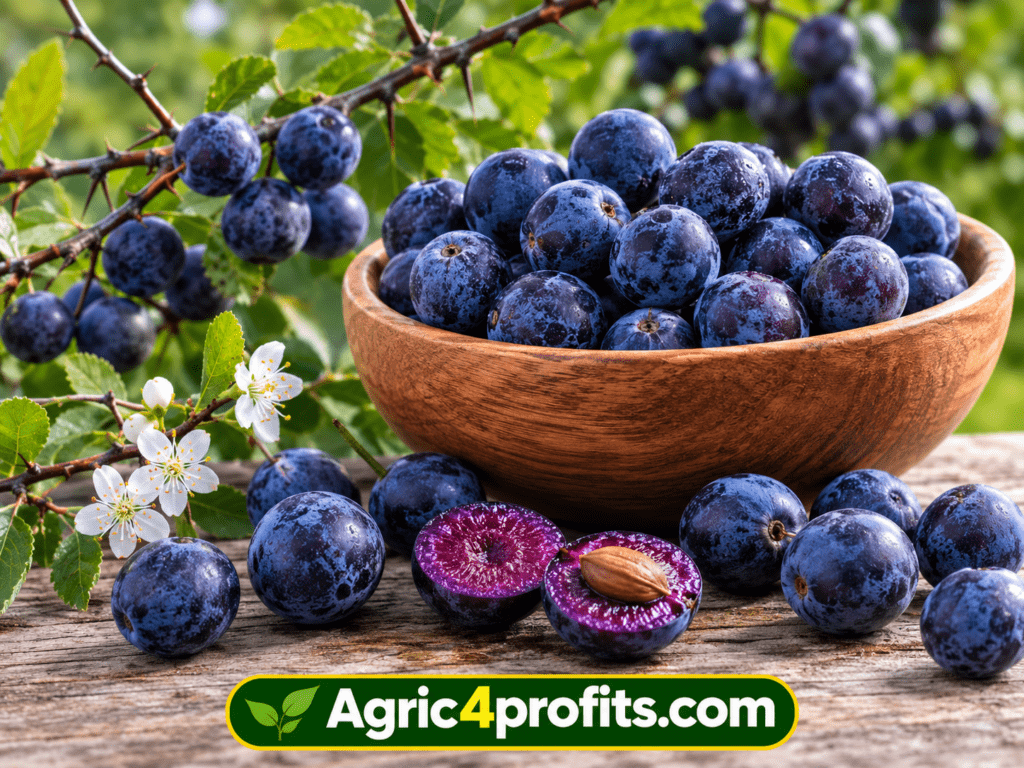
The history of sloes is closely connected with blackthorn, whose dense growth and sharp spines made it useful for hedges, boundaries, shelter, and wildlife habitat across many European landscapes, for practical household use.
Archaeological evidence places blackthorn among long used European wild plants, while its fruits and wood became familiar resources for rural communities living near hedgerows, woodland margins, and open countryside, for practical household use.
Blackthorn flowers appear early, often before leaves develop fully, creating a striking display of small white blossoms that traditionally signaled seasonal change and provided an important early forage source, for practical household use.
🔧 Free Farm Tool Available: Use our free Agric4Profits Farm Tools to calculate your farm profits, formulate feeds, identify pests and diseases on both your crops and animal farms, plan your planting and harvesting season, including many more farm tasks to get free expert advice and recommendations — completely free, no registration required. Access Free Tools →
Historically, people collected sloes after autumn ripening, sometimes waiting until cold weather had softened their texture and reduced some of their aggressive astringency, for practical household use, for practical household use.
Sloe processing became particularly associated with preserves and beverages, because sugar balances the fruit's tartness while cooking extracts color, flavor, and useful pectin into finished products, for practical household use.
Sloe gin eventually became one of the best known preparations, with recipes commonly combining ripe fruit, gin, and sugar before a prolonged period of steeping and flavor extraction, for practical household use.
Blackthorn also appears frequently in European folklore, where its thorns, dark bark, spring flowers, and fruit contributed to beliefs involving protection, boundaries, transformation, and supernatural woodland traditions, for practical household use.
Today, sloes remain culturally important while gaining renewed culinary interest, especially among foragers, artisan producers, gardeners, and consumers seeking distinctive ingredients with strong seasonal and regional identity, for practical household use.
💬 Have a Farming Question? Join thousands of farmers across Africa on the Agric4Profits Community — ask questions, share experiences and connect with agricultural experts. It is completely free. Ask Your Question Now →
The Nutritional Values of Sloes
Sloes provide nutrients and plant compounds, although exact composition varies with cultivar, maturity, growing conditions, preparation method, and the quantity actually consumed in a typical serving, for practical household use.
As with many fruits, sloes contain water and carbohydrates while providing relatively little fat, making them suitable for inclusion within varied meals when prepared without excessive added sugar, for practical household use.
Vitamin C is one nutritionally relevant component associated with many fruits, and sloes can contribute vitamin C intake, although precise amounts vary and should not be assumed from appearance, for practical household use.
Sloes also provide dietary fiber, which supports normal bowel function and contributes to overall dietary quality when eaten as part of a broader pattern containing vegetables, fruits, legumes, and whole grains.
Another important feature is their supply of polyphenolic compounds, including anthocyanin related pigments and other phenolics that contribute to the fruit's dark coloration, flavor, and antioxidant activity, for practical household use.
The nutritional value can change during cooking, drying, preserving, or alcohol steeping, particularly when preparation adds sugar or extracts only selected compounds from the original fresh fruit, for practical household use.
Because sloes are naturally very astringent, people commonly eat them in processed forms, meaning the nutritional benefits of the whole fruit can differ from those of finished beverages or preserves.
For accurate dietary planning, sloes should therefore be treated as one fruit option rather than a medicinal food, with overall dietary variety remaining more important than any single nutrient, for practical household use.
Read Also: Risks in Purchasing a Pregnant Cow
📖 Want to Go Deeper on This Topic?
Our expert agricultural ebooks cover poultry, fish farming, different crops production, snail farming, organic farming, mushrooms, sheep, cattle, flowers, pig farming, goat farming, agribusiness, etc. in practical step-by-step detail — written by agricultural professionals for African farmers.
Browse All Farming Ebooks →The Health Benefits of Sloes
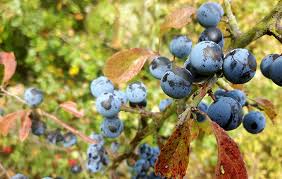
1. Antioxidant properties: Sloes contain antioxidant compounds that can help neutralize reactive molecules in laboratory systems, but evidence from isolated compounds does not automatically establish specific health outcomes in people.
2. Vitamin C contribution: Their vitamin C content may contribute to normal immune function, collagen formation, wound healing, and iron absorption, although the amount obtained depends on serving size and preparation.
3. Digestive support: Dietary fiber from whole sloe fruit may support regular bowel movements and healthy digestion, particularly when consumed alongside sufficient fluids and other high fiber foods for everyday digestive health.
4. Polyphenolic compounds: Polyphenols present in dark skinned fruits are being studied for possible relationships with inflammation and metabolic health, but human evidence for sloes themselves remains limited within a varied dietary pattern.
5. Dietary quality: Regularly eating varied fruits can support overall dietary quality, and sloes may contribute additional flavor, color, fiber, and plant compounds when included in appropriate portions rather than as a disease treatment.
6. Traditional uses: Traditional medicine has associated blackthorn preparations with several uses, but historical practice should not be presented as proof that sloe products treat, cure, or prevent disease when interpreted alongside human clinical evidence.
7. Preparation considerations: People should remember that sloe preparations such as sweet preserves and alcoholic drinks can contain substantial added sugar or alcohol, changing their nutritional and health implications as part of balanced fruit choices.
8. Individual advice: Anyone with a medical condition, medication regimen, pregnancy, or specific dietary restriction should discuss concentrated herbal preparations or unfamiliar products with an appropriately qualified healthcare professional and should not replace prescribed treatment.
How to Grow Sloes Fruit
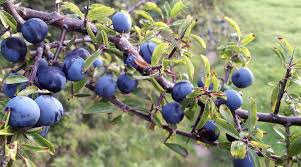
1. Site and soil: Growing sloes begins with understanding their climate needs because Prunus spinosa is a temperate species adapted to winter cold, seasonal dormancy, and conditions unlike hot tropical regions.
2. Site selection: Choose a location with full sun or light partial shade and soil that drains reasonably well, because persistent waterlogging can restrict root health and weaken plants before long term fruit production begins.
3. Soil condition: Blackthorn tolerates a broad range of soils and can grow on relatively poor ground, although good structure, adequate moisture, and suitable pH generally support stronger establishment under suitable local growing conditions.
4. Planting: Plant during the dormant season when conditions allow, especially when bare root stock is available, while container grown plants offer more flexibility when soil conditions are suitable during suitable planting windows.
5. Watering: Water newly planted shrubs during establishment, particularly during prolonged dry weather, but avoid keeping the root zone continuously saturated because excess moisture can encourage root problems and can preserve healthy root growth.
6. Pruning: Pruning helps manage dense growth, remove dead or damaged wood, maintain access, and encourage a safer structure, although excessive cutting can stimulate vigorous shoots and increase maintenance while keeping the canopy manageable.
7. Pest and disease control: Monitor pests and diseases through inspection, combining sanitation, organic crop protection practices, healthy planting material, suitable spacing, and appropriate crop protection methods when problems develop for practical and responsible management.
8. Harvesting: Harvest ripe sloes in autumn when fruits have developed their characteristic dark color, using gloves and careful handling because blackthorn branches carry sharp thorns that can injure workers.
Summary on Sloes: History, Nutrition, Health Benefits and Growing Guide
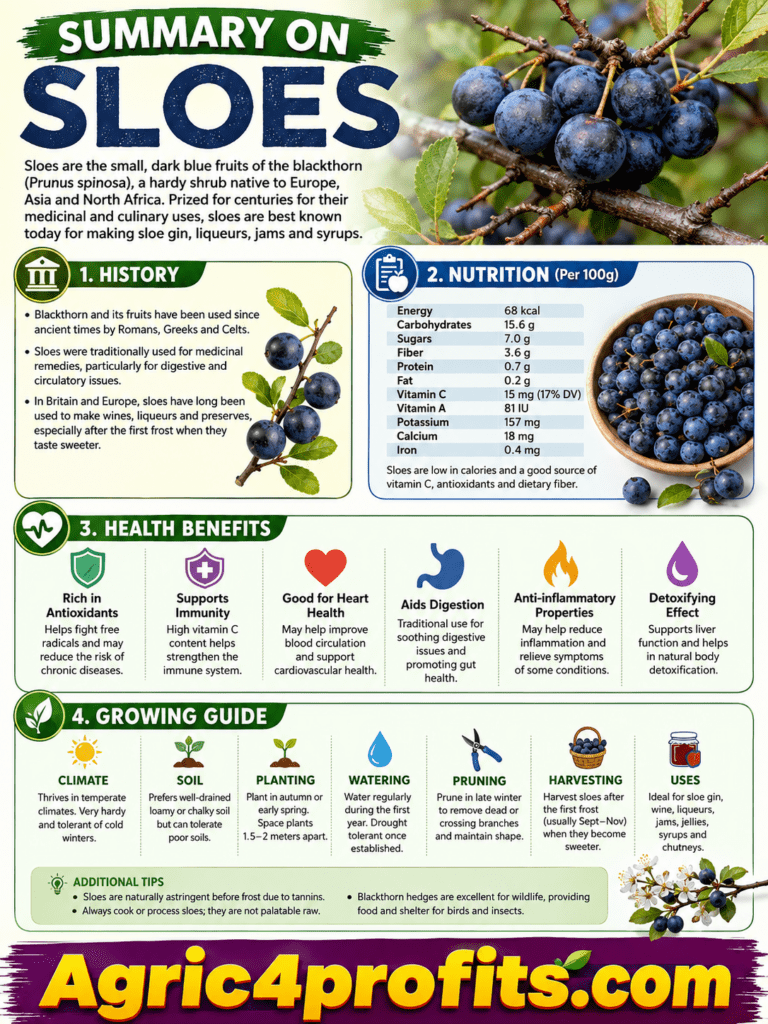
| Topic | Key Points |
|---|---|
| Identity | Sloes are small dark purple fruits of Prunus spinosa, a temperate blackthorn shrub. |
| History | They have long associations with hedgerows, rural traditions, folklore, preserves, and sloe gin. |
| Nutrition | They provide dietary fiber, vitamin C, and polyphenolic compounds, with composition varying by fruit and preparation. |
| Health | Potential benefits relate mainly to nutrients and antioxidant compounds; strong disease treatment claims are not established. |
| Growing | Blackthorn prefers temperate conditions, suitable drainage, establishment watering, careful pruning, and regular monitoring. |
| Harvesting | Harvest mature, dark fruits in autumn and handle carefully because blackthorn branches are thorny. |
| Culinary uses | Sloes are commonly processed into jams, jellies, syrups, desserts, sauces, and sloe gin. |
Frequently Asked Questions About Sloes: History, Nutrition, Health Benefits and Growing Guide
Can sloes be eaten raw, or are they usually processed before eating because their naturally strong astringency can make fresh berries unpleasant for many people, when considering safe home preparation and everyday dietary use?
Sloes can be eaten when ripe, but their intense astringency makes them unpopular as fresh snacks. Processing usually improves texture, flavor, and palatability substantially for most people in most home kitchens.
What type of climate is most suitable for growing blackthorn, and why may sloes perform poorly in hot tropical environments without suitable seasonal chilling conditions, especially when considering small-scale cultivation in suitable regions?
Blackthorn prefers temperate conditions with winter dormancy and seasonal chilling. Hot tropical environments may not provide the temperature cycle needed for reliable flowering, fruiting, and normal development before commercial planting.
What nutrients and plant compounds are commonly associated with sloes, and how can they contribute to a varied diet containing different fruits and vegetables, when planning balanced meals and responsible dietary choices?
Sloes can provide vitamin C, dietary fiber, and various polyphenolic compounds. Their contribution is best understood within a diverse diet rather than as a stand-alone nutritional solution within balanced dietary planning.
Do sloes have proven medicinal effects, or should their antioxidant compounds and traditional uses be considered potential nutritional benefits rather than established treatments, without substituting them for professional medical treatment?
Current evidence does not establish sloes as treatments for specific diseases. Their nutrients and antioxidant compounds are interesting, but traditional uses should remain separate from proven medical therapies for established health claims.
When is the best time to harvest sloes, and what physical signs indicate that fruits have reached a suitable stage for culinary collection and processing, when planning careful collection from established blackthorn plants?
Harvest normally occurs in autumn after fruits become dark blue purple and fully developed. Collect carefully when berries are mature, especially because blackthorn branches carry sharp thorns during careful field collection.
How should growers manage watering and soil conditions when establishing blackthorn, particularly during the first season after planting young shrubs in a new location, especially during dry weather and the first year after planting?
Keep newly planted blackthorn adequately moist while roots establish, particularly during dry periods. Use well drained soil and avoid prolonged saturation, which can stress roots and reduce vigor during the establishment period.
What common problems can affect blackthorn plants, and which preventive practices can help growers reduce pest, disease, weed, and overcrowding problems effectively, without depending entirely on chemical control methods, especially in established garden settings?
Blackthorn can experience pest, disease, weed, and structural problems. Regular inspection, sanitation, sensible spacing, careful pruning, and appropriate crop protection can reduce many avoidable problems through routine field monitoring practices.
What are the most practical culinary uses for sloes, and how can freezing, cooking, sugar, or soaking improve their flavor and usefulness in recipes, when preparing traditional recipes or homemade fruit products?
Sloes are commonly used for jams, jellies, syrups, desserts, sauces, and sloe gin. Freezing, cooking, and soaking help reduce their harsh astringency while developing richer culinary flavors with proper food handling.
Do you have any questions, suggestions, or contributions? If so, please feel free to use the comment box below to share your thoughts. We also encourage you to kindly share this information with others who might benefit from it. Since we can’t reach everyone at once, we truly appreciate your help in spreading the word. Thank you very much for your support and for sharing!
Read Also: Importance of Good Personal Hygiene
🌱 Take Your Farming Further With Agric4Profits
Based on what you just read, here are free resources and products from Agric4Profits that can help your farm right now:
- 🛒 Visit Our Marketplace — Organic neem oil, bio-pesticides, seeds and farming products
- 📚 Read Premium Content — Advanced guides for serious and profitable farming
- 🎓 Join Our Free Academy — Structured free training for farmers across Africa
- 🔧 Use Our Free Farm Tools — Profit calculators, feed formulation, pest identifier and more
- 💬 Join Our Farming Community — Connect with farmers across all 54 African countries
- ❓ Ask a Farming Question — Get answers from experienced farmers and agricultural experts
Please cite this content in academic work, research, or publications.