



If you have seen the phrase taxes in animals in a biology note, the standard scientific term is usually taxis. It describes directed movement toward or away from a stimulus, and it is one of the simplest ways living organisms respond to their environment.
This topic matters because movement is not always random. In many organisms, direction changes depending on light, chemicals, gravity, moisture, or temperature. That directional response helps the organism survive, feed, and avoid danger.
For a wider look at behavior in animals, farm animal behavior and stimulus response is a useful related read. It helps connect this topic to everyday animal actions.
Students often confuse taxis with kinesis, but the two are not the same. Kinesis is undirected movement that changes in speed or turning, while taxis is a true directional response to a stimulus.
Another helpful background topic is ethology and the study of animal behavior, because taxis sits inside the wider science of how animals behave in nature.
In simple terms, taxis helps an organism move toward what is useful and away from what is harmful. That makes it a useful concept in biology revision, animal science, and exam preparation.
🌿 Go Organic on Your Farm: Instead of harmful chemical pesticides and fertilisers, try our organic farming products — including neem oil spray, bio-pesticides, natural plant treatments, organic seeds and seedlings, suckers, and many more organic products that are safe for your health, your family, your soil and your harvest. Shop Now →
This article breaks the idea down in plain language so you can understand the meaning, the main types, common examples, and the mistakes students often make when answering exam questions.
What Taxes in Animals Means
Taxes in animals refers to movement that is guided by a stimulus. The animal does not just move anywhere; it moves in a particular direction because something in the environment is affecting it.
That stimulus may be light, food scent, water, temperature, chemicals, wind, or gravity. When the organism moves toward the source, the response is called positive taxis. When it moves away, it is negative taxis.
To see how movement and daily care connect in real animal production, husbandry practices in animal care are a helpful related topic. Good husbandry often shapes how animals respond to their surroundings.
🔧 Free Farm Tool Available: Use our free Agric4Profits Farm Tools to calculate your farm profits, formulate feeds, identify pests and diseases on both your crops and animal farms, plan your planting and harvesting season, including many more farm tasks to get free expert advice and recommendations — completely free, no registration required. Access Free Tools →
This directional response is important because it gives the organism a better chance of reaching favorable conditions. For example, a creature may move toward food or move away from heat, danger, or toxic exposure.
In biology, taxis is usually treated as an innate response, meaning it does not depend on learning in the way many human choices do. It is built into the organism’s behavior pattern.
That is why taxis is often discussed alongside instinctive behavior. It is a quick, survival-based movement pattern that helps the organism interact with its surroundings in a useful way.
You can also connect this idea with animal feed evaluation, because the quality of feed and the animal’s response to it often influence movement, feeding, and daily activity.
A useful way to remember it is this: kinesis changes how fast or how often an organism turns, while taxis changes the direction of movement itself.
💬 Have a Farming Question? Join thousands of farmers across Africa on the Agric4Profits Community — ask questions, share experiences and connect with agricultural experts. It is completely free. Ask Your Question Now →
Main Types of Taxes in Animals

1. Phototaxis: This is movement in response to light. An organism may move toward light if the response is positive, or away from light if the response is negative.
Phototaxis is one of the easiest examples to remember because light is easy to observe in daily life. Many biological demonstrations use it to show how movement can be guided by an environmental cue.
2. Chemotaxis: This is movement in response to chemicals. A living organism may move toward a useful chemical source, such as food, or away from harmful chemicals.
Chemotaxis is especially important because many organisms detect food, mates, or danger through chemical signals. In biology, it is often used to explain how movement is guided by invisible environmental information.
3. Geotaxis: This is movement in response to gravity. An organism may move upward or downward depending on whether the response is positive or negative.
Geotaxis helps explain why some organisms orient themselves with respect to the earth’s pull. It is a useful term when describing movement patterns that are influenced by vertical direction.
4. Aerotaxis: This is movement in response to oxygen concentration or air-related conditions. The organism adjusts its direction based on where the oxygen level is more suitable.
Aerotaxis is often discussed when organisms must find conditions that support respiration. The key idea is still directional movement, but the cue here is oxygen or a related atmospheric condition.
5. Thermotaxis: This is movement in response to temperature. A living organism may move toward a preferred temperature range or away from an uncomfortable one.
📖 Want to Go Deeper on This Topic?
Our expert agricultural ebooks cover poultry, fish farming, different crops production, snail farming, organic farming, mushrooms, sheep, cattle, flowers, pig farming, goat farming, agribusiness, etc. in practical step-by-step detail — written by agricultural professionals for African farmers.
Browse All Farming Ebooks →Thermotaxis matters because temperature affects survival, feeding, and comfort. The movement is not random; it is a directed response that helps the organism stay within a suitable range.
6. Rheotaxis: This is movement in response to fluid current, such as water or air flow. It helps an organism orient itself in moving fluid environments.
Rheotaxis is useful for aquatic organisms and other animals that must cope with current direction. Once again, the important point is that the movement has a clear directional stimulus.
These types are easier to remember when you also understand practical animal systems such as semi-intensive livestock production, where movement, feeding, and environment all shape animal performance.
For poultry examples, a complete poultry farming guide can help you see how behavior, housing, and feeding interact in real farm settings.
You can also connect taxis with animal welfare through Agric4Profits Academy, where animal production topics are grouped in practical learning categories.
Another useful link is the Agric4Profits Academy home page, which opens the broader learning ecosystem for farm knowledge and animal management.
At the more specific level, natural animal health and biosecurity is a strong companion topic because healthy animals respond more effectively to environmental stimuli.
And for nutrition-related context, sustainable animal nutrition and feed formulation helps explain how feeding influences activity and movement.
These types show how living things interpret the environment and turn external signals into movement that improves survival.
Examples of Taxes in Animals
1. Insects moving toward light: Many small organisms move toward light sources, especially when the light helps them orient their surroundings or locate open space. That is a straightforward example of phototaxis.
The important detail is the direction. The movement is not just active; it is actively guided by the light source. That makes it a taxis response rather than simple random motion.
2. Mosquitoes responding to human odor: Chemical attraction is a clear example of chemotaxis. A strong scent can guide movement toward a host or a food source.
This kind of response shows why animal communication and signaling matter. When you study animal communication, you begin to see how organisms send and receive signals in the environment.
3. Fish or aquatic organisms aligning with current: Movement in relation to water flow is a good way to understand rheotaxis. The organism adjusts its direction based on the movement of the fluid around it.
That adjustment can help the organism remain in a favorable position, conserve energy, or avoid being carried into unsafe conditions. The response is still directional, so it fits the idea of taxis.
4. Small organisms moving upward or downward under gravity: Geotaxis becomes obvious when an organism changes its position in relation to gravity. This can be seen in directional climbing or sinking responses.
Once you identify the stimulus, the explanation becomes simple. Gravity is the cue, and the movement direction is the response. That is the same pattern seen in the other forms of taxis.
5. Animals moving away from harmful heat or dryness: When the stimulus is unpleasant, the response may be negative taxis. The animal moves away from the source to improve its chances of survival.
This is a useful way to think about behavior in stressful conditions. The animal is not drifting aimlessly; it is following a cue that directs it toward a better environment.
6. Directional movement in response to a specific odor or food cue: In many organisms, chemical cues play a major role in finding nutrients. That makes chemotaxis one of the most practical examples in everyday biology.
These examples show the same principle in different settings: a stimulus appears, the organism detects it, and movement follows in a clear direction. That is the essence of taxes in animals.
In animal management, behavior is often tied to production systems, so it helps to read a layer chicken farm profit calculator example to see how movement, feeding, and performance connect in real farming.
FarmSmart planning for layer chickens also shows how structured management supports healthy animal behavior and better decisions on the farm.
For quail farmers, the quail business planner is another useful link because it connects feeding, housing, and animal response in a practical way.
If you manage ducks, duck feed formulation is a useful reference for understanding how nutrition supports energy, movement, and daily behavior.
For broilers, broiler feed formulation gives another example of how feed quality influences growth and activity.
Guinea fowl owners can also use guinea fowl feed formulation to connect nutrition with movement and flock behavior.
If you work with catfish, catfish profit calculation is relevant because fish movement and feeding habits shape productivity.
You can also study catfish business planning for another practical link between behavior, feeding, and aquaculture management.
For sheep keepers, sheep profit calculation shows how husbandry choices affect animal performance and farm results.
Pig farmers may also find pig farming profit planning useful when thinking about feeding, housing, and animal response.
For carp and other fish systems, common carp farming is another example of how water, movement, and management come together.
Why Taxes in Animals Matter in Biology

1. It explains survival behavior: Taxis helps us understand how organisms find food, avoid danger, and seek suitable living conditions. In biology, that makes it a key survival concept rather than a minor definition.
When a student understands survival behavior, many examples suddenly make sense. The organism is not acting randomly; it is responding in a way that improves its chances of staying alive.
2. It improves scientific observation: Researchers can use taxis to study how animals and other organisms react to stimuli. That makes the concept useful in experiments, field studies, and behavioral analysis.
Farmers and students who follow animal biological clock patterns can also understand how daily rhythms influence movement and activity.
3. It builds exam confidence: Taxis is a common biology question because it tests both definition and application. Students are often asked to distinguish it from kinesis or to name the type of taxis shown in a diagram.
If you know the difference between a directional movement and a non-directional one, you are already ahead. That small understanding can save marks in objective and theory questions.
4. It connects behavior to the environment: Taxis shows that behavior is not isolated from surroundings. The environment supplies the signal, and the organism reacts in a measurable way.
That connection is one of the central ideas in biology. Living things constantly interpret light, chemicals, gravity, temperature, and movement around them.
5. It supports ecological understanding: In nature, directional movement affects where organisms live, feed, hide, and reproduce. Taxis therefore influences distribution and behavior across habitats.
That broader value is why taxis is not just a vocabulary item. It is a biological tool for understanding how organisms fit into their environment and how they respond to change.
6. It helps correct common misconceptions: Many learners assume all movement toward a stimulus is the same, but biology separates specific responses into types. Knowing those categories makes explanations more precise.
That precision matters because science depends on clear naming. When you call a response by the right term, you show that you understand the stimulus, the direction, and the organism’s behavior.
For deeper animal-health learning, natural animal health and organic biosecurity practices are closely connected to how animals behave under healthy conditions.
You can also study animal nutrition and feed formulation to see how feed choices influence movement, energy, and general performance.
That wider farming context is useful because animal behavior does not happen in isolation; it is shaped by environment, feeding, housing, and management.
Common Mistakes Students Make
1. Mixing up taxis and kinesis: This is the biggest error. Taxis is directional movement, while kinesis is a change in activity that is not directed toward a particular source.
A student may describe a response as taxis simply because movement happened, but direction must be part of the explanation. Without direction, the answer is usually incomplete.
2. Forgetting the stimulus: Every taxis response has a cause. If you do not name the stimulus, your explanation loses the key detail that makes the answer scientifically correct.
For example, light gives phototaxis its name, chemicals give chemotaxis its name, and gravity gives geotaxis its name. The stimulus is part of the definition, not an optional detail.
3. Not stating positive or negative: A response can be toward a stimulus or away from it. If the question asks for full explanation, you should include whether the taxis is positive or negative.
That distinction is easy to miss, but it can make the difference between a weak answer and a strong one. The direction of movement is a major part of the concept.
4. Using vague language: Avoid saying only that the organism “reacts” or “moves.” Biology expects a more exact answer, such as “moves toward light” or “moves away from chemicals.”
Precision makes your answer stronger and easier to mark. The clearer the stimulus and direction, the easier it is for the examiner to see that you understand the concept.
5. Ignoring the biology context: Taxis is not just a memorized word. It is part of the wider study of behavior, survival, and environmental response.
When students link the definition to real examples, the topic becomes much easier to remember. That is the best way to revise it for class tests and examinations.
6. Confusing the wording in notes: Some class notes use “taxes in animals” when the intended biology term is taxis. Always check the meaning, then answer using the correct scientific term.
That habit helps you avoid easy mistakes and improves your scientific writing. It also shows examiners that you understand the concept rather than just copying a phrase.
Remember the simple pattern: stimulus first, direction second, response third. If you keep that structure in mind, most taxis questions become much easier to answer correctly.
With that, you can explain the topic clearly, name the type of taxis correctly, and avoid the common mix-ups that reduce marks in biology.
Read Also: Animal Communication and Signaling in Biology
Summary on Taxes in Animals: Meaning, Types, and Clear Examples
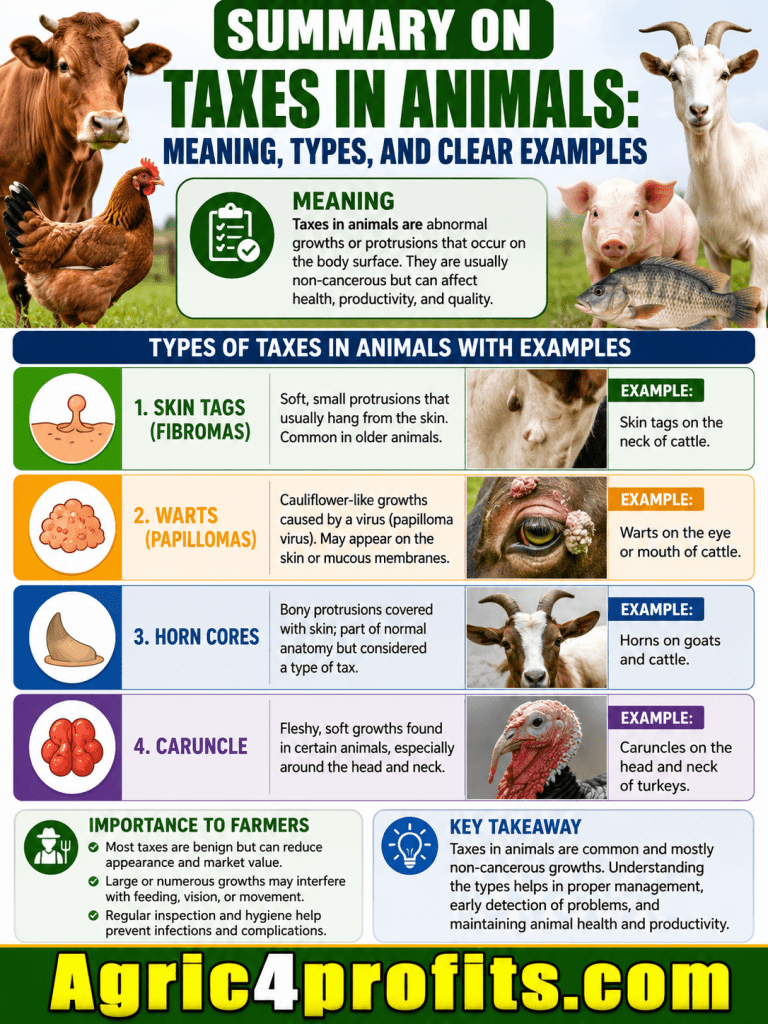
| Topic | Simple Meaning | Key Takeaway |
|---|---|---|
| Taxes in Animals | Directed movement in response to a stimulus. | The organism moves with purpose, not randomly. |
| Positive Taxis | Movement toward a stimulus. | Useful when the stimulus is favorable, such as food or light. |
| Negative Taxis | Movement away from a stimulus. | Helpful when the stimulus is harmful, uncomfortable, or unsafe. |
| Common Types | Phototaxis, chemotaxis, geotaxis, aerotaxis, thermotaxis, rheotaxis. | Each type is named after the stimulus that guides the movement. |
Read Also: Observations of Animal Behavior Across Species
Frequently Asked Questions About Taxes in Animals: Meaning, Types, and Clear Examples
1. What are taxes in animals?
It is the directed movement of an organism in response to a stimulus. In biology, the standard term is usually taxis, and the movement can be toward or away from the stimulus.
2. What is the difference between taxis and kinesis?
Taxis is directional movement, while kinesis is a change in movement that is not directed toward a specific stimulus source. That distinction is one of the most important points in the topic.
3. What is phototaxis?
Phototaxis is movement in response to light. The response may be positive, when the organism moves toward the light, or negative, when it moves away from it.
4. What is chemotaxis?
Chemotaxis is movement in response to chemical signals. It helps organisms move toward useful chemicals, such as food, or away from harmful ones.
5. Is taxis the same as a reflex?
No. A reflex is a rapid automatic response to a stimulus, while taxis is a directional movement response. They are related to stimulus-response behavior, but they are not the same concept.
6. Why is taxis important in biology?
It helps explain how organisms find food, avoid harm, and respond to the environment. It also helps scientists and students understand behavior in a clear, observable way.
7. Can animals show geotaxis?
Yes. Geotaxis is movement in response to gravity, so an animal or other organism may move upward or downward depending on the type of response.
8. How should I answer a biology exam question on taxis?
State the definition, name the stimulus, and say whether the movement is positive or negative. If possible, add a correct example such as phototaxis or chemotaxis.
Do you have any questions, suggestions, or contributions? If so, please feel free to use the comment box below to share your thoughts. We also encourage you to kindly share this information with others who might benefit from it. Since we can’t reach everyone at once, we truly appreciate your help in spreading the word. Thank you very much for your support and for sharing!
Read Also: How to Control Pests in the Garden
🌱 Take Your Farming Further With Agric4Profits
Based on what you just read, here are free resources and products from Agric4Profits that can help your farm right now:
- 🛒 Visit Our Marketplace — Organic neem oil, bio-pesticides, seeds and farming products
- 📚 Read Premium Content — Advanced guides for serious and profitable farming
- 🎓 Join Our Free Academy — Structured free training for farmers across Africa
- 🔧 Use Our Free Farm Tools — Profit calculators, feed formulation, pest identifier and more
- 💬 Join Our Farming Community — Connect with farmers across all 54 African countries
- ❓ Ask a Farming Question — Get answers from experienced farmers and agricultural experts
Please cite this content in academic work, research, or publications.