


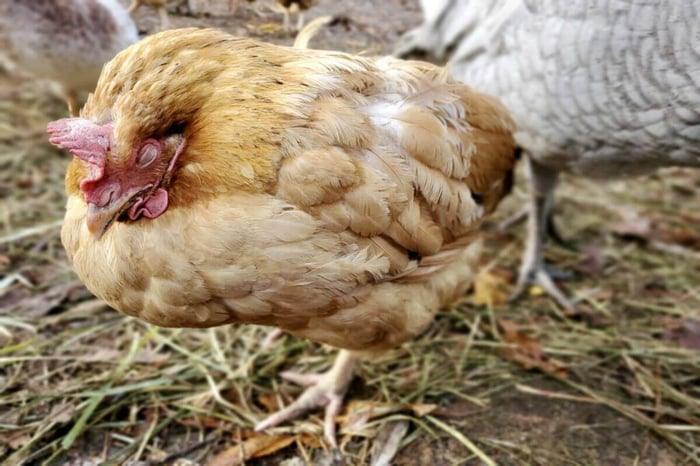
Coccidiosis hits hard in poultry farms, especially when birds live on deep litter. This setup lets parasites thrive if litter stays damp or dirty. Farmers deal with it often because it spreads fast and cuts into profits. Birds get weak, stop eating, and drop bloody feces. Without quick action, death rates climb. Treatment timing ties to how you manage litter and what meds you pick.
Some use vaccines like Livercox or Immucox to skip repeat doses. Others watch for signs and treat as needed. Signs show up clear: no appetite, brown or bloody droppings, and sometimes many birds die off. This disease comes from protozoan parasites called Eimeria.
It mainly affects broilers but can hit any chicken. In the US, it’s a top issue for subclinical cases where birds look okay but grow slow. Over time, farms have leaned on feed additives and vaccines to keep it in check. Good management helps too, like dry litter and right stocking.This
This guide covers control, key species, diagnosis, prevention, and treatment. It aims to help farmers spot trouble early and act smart.
1. Coccidiosis Control
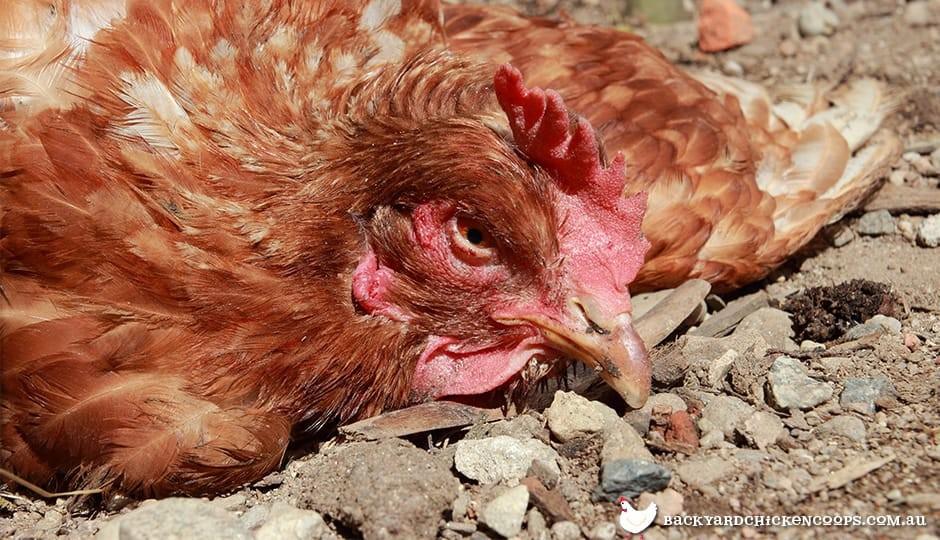
Coccidiosis stems from Eimeria parasites that invade the gut. It splits into two forms.
A. Clinical Coccidiosis: Birds show clear signs like bloody droppings and higher deaths. This type demands fast treatment to curb losses.
B. Subclinical Coccidiosis: No obvious symptoms, but checks reveal gut damage and parasites. Performance drops without notice. Most broilers get anticoccidial drugs in feed, so full outbreaks are rare. Still, subclinical cases top the list in US diagnoses. They hurt growth and feed use. With no new drugs coming, focus on prevention. Keep houses clean and use proven methods to limit impact.
As long as broiler chickens are continued to be raised in confinement under the current production systems, the prevalence of subclinical coccidiosis is unlikely to change, yet no new anticoccidial drugs are being developed. Prevention and control methods must be used to minimize the negative impact of subclinical coccidiosis on broiler flock performance.
2. Important Coccidia in Broiler Chickens
Three main Eimeria species cause trouble in US broilers. Each targets a different gut part, so ID matters for treatment. Add info: These parasites cycle through birds and litter, building up if not managed. Rotation of drugs helps avoid resistance.
Although there are seven widely recognized species of coccidia, only three of them cause most of the problems related to coccidiosis in the USA: Eimeria acervulina, E. maxima, and E. tenella.
Each species of coccidia has its own unique area of the intestinal tract. For example, E. acervulina lesions are found in the upper small intestine, while those of E. maxima will be found in the middle small intestine and E. tenella lesions in the caeca. It is important to identify the type of coccidia affecting the flock as they require different treatments.
Read Also: Cold Weather Poultry Diseases and How to Manage Them
3. Diagnosis of Coccidiosis
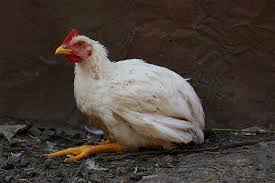
Spot it early to save the flock. Add info: Vets scrape guts for oocysts under microscopes. Pale skin often signals start, even in subclinical cases.
Despite most broiler flocks are raised with anticoccidial drugs added to their feed, drug resistance – especially to chemical anticoccidials or feed mixing errors – may lead to clinical coccidiosis.
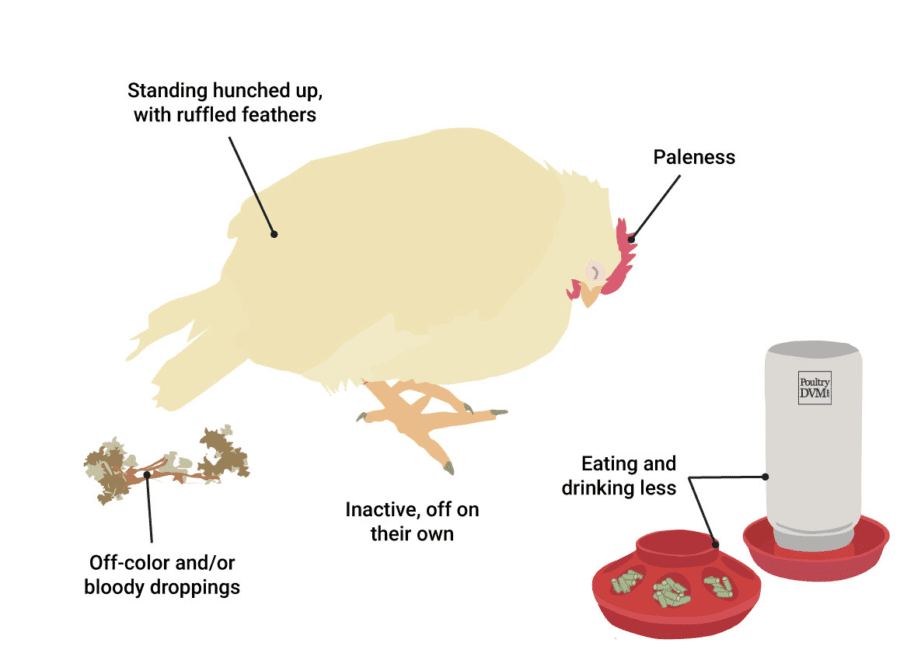
Birds with clinical cases of coccidiosis frequently display a typical ‘sick bird’ attitude with depression, prostration, huddling under the heat source as if chilled, soiled vents and watery or bloody droppings. One of the first signs of clinical and even subclinical coccidiosis may be paleness.
In birds that have recently died, post mortem examination should start with examination of the intestinal tract and the caeca for the presence of gross lesions. Gross lesions caused by E. acervulina are usually the most prevalent and are usually confined to the upper small intestine (duodenum), although some times they may extend to the mid-gut (jejunum).
The lesions have a unique appearance, consisting of white patches or transverse white lines inside the gut that may already be observed from the outside.
Lesions of E. maxima comprise multiple petechial (pin-point size) haemorrhages often seen from the outside of the mid-gut area, in addition, segmental ballooning or enlargement of the mid-gut with presence of orange-tainted mucous may be noted.
However, unless the lesions are typical they are harder to identify than those caused by E. acervulina and E. tenella and therefore it is highly desirable to confirm its presence by identifying the presence of coccidial oocysts (eggs) in a scraping from the mid gut under a microscope.
Gross lesions of E. tenella are confined to the caeca and consist of the presence of haemorrhages on the outside or inside of the wall of the caeca, free-blood or a chocolate-coloured fluid content inside the caeca with a thickening of its wall or the presence of a large core of cellular debris and blood.
E. tenella can kill birds so dead birds in a flock with increased mortality should always be examined for the presence of lesions compatible with E. tenella infection or caecal coccidiosis.
Read Also: How to Control and Prevent Disease Outbreak on your Poultry Farms
4. Coccidiosis Prevention
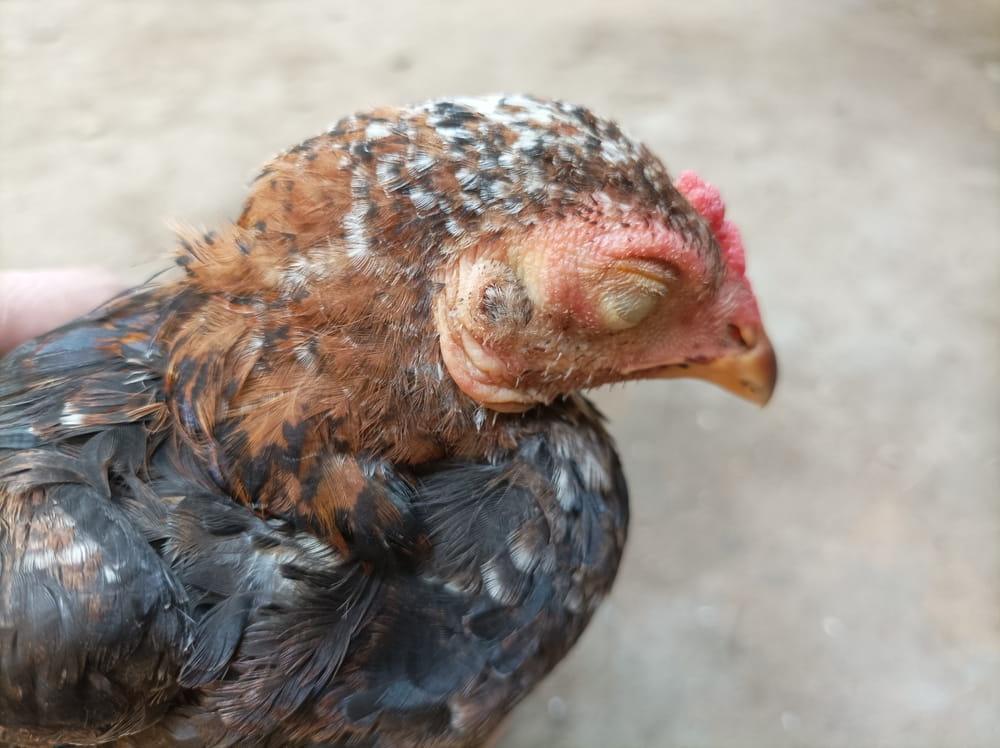
Stop it before it starts with drugs or vaccines. Add info: Dry litter cuts oocyst survival. Rotate programs yearly.
Coccidial oocysts are extremely resistant to environmental conditions and disinfectant agents so eradication of coccidiosis from chicken houses by litter removal, cleaning and disinfection is not feasible.
Since the early 1950s, there have been two main tools to prevent and control coccidiosis in broiler flocks. Anticoccidial agents added to the feed have been used since the mid-1950s and have been instrumental in allowing the expansion of the broiler industry to what it is today.
For many years coccidiosis prevention and control relied on the use of synthetic anticoccidials, commonly referred to as chemicals. In many cases, resistance to these drugs quickly occurred – within 1 to 3 years – and they became ineffective. Of this group, only nicarbazin remains effective today.
A major breakthrough in the prevention of coccidiosis through feed medication occurred in 1972, with the launch of the first polyether ionophore anticoccidial, monensin.
This type of anticoccidial agents have been commonly referred to as ionophores, a term derived from their general chemical structure. They are the most widely used drugs for coccidiosis prevention in broilers.
Each has a different mode of action and so no significant resistance has developed. Monensin, for example, is still used successfully more than 35 years after its introduction.
The second method for the prevention and control of coccidiosis in broiler chickens that has been available since 1952 in the USA, is through the use of live non-attenuated coccidiosis vaccines. For many years, the use of live coccidiosis vaccines was restricted to broiler breeder replacements.
The introduction of better and more practical vaccination techniques, e.g. the administration by coarse-spray or gel-spray cabinet at the hatchery, has resulted in more uniform administration and better protective immunity. Use of coccidiosis vaccines has increased in broiler chickens but this remains a relatively minor use compared to anticoccidials drugs in the feed.
New methods of administration of live coccidiosis vaccines, like the in-ovo injection method into embryonated chicken eggs at 18 days of incubation, allowing precise individual dosing and the early development of immunity.
When the same ionophore anticoccidial is added to the starter and grower feeds, this is popularly referred to as a straight program. These are commonly used in spring and summer.
In some straight programs, the concentration of the anticoccidial may be increased in the grower feed to provide maximum protection at the time of peak coccidial oocyst shedding (3-4 weeks).
This is known as a step-up program, in other cases, the concentration of the anticoccidial may be decreased in the grower or finisher feed, this known as a step-down program.
In other cases, a chemical anticoccidial is added to the starter feed and an ionophore anticoccidial to the grower feed(s), this is popularly referred to as a shuttle program. These minimize anticoccidial resistance because the time of exposure to the same drug is limited.
However, other important factors must be considered: for example, when the starter feed is given for just 14-18 days, the typically strongest chemical anticoccidial will not be consumed during the time of peak coccidial oocyst shedding.
When live vaccines are used, their use is primarily limited to the summer. Because the current vaccines contain live non-attenuated coccidia and because they induce immunity in the bird by cycling through it, the vaccines induce some lesions.
These lesions stimulate active immunity but they also predispose the bird to necrotic enteritis, a fatal disease caused by Clostridium perfringens.
Therefore, it is recommended to use an antibiotic growth promoter in the feed with solid anti-clostridial activity (such as virginiamycin) when live coccidiosis vaccines are used.
Another important factor to consider when live coccidiosis vaccines are used is the amount of moisture of the litter. Very dry litter is undesirable because in slows the development of protective immunity against coccidiosis in vaccinated birds.
Finally, other important factors to consider include the timing of the release of the birds from partial house-brooding to whole-house brooding for proper ‘seeding’ of the house with the vaccine oocysts, and the quality and nutrient content of the feed.
Read Also: The Diseases Poultry Birds can get from Feeds
Coccidiosis Treatment

Act fast on outbreaks. Add info: Support with vitamins to aid recovery. Watch for secondary infections.
In spite of our best efforts, cases of clinical coccidiosis may occur from time to time. This could be due to a variety of reasons. These include:
i. The feed mill inadvertently omitting the the anticoccidal drug or including too low a dose.
ii. The birds may have been offered the withdrawal feed for too long a period of the feed, or
iii. The coccidia involved might have suddenly developed resistance against the drug.
Keep in mind that outbreaks of coccidiosis may also occur due to more indirect causes, for example, birds that are immuno-compromised or with a deficient immune system (regardless of the cause) are more likely to suffer from outbreaks of coccidiosis.
Also, if there is wet litter in the house, the high number of infective eggs may overwhelm the best preventive drug. Management practices that restrict access to light, water or feed – whether intentional or accidental – or increase stocking densities can also increase the problem.
Prompt resolution of the problem can prevent significant losses to the producer.
Key points to remember regarding treatment are:
i. Pick for treatment the drug most likely to be effective for the type of coccidiosis that you want to control.
ii. Ensure the water lines have been flushed and do not contain residues of other drugs or water-administered supplements (vitamins, electrolytes, etc.)
iii. Sulphonamides are more stable and effective at neutral to alkaline water pH.
iv. Remember that the required withdrawal periods varies between sulphonamides, and
v. Be mindful of label directions and withdrawal periods to ensure efficacy and avoid tissue residues.
The table below lists the drugs available for the treatment of coccidiosis in broilers, the manufacturer’s recommended dosages, duration of therapy and type of coccidiosis most likely to respond favourably.
| Trade Name | Active Ingredient | Dosage & Treatment Duration² | Type of Coccidiosis Most Likely to Respond Favourably |
|---|---|---|---|
| Amprol 9.6% oral solution | Amprolium | 41 fl oz/gallon stock solution for 3-5 days; then 10.25 fl oz/gallon stock solution for 7 days | Severe outbreaks of caecal coccidiosis |
| Amprol 9.6% oral solution | Amprolium | 20.5 fl oz/gallon stock solution for 3-5 days; then 10.25 fl oz/gallon stock solution for 7 days | Moderate outbreaks of caecal coccidiosis |
| Amprol 128 – 20% soluble powder | Amprolium | 20 oz/gallon stock solution for 3-5 days; then 5 oz/gallon stock solution for 7 days | Severe outbreaks of caecal coccidiosis |
| Amprol 128 – 20% soluble powder | Amprolium | 10 oz/gallon stock solution for 3-5 days; then 5 oz/gallon stock solution for 7 days | Moderate outbreaks of caecal coccidiosis |
| Albon – 12.5% drinking water solution & soluble powder | Sulphadimethoxine | 0.05% in the drinking water for 6 consecutive days | Outbreaks of intestinal coccidiosis |
| Various | Sulphaquinoxaline | 0.04% in the drinking water for 2 days; off 3 days; 0.025% in the water for 2 days; off 3 days; 0.025% in the water for 2 days | Severe outbreaks of intestinal coccidiosis |
| Various | Sulphaquinoxaline | 0.025% in the drinking water for 2 days; off 3 days; on 2 days; off 3 days; on 2 days | Moderate outbreaks of intestinal coccidiosis |
| Poultry Sulfa | Sulphamethazine; Sulphamerazine; Sulphaquinoxaline | 0.04% solution for 2 days; plain water for 3 days; 0.4% solution for 2 days | Coccidosis caused by E. necatrix or E. tenella |
Summary on Coccidiosis in Poultry: Signs, Drugs, and Treatment
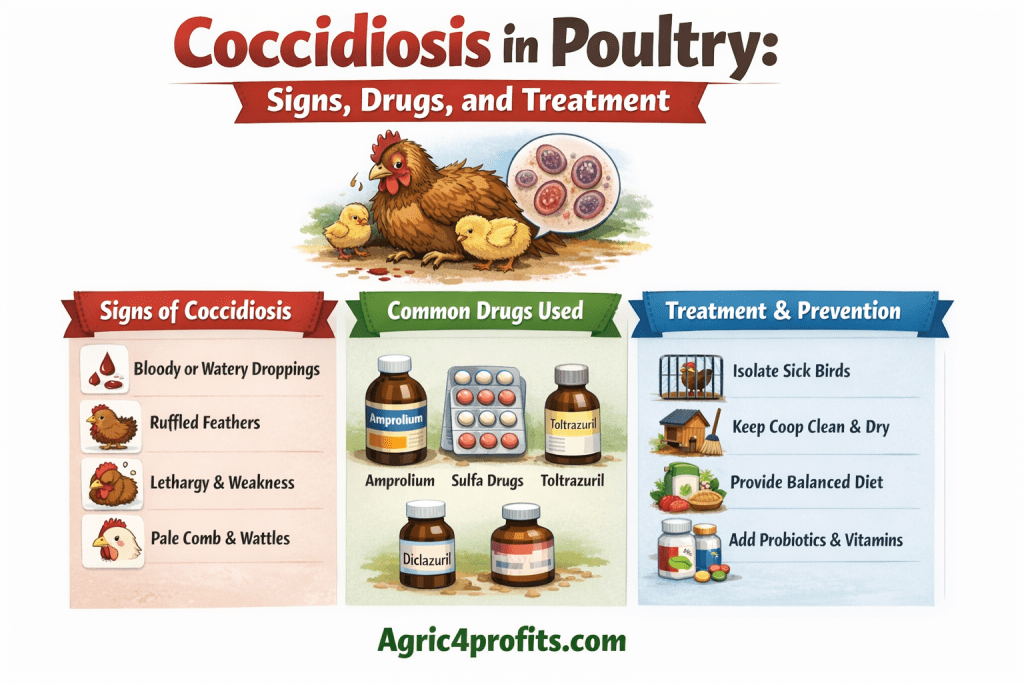
| Section | Key Points |
|---|---|
| Introduction | Coccidiosis affects poultry on deep litter; signs include loss of appetite, bloody droppings; treatment depends on management. |
| Control | Two types: clinical (visible symptoms) and subclinical (hidden but impacts performance); use prevention to limit effects. |
| Important Species | E. acervulina, E. maxima, E. tenella; each hits different gut areas. |
| Diagnosis | Look for sick posture, pale skin, gut lesions; confirm with microscope. |
| Prevention | Use anticoccidials in feed or vaccines; programs like straight, shuttle; manage litter moisture. |
| Treatment | Drugs like amprolium, sulphonamides; flush lines, follow labels; support with vitamins. |
Frequently Asked Questions About Coccidiosis in Poultry: Signs, Drugs, and Treatment
1. What causes coccidiosis in chickens?
Protozoan parasites from the Eimeria genus spread through contaminated litter and feed.
2. How can I tell if my birds have coccidiosis?
Watch for no eating, bloody or brown droppings, huddling, and sudden deaths.
3. Is coccidiosis preventable?
Yes, with anticoccidial drugs in feed, vaccines, and good litter management.
4. What drugs treat coccidiosis?
Amprolium and sulphonamides work well; pick based on species and severity.
5. Can vaccines stop coccidiosis?
Live vaccines build immunity but need proper admin and litter conditions.
6. Why does litter matter?
Wet litter helps oocysts survive and spread; keep it dry to reduce risk.
7. What’s subclinical coccidiosis?
Birds show no signs but grow slower due to gut damage.
8. How often to treat?
Depends on signs; vaccinated flocks may skip repeats.
9. Are there resistant strains?
Yes, rotate drugs to avoid resistance buildup.
10. What if treatment fails?
Check for errors like wrong dose or wet litter; consult a vet.
Do you have any questions, suggestions, or contributions? If so, please feel free to use the comment box below to share your thoughts. We also encourage you to kindly share this information with others who might benefit from it. Since we can’t reach everyone at once, we truly appreciate your help in spreading the word. Thank you very much for your support and for sharing!
Read Also: Cordyline Care 101: A Complete Guide