


A poultry farm is a place where chickens, ducks, turkeys, and other birds are raised for eggs and meat. These farms are like big homes for the birds, where they live and grow under the care of farmers. The farm has different areas for the birds to eat, rest, and move around freely.
At a poultry farm, the most common birds are chickens. There are many types of chickens, each with its own purpose. Some chickens are raised for their eggs, while others are raised for their meat. The farmer takes care of these chickens by providing them with proper food, clean water, and a safe place to live.
The houses where the chickens stay are called coops or poultry houses. These houses are designed to keep the chickens safe from bad weather, predators, and diseases. Inside these houses, there are special areas where the chickens lay their eggs comfortably.
The eggs collected from the farm are cleaned and packed carefully. Some of these eggs are sold to stores for people to buy and eat. Other eggs are kept to hatch into baby chicks. The farmer uses special machines called incubators to keep these eggs warm until they hatch.
Once the chicks hatch, they need a lot of care. They stay in a warm place and are given special food to help them grow healthy and strong. As they get older, they move to bigger spaces where they can walk and play around.
Apart from chickens, some poultry farms also raise ducks and turkeys. Ducks are known for their eggs and meat, while turkeys are mostly raised for their delicious meat, especially during festive seasons like Thanksgiving.
Poultry farms play an important role in providing food to people around the world. They ensure that fresh and healthy poultry products are available in markets for everyone to enjoy. These farms help in meeting the demand for eggs and meat, making sure there’s enough food for everyone.
A poultry farm is a special place where birds like chickens, ducks, and turkeys are raised with care to provide us with eggs and meat. Farmers work hard every day to make sure these birds are healthy and happy, so we can have delicious and nutritious food on our tables.
Poultry farming requires a lot of attention and effort from the farmers. They need to check on the birds every day to make sure they are healthy. Farmers also need to keep the coops clean by removing waste and adding fresh bedding for the birds to stay comfortable.
Feeding the birds is another important task on the farm. Farmers provide them with a balanced diet that includes grains, vitamins, and minerals to keep the birds strong. They make sure the birds have enough food and clean water at all times.
One of the challenges on a poultry farm is to protect the birds from diseases. Farmers work hard to keep the birds healthy by giving them vaccines and medicines when needed. They also keep the coops clean and separate sick birds from the healthy ones to prevent the spread of diseases.
Another interesting thing about poultry farming is how it helps the environment. The waste produced by the birds, like manure, can be used as fertilizer for crops. This helps in growing more food and reduces waste. Some farms even use special systems to turn this waste into energy.
Poultry farming is not only about raising birds; it also provides job opportunities for people. Many individuals work on poultry farms, taking care of the birds, managing the farm, and ensuring that everything runs smoothly.
Moreover, some poultry farms focus on organic farming methods. These farms avoid using chemicals and antibiotics in raising the birds. Instead, they rely on natural methods to keep the birds healthy, which can result in healthier products for consumers.
Overall, a poultry farm is not just a place where birds are raised; it’s a hub of activity and care, contributing to the food supply chain and providing various benefits to both people and the environment. Through dedication and hard work, farmers ensure that we have access to high-quality poultry products while maintaining the well-being of the birds and the land.
Read Also: How to Care for Thinleaf Cottonsedge (Eriophorum Viridicarinatum)
A. How to Start a Poultry Farm
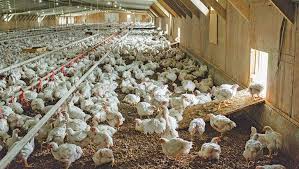
Starting a poultry farm involves several steps:
1. Research and Planning: Learn about poultry farming by reading books, attending workshops, or talking to experienced farmers. Understand the different aspects involved, such as breeds, housing, feeding, and healthcare. Create a solid business plan detailing your goals, expenses, and expected profits.
2. Choose the Poultry Type: Decide on the type of poultry you want to raise—whether it’s chickens for eggs, meat, or both, ducks, turkeys, etc. Each type has its own requirements and market demands.
3. Location and Housing: Find a suitable location for your farm. Ensure it has enough space for the poultry houses or coops. Construct sturdy and well-ventilated housing that protects the birds from harsh weather and predators.
4. Equipment and Supplies: Purchase necessary equipment such as feeders, drinkers, incubators (if hatching eggs), and healthcare supplies. Ensure a steady supply of quality feed for your birds.
5. Obtain Birds: Source your initial flock from reputable hatcheries or breeders. Ensure they are healthy and disease-free.
6. Care and Management: Implement proper care and management practices. Provide a balanced diet, clean water, and regular healthcare to your birds. Monitor their growth and adjust as necessary.
7. Marketing and Sales: Determine your market—whether it’s local stores, restaurants, or direct sales to consumers. Develop marketing strategies to sell your poultry products effectively.
8. Compliance and Regulations: Understand the legal requirements and regulations for running a poultry farm in your area. Obtain necessary permits and licenses.
9. Start Small: It’s often advisable to start with a manageable number of birds and gradually expand as you gain experience and confidence in managing the farm.
10. Continuous Learning and Adaptation: Keep learning about new advancements and techniques in poultry farming. Adapt your practices to improve efficiency and the well-being of your birds.
Starting a poultry farm requires dedication, hard work, and a willingness to learn and adapt to the needs of the birds and the market. It’s essential to maintain the health and welfare of the birds while also managing the business aspect effectively.
B. Importance of Poultry Farm

Poultry farming holds significant importance for various reasons:
1. Food Production: Poultry farms contribute significantly to global food production by providing eggs and meat, meeting the nutritional needs of millions worldwide.
2. Economic Impact: Poultry farming creates job opportunities, supports rural economies, and provides income for farmers and workers involved in the industry.
3. Nutritional Value: Eggs and poultry meat are rich in protein, essential vitamins, and minerals, contributing to a balanced and healthy diet for consumers.
4. Resource Efficiency: Compared to larger livestock, poultry require less space and time to grow. They have a quicker turnaround time from hatching to market, making them more resource-efficient.
5. Sustainability: Proper management of poultry waste can be used as fertilizer, contributing to sustainable agricultural practices. Some farms even use waste-to-energy systems, reducing environmental impact.
6. Diversification: Poultry farming allows farmers to diversify their agricultural activities, providing additional income streams and stability for their operations.
7. Accessibility: Poultry products are more affordable and accessible to a wide range of consumers, making them an important source of animal protein, especially in regions with limited resources.
8. Health Benefits: When raised in proper conditions, poultry products offer healthier alternatives to red meat, contributing to reduced risks of certain health issues.
9. Global Food Security: Poultry farming plays a vital role in ensuring a stable and consistent supply of protein-rich food globally, contributing to food security.
10. Innovation and Development: Poultry farming continues to evolve with advancements in technology, genetics, and farming practices, leading to improved efficiency and sustainability.
Overall, poultry farming is integral to meeting food demands, supporting livelihoods, providing nutritious food, and promoting sustainable agricultural practices, making it an essential component of the global food system.
Read Also: The Morphology of Grasses: Morphological Characteristics of Grasses
C. Types of Poultry Farm

Here are some common types of poultry:
1. Chickens: Among the most common and versatile poultry, chickens are raised for their meat (broilers) or eggs (layers). There are various breeds, each with specific characteristics suited for either meat or egg production.
2. Ducks: Raised for their eggs, meat, and feathers, ducks are adaptable and efficient foragers. They offer rich, flavorful meat and are known for their high-quality eggs.
3. Turkeys: Primarily raised for their meat, particularly during festive occasions like Thanksgiving. Turkeys have large breast muscles and offer a different taste compared to chicken.
4. Geese: Geese are known for their meat, down feathers, and liver (foie gras). They are hardy birds and can be raised for meat, eggs, or as pets.
5. Quail: Smaller birds that are gaining popularity due to their small size and fast maturity. They are raised for both eggs and meat.
6. Guinea Fowl: These birds are known for their insect-eating capabilities, serving as natural pest controllers. They are also raised for their flavorful meat.
7. Pigeons: Often overlooked in modern farming, pigeons are raised for meat and sometimes as pets. They were historically used for delivering messages.
Each type of poultry has its own characteristics, benefits, and purposes, allowing farmers to choose the type that best suits their goals and resources for farming.
D. Poultry Health and Diseases
Poultry health is crucial for successful farming. Here are some common poultry diseases and health concerns:
1. Avian Influenza (Bird Flu): A highly contagious viral disease affecting birds, with various strains. It can cause severe illness and mortality in poultry and poses a potential risk to human health.
2. Newcastle Disease: Highly contagious and fatal viral disease affecting respiratory, nervous, and digestive systems in birds. Vaccination is crucial for prevention.
3. Infectious Bronchitis: A viral respiratory disease causing coughing, sneezing, and decreased egg production in layers. Vaccination helps control outbreaks.
4. Coccidiosis: Caused by a parasite affecting the intestinal tract, leading to diarrhea, weight loss, and sometimes death. Managed through medication or preventive measures.
5. Fowl Cholera: Bacterial disease causing respiratory distress, swollen joints, and sudden death in birds. Vaccination and proper hygiene are essential for prevention.
6. Marek’s Disease: A viral disease affecting nervous and immune systems in chickens, causing tumors and paralysis. Vaccination is the primary preventive measure.
7. Salmonella: Bacterial infection affecting birds and causing foodborne illness in humans. Proper hygiene, sanitation, and biosecurity measures are critical for prevention.
8. Egg Drop Syndrome (EDS): Viral disease causing a decrease in egg production and quality. Vaccination is used for prevention.
9. External Parasites: Mites, lice, and ticks can infest poultry, causing irritation, feather loss, and anemia. Regular cleaning, disinfection, and treatment are necessary.
Prevention of poultry diseases involves maintaining proper hygiene, providing clean water and balanced nutrition, implementing biosecurity measures, regular vaccination programs, and prompt veterinary care when issues arise. Early detection and proper management are essential to maintain flock health and minimize economic losses.
E. Economic Benefits of Poultry Farm
The economic benefits of poultry farming are substantial:
1. Income Generation: Poultry farming serves as a significant income source for farmers. It provides a steady revenue stream through the sale of eggs, meat, feathers, and other poultry products.
2. Employment Opportunities: Poultry farming creates job opportunities across various levels, from farm workers to technicians, veterinarians, marketers, and managers, thereby reducing unemployment rates in rural areas.
3. Local Economy Support: Poultry farming contributes to local economies by generating income that circulates within the community. This income supports businesses, services, and infrastructure development in rural regions.
4. Rapid Turnover and High Returns: Poultry, especially chickens, have a short production cycle compared to other livestock. They reach market weight or start laying eggs relatively quickly, leading to faster returns on investment.
5. Efficient Use of Resources: Poultry farming requires less space and feed compared to larger livestock, making it more resource-efficient. It helps farmers optimize land usage and feed resources for increased productivity.
6. Export and Trade: Poultry products, particularly chicken meat and eggs, are frequently exported, contributing to national economies through trade and export revenues.
7. Value-Added Products: Poultry farming facilitates the production of various value-added products like processed meats, canned goods, and feather-based products, enhancing market diversity and profitability.
8. Diversification in Agriculture: Integrating poultry farming with other agricultural activities provides farmers with diversified income streams, reducing dependency on a single crop or livestock species.
9. Supporting Livelihoods: Poultry farming often serves as an additional income source for small-scale farmers, empowering them economically and improving their standards of living.
10. Adaptability and Scalability: Poultry farming can be easily adapted to various scales, from small backyard operations to large commercial farms, making it accessible to a wide range of farmers.
Summary on Poultry Farm: A Beginner’s Guide
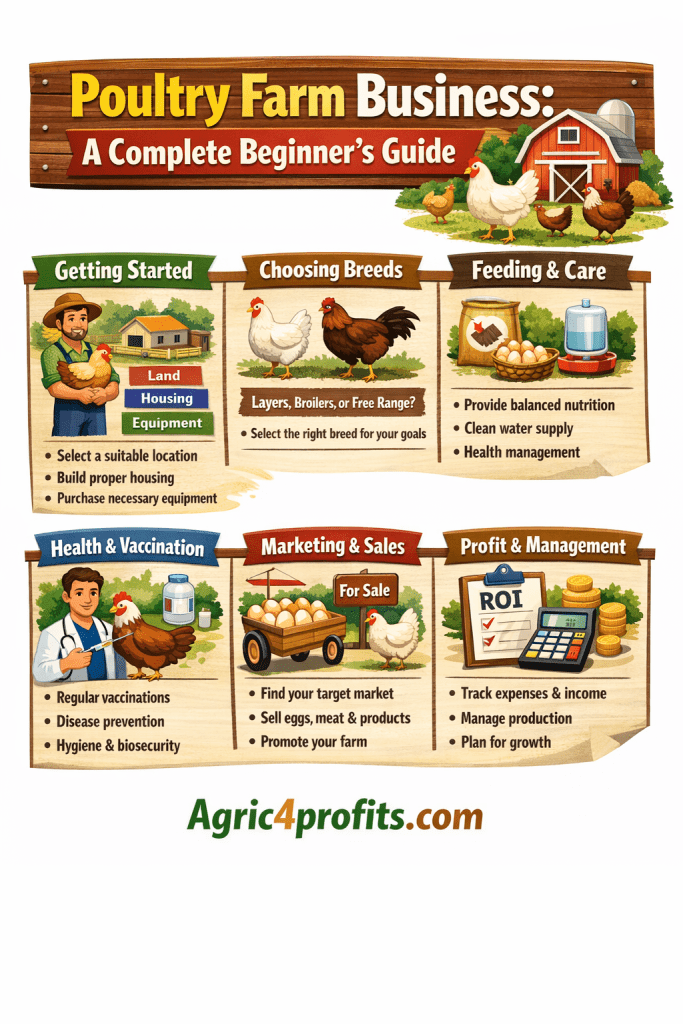
| Aspect | Details |
|---|---|
| Definition | Poultry farming is the practice of raising domesticated birds, primarily chickens, but also turkeys, ducks, and geese, for meat, eggs, feathers, or breeding stock |
| Why Start Poultry Farming | Low start-up cost relative to other livestock, quick returns, steady demand, minimal land requirement, creates employment, and contributes to food security |
| First Step | Develop a solid business plan covering goals, target market, production type, budget, financial projections, and risk management |
| Types of Production | Broiler farming (meat), Layer farming (eggs), Dual-purpose farming (both meat and eggs) |
| Farming Systems | Intensive/Commercial (deep litter, battery cage, slatted floor); Semi-intensive (partial cage, partial free-range); Free-range; Backyard/Village |
| Breed Selection – Broilers | Cobb 500, Ross 308, Hubbard; fast-growing, reach ~2 kg market weight in 6-8 weeks; select for growth rate, feed conversion, and disease resistance |
| Breed Selection – Layers | Hy-Line, Lohmann, ISA Brown, White Leghorn, Rhode Island Red; high egg yield (280-320 eggs/year); select for laying capacity and local climate adaptability |
| Dual-Purpose Breeds | Plymouth Rock, Sussex, Rhode Island Red; balanced for both meat and eggs; suitable for smallholder and backyard farmers |
| Site Selection | Good access roads, proximity to feed suppliers and markets, adequate land, good drainage, prevailing wind direction (away from residential areas), and reliable water supply |
| Housing Requirements | Adequate space (broilers: ~0.1 m²/bird; layers: varies by system), proper ventilation, controlled lighting (layers need 16-17 hours/day), temperature regulation, predator-proofing, and easy cleaning |
| Housing Types | Deep litter (most common for broilers), battery/layer cages, slatted/wire floor, free-range coops |
| Essential Equipment | Feeders, drinkers, brooders/heat lamps, incubators (if hatching), nesting boxes (layers), egg trays, weighing scale, thermometers, sprayers, and lighting systems |
| Brooding Management | Maintain temperature of 32-35°C (90-95°F) in week 1; reduce by ~3°C/week until ambient temperature reached; ensure draft-free environment; provide adequate feed, water, and light |
| Feed & Nutrition | Provide balanced compound feed by stage: Starter (0-3 weeks, 22-24% protein), Grower (3-6 weeks, 18-20%), Finisher (6-8 weeks, 16-18%) for broilers; Chick mash, Grower mash, Layer mash for layers; supplement with vitamins and minerals |
| Feed Cost | Accounts for 60-70% of total production cost; bulk purchasing, on-farm feed mixing, and minimising wastage are key to profitability |
| Water Management | Chickens drink 2x their feed intake; clean, fresh water must be available at all times; water deprivation rapidly reduces growth and egg production |
| Vaccination Program | Marek’s Disease (hatch), Newcastle Disease (day 7, 4 weeks, 8 weeks), IBD/Gumboro (14-18 days), Infectious Bronchitis (day 1 or 14), Fowlpox (4-8 weeks); schedule varies by region and farm type |
| Biosecurity Measures | Control farm entry (one entrance), disinfection footbaths and vehicle dips, separate age groups (all-in/all-out), restrict visitor access, quarantine new birds (2+ weeks), prevent wild bird contact, clean and disinfect housing between flocks |
| Health Monitoring | Observe birds daily for signs of illness (depression, reduced feed/water intake, abnormal droppings, respiratory signs, swollen joints); maintain flock health records; consult a veterinarian promptly |
| Common Diseases to Watch | Newcastle Disease, Infectious Bursal Disease (Gumboro), Infectious Bronchitis, Marek’s Disease, Avian Influenza, Coccidiosis, Fowl Typhoid, Colibacillosis, Mycoplasmosis |
| Lighting Management | Broilers: 23 hours light/1 hour dark in early weeks; Layers: 16-17 hours light/day at peak production to stimulate laying; use yellow, red, or orange light for broilers |
| Waste Management | Poultry litter/manure is a high-value organic fertilizer; compost and sell or use on-farm; proper disposal prevents environmental pollution and disease build-up |
| Record Keeping | Track mortality rates, feed consumption, feed conversion ratio (FCR), egg production, body weight, vaccination dates, and sales; records guide management decisions and profitability analysis |
| Marketing Channels | Local open markets, hotels and restaurants, supermarkets, food processors, direct-to-consumer, online platforms, and farmer cooperatives |
| Key Performance Indicators | Feed Conversion Ratio (FCR), mortality rate, daily weight gain (broilers), egg production rate (layers), egg quality, and cost per kg of meat/egg produced |
| Common Beginner Mistakes | Overcrowding, ignoring biosecurity, poor ventilation, inconsistent feeding and watering, skipping vaccinations, buying poor-quality chicks, and lack of record keeping |
| Technology in Poultry Farming | Automated feeding and drinking systems, temperature and humidity sensors, IoT monitoring apps, mobile farm management platforms, and AI-driven health monitoring tools |
| Profitability Tips | Buy quality chicks from reputable hatcheries, minimize feed wastage, complete multiple batches per year (broilers), maintain peak egg production (layers), sell by-products (manure, feathers, spent hens), and keep detailed financial records |
Frequently Asked Questions About Poultry Farm: A Beginner’s Guide
1. What is the best bird to start with as a beginner poultry farmer?
Chickens are universally recommended for beginners due to their widespread market demand, relatively low cost, short production cycles, and ease of management. Within chickens, broilers are ideal if you want quick returns (6-8 weeks per cycle), while layers suit those who prefer steady, daily income from egg sales.
2. How much space do I need to start a poultry farm?
Space requirements depend on the farming system and scale. For a deep litter system, allow at least 0.1 m² per broiler bird and 0.2-0.3 m² per layer bird inside the house. A small commercial unit of 500 broilers can be managed on a modest plot. The farm should also have space for a feedstore, quarantine area, and waste management area.
3. What equipment do I need before bringing in chicks?
Before stocking chicks, you must have the brooder (heat source), feeders and drinkers (chick-size), thermometer, litter material (wood shavings or sawdust), and a clean, disinfected house. All equipment should be in place and the brooder temperature (32-35°C) reached at least 24 hours before chick arrival.
4. What is the best temperature for brooding chicks?
Start at 32-35°C (90-95°F) directly under the heat source in the first week. Reduce the temperature by approximately 3°C each week until it matches the ambient temperature (usually around week 4-5). Observe chick behavior: huddling under the heat indicates it is too cold; spreading away from the heat source indicates it is too hot.
5. How do I choose the right feed for my chickens?
Feed selection depends on the bird type and age. Broilers require Starter feed (22-24% crude protein, 0-3 weeks), Grower feed (18-20%, 3-6 weeks), and Finisher feed (16-18%, 6-8 weeks). Layers need Chick Mash (0-8 weeks), Grower Mash (8-18 weeks), and Layer Mash (18+ weeks, high calcium for eggshell formation). Always buy feed from reputable, licensed manufacturers and check for expiry dates and moisture content.
6. How do I prevent disease outbreaks on my farm?
Prevention is built on three pillars: vaccination, biosecurity, and good management. Follow a structured vaccination schedule for your region. Maintain strict biosecurity: limit farm access, use disinfection footbaths, keep age groups separate (all-in/all-out), quarantine new birds for at least 2 weeks, and prevent wild bird contact. Keep housing clean, well-ventilated, and dry. Monitor birds daily and consult a veterinarian at the first sign of illness.
7. How long does it take to make a profit from a poultry farm?
Broiler farmers can begin recovering costs and making profit from their first batch at 6-8 weeks, though significant net profit often depends on scale and efficient management. Layer farmers typically wait 16-21 weeks before hens begin laying and may take 2-3 months of egg sales before recouping initial investment. Keeping operational costs, especially feed, low is the single greatest determinant of profitability.
8. What are the most common mistakes beginners make in poultry farming?
The most frequent mistakes include overcrowding birds, neglecting biosecurity, poor ventilation leading to respiratory disease, skipping or delaying vaccinations, buying low-quality day-old chicks from unvetted hatcheries, failing to keep farm records, underestimating feed costs, and not having a clear marketing plan before birds reach market age.
9. Do I need a veterinarian for a small poultry farm?
Yes. Even for small flocks, having access to a poultry veterinarian is strongly advisable. A vet can help you design a vaccination and deworming schedule, diagnose disease outbreaks early, advise on treatment options, and conduct post-mortem examinations when birds die unexpectedly. Early professional intervention can prevent a small problem from becoming a flock-wide catastrophe.
10. How do I market and sell my poultry products?
Start by identifying buyers before your birds reach market age. Key channels include local open markets and butchers, hotels and restaurants (consistent high-volume buyers), supermarkets and retail chains, food processors, and direct-to-consumer sales via social media or WhatsApp. Joining a farmer cooperative or poultry association can help you access better prices, shared transport, and collective bargaining power. Value-added products such as dressed chicken, smoked poultry, and packaged eggs command higher margins.
Do you have any questions, suggestions, or contributions? If so, please feel free to use the comment box below to share your thoughts. We also encourage you to kindly share this information with others who might benefit from it. Since we can’t reach everyone at once, we truly appreciate your help in spreading the word. Thank you very much for your support and for sharing!
Read Also: How to Make a Potholder