



Creamy and mild, cashews are easy to love and hard to stop eating. While the list of cashew nuts’ health benefits is long, there is one main disadvantage: Cashews are high in fat and calories, and eating too many can lead to weight gain.
Cashew nuts may taste decadent, but they’re actually good for your health. Rich in important nutrients such as protein, fiber and iron, cashews are a snack you can eat every day without guilt. That said, eating large amounts of cashews can easily lead to weight gain, so stick with just one serving for your waistline’s sake
Cashews are a type of nut with a soft consistency and sweet flavor. They are native to South America, specifically Brazil, and were introduced by colonists to Africa and India. These regions are the largest producers of cashews today. Cashews are sold both raw or roasted, and salted or unsalted.
Cashews have recently been used to make dairy alternatives, such as cashew milk, cashew-based cheese, and cashew-based cream sauces and sour cream.
It gives information on the nutritional value of cashews and their possible health benefits. You will also find some tips on how to include cashews in the diet and learn about any possible health risks.
Disadvantages of Cashew Nuts
When consumed in moderation, cashew nuts are a nutritious addition to your diet. Like all nuts, they are a good source of healthy fats, fiber, protein, vitamins, minerals, and antioxidant phytochemicals, according to a research review published in Nutrients in December 2017.
But like all nuts, cashews are high in fat, which makes them high in calories. Fat is a more concentrated source of calories than carbohydrates or protein, so you can only eat a small amount at one time; one serving of nuts is 1 ounce.
One ounce of cashews — about 18 medium nuts, according to Cleveland Clinic, has 157 calories. That’s not a huge amount — about 8 percent of the total daily calories for a typical 2,000-calorie diet. However, it’s very easy to eat more than 18 cashews in one sitting without even realizing it.
1) Oxalate Content

Cashews have consistently been determined to have high oxalate content. Oxalates are naturally occurring organic acids found in a wide variety of foods, and in the case of certain medical conditions, they must be greatly restricted in a meal plan to prevent over-accumulation inside the body.
This can quickly increase the calories in your snack and make up an even greater portion of your daily calories. For example, if you ate 3 ounces or 5 ounces of cashews at once, that would be 471 or 785 calories — 23.5 or 39 percent of a typical 2,000-calorie diet.
Unless you are carefully watching your intake of other foods, consuming all those cashews means you’re going to exceed your calorie needs for the day. Doing that leads to weight gain — the more calories you eat in excess of your body’s daily needs, the more weight you gain.
Read Also: Nutritional Profile and Food Rating System Chart of Cashew
2) A Heavy Calorie Load
Cashews are rich in heart-healthy monounsaturated fat. But even nutritious fats contain more than double the calories of carbohydrates or protein, so cashews pack a hefty caloric punch. Just 1 ounce of dry-roasted cashews contains 163 calories; eat 1 cup — easy to do when snacking straight from the bag — and you’ll have consumed 786 calories, nearly 40 percent of what you need in a 2,000-calorie diet. When you eat more calories than your body needs for energy, it stores the excess as body fat, and you gain weight.
3) Excess Sodium

Although plain cashews contain very little sodium, salted versions may contain about 181 milligrams of sodium per ounce. Excess sodium may increase your blood pressure, possibly raising your risk of cardiovascular disease.
The Centers for Disease Control and Prevention recommends that healthy people get no more than 2,300 milligrams of sodium per day, while those at risk of heart disease should get no more than 1,500 milligrams of sodium per day.
While cashews’ sodium content may seem relatively low compared to these numbers, sodium adds up quickly with multiple servings, and if you’re like most Americans, you’re already getting too much sodium in your diet. Choose unsalted cashews to avoid this issue.
Read Also: How to Select, Store and Enjoy Cashew
4) Raw Cashew Dangers
You’re unlikely to find raw or in-shell cashews at the store, but if you do, steer clear. Cashews are related to poison ivy and poison sumac, and oils in their shells cause an itchy, unpleasant reaction on your skin.
Roasting the de-shelled cashews at high temperatures destroys any lingering toxic oils, which is why you’re perfectly safe eating commercially prepared cashews.
5) Eating in Balance
Your body needs a broad range of nutrients to thrive, and eating too many cashews will leave little room for other important foods. The U.S. Department of Agriculture’s MyPlate guidelines recommend eating just 5.5 ounces of high-protein foods including nuts, beans, tofu, and fish each day, and you’ll be healthiest choosing a variety of items from this group. You also need plenty of fruits, vegetables, and grains, so don’t let cashews or any other food dominate your diet.
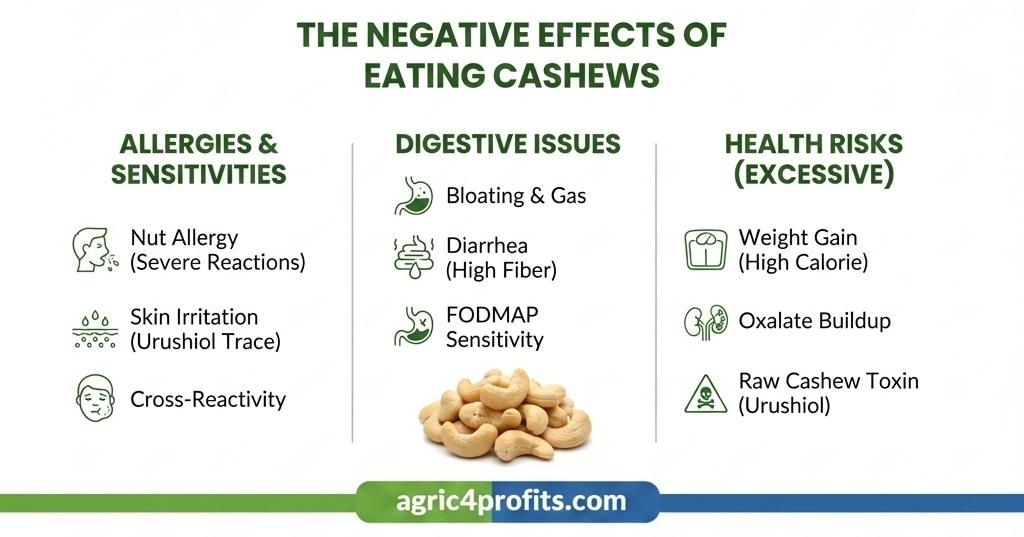
Summary of The Negative Effects of Eating Cashews
| Key Aspect | Description |
|---|---|
| Introduction to Cashews | Cashews are creamy, mild nuts native to South America, now produced mainly in Africa and India. They are used in snacks and dairy alternatives, offering nutrients like protein, fiber, and iron. |
| General Disadvantages | High in fat and calories, leading to potential weight gain if overconsumed. Moderation is key, with one serving being 1 ounce (about 157 calories). |
| Oxalate Content | High oxalates can be problematic for those with certain medical conditions, requiring dietary restrictions. |
| Heavy Calorie Load | Rich in monounsaturated fats, but excessive intake (e.g., 1 cup = 786 calories) promotes weight gain. |
| Excess Sodium | Salted cashews add sodium (181 mg per ounce), which can raise blood pressure; opt for unsalted versions. |
| Raw Cashew Dangers | Raw cashews contain toxic oils related to poison ivy; always consume roasted ones. |
| Eating in Balance | Overconsumption limits intake of other nutrients; follow USDA guidelines for varied protein sources. |
FAQ About The Negative Effects of Eating Cashews
1. What are the main disadvantages of eating cashews?
Cashews are high in calories and fat, which can lead to weight gain if eaten in large quantities. They also contain oxalates, excess sodium in salted versions, and potential risks from raw nuts.
2. How many cashews should I eat per day?
A recommended serving is 1 ounce, about 18 medium nuts, providing around 157 calories. Stick to this to avoid exceeding daily calorie needs.
3. Are cashews high in oxalates?
Yes, cashews have high oxalate content, which may need to be restricted for individuals with certain medical conditions to prevent accumulation in the body.
4. Can eating too many cashews cause weight gain?
Absolutely, since they are calorie-dense. For example, 3 ounces provide 471 calories, which can add up quickly and lead to excess calorie intake.
5. What is the sodium content in salted cashews?
Salted cashews contain about 181 milligrams of sodium per ounce, which can contribute to high blood pressure if consumed excessively.
6. Are raw cashews safe to eat?
No, raw cashews contain toxic oils that can cause skin reactions similar to poison ivy. Always choose roasted cashews.
7. How do cashews fit into a balanced diet?
They should be part of a varied intake of high-protein foods, limited to about 5.5 ounces per day alongside fruits, vegetables, and grains.
8. What nutrients do cashews provide despite their disadvantages?
Cashews offer healthy fats, fiber, protein, vitamins, minerals, and antioxidants, making them nutritious in moderation.
9. Should I choose salted or unsalted cashews?
Unsalted cashews are better to avoid excess sodium, especially if you have heart disease risks or already consume high-sodium foods.
10. Can cashews be used in dairy alternatives?
Yes, they are commonly used to make cashew milk, cheese, cream sauces, and sour cream as plant-based options.
Do you have any questions, suggestions, or contributions? If so, please feel free to use the comment box below to share your thoughts. We also encourage you to kindly share this information with others who might benefit from it. Since we can’t reach everyone at once, we truly appreciate your help in spreading the word. Thank you very much for your support and for sharing!
Disclaimer: This article is for educational and informational purposes only. The health benefits described are based on scientific research and traditional knowledge. They ayre not a substitute for professional medical advice, diagnosis, or treatment. Always consult a healthcare professional before using any herb or natural remedy for medical purposes.
Read Also: Setbacks of Forest and Wildlife Resources