


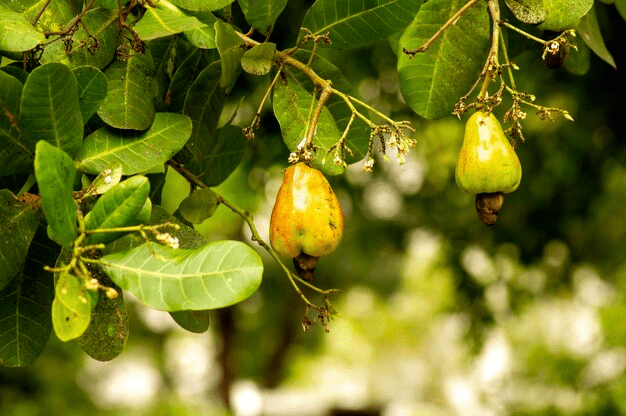
Cashew (Anacardium Occidentale) is originally from Central and South America, with its primary area of diversity in eastern Brazil. Today, cashew is cultivated in many regions where cold temperatures do not restrict its growth.
The global production of cashew nuts, the plant's main commercial product, is about 500,000 tons annually, with more than 60% of this production coming from South Asia and East Africa, especially India and Tanzania. Smaller amounts are produced in West Africa, including Nigeria, where it's mainly grown by small-scale farmers in the north-central zone.
Taxonomy
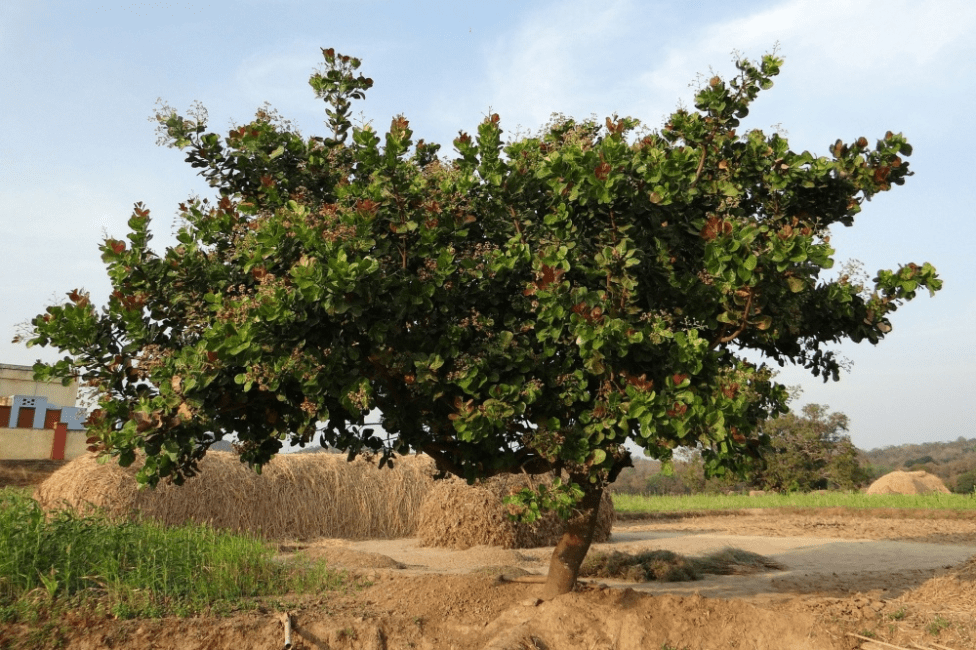
Cashew belongs to the family Anacardiaceae, which also includes mangoes. The genus Anacardium consists of about eight species of trees and shrubs, with Anacardium occidentale being widely grown in tropical regions for its nuts. The cashew tree is medium-sized, with a spreading canopy, and it often has drooping branches. It reaches a mature height of 10–11 meters.
Uses
Cashew seeds, or nuts, are produced by shelling the fruits. These nuts are used in sweets and desserts and yield edible oil, though it is rarely extracted due to the high cost of the kernels. The shells produce cashew-shell oil, which can be used as a waterproofing agent and preservative.
🌿 Go Organic on Your Farm: Instead of harmful chemical pesticides and fertilisers, try our organic farming products — including neem oil spray, bio-pesticides, natural plant treatments, organic seeds and seedlings, suckers, and many more organic products that are safe for your health, your family, your soil and your harvest. Shop Now →
When distilled and polymerized, cashew oil can be used in insulating varnishes, typewriter rolls, oil and acid-proof cement, tiles, brake linings, and inks. The cashew apple, the fleshy part, is juicy, astringent, and edible, while the juice can be fermented into wine, and the pulp can be made into preserves. The sap from the bark can be used to make indelible ink, and the apple pulp can be fed to livestock.
Read Also: The Negative Effects of Eating Cashews
Origin and Distribution
🔧 Free Farm Tool Available: Use our free Agric4Profits Farm Tools to calculate your farm profits, formulate feeds, identify pests and diseases on both your crops and animal farms, plan your planting and harvesting season, including many more farm tasks to get free expert advice and recommendations — completely free, no registration required. Access Free Tools →
The cashew is native to tropical America, ranging from Mexico to Peru and Brazil, as well as the West Indies. It was one of the first fruit trees from the New World to be widely distributed throughout the tropics by early Portuguese and Spanish explorers.
The Portuguese introduced it to India from Brazil in the 16th century, and it likely reached East Africa and Malaysia around the same time. Cashew has now become naturalized in many tropical countries, including Nigeria.
Ecology
Cashew is hardy and drought-resistant but susceptible to frost. It thrives under a variety of climatic and soil conditions and can be grown from sea level up to 300 meters, although it is best suited to lower elevations. It prefers areas with annual rainfall between 50 and 375 cm. Cashew grows best on sandy soils with good drainage but is often found on hillsides that are too dry and rocky for other crops.
Site Selection
💬 Have a Farming Question? Join thousands of farmers across Africa on the Agric4Profits Community — ask questions, share experiences and connect with agricultural experts. It is completely free. Ask Your Question Now →
Unlike other tree crops, cashew can grow under a wide range of ecological conditions. It is tolerant of low soil moisture and is not adversely affected by high soil moisture, though it does not tolerate waterlogged conditions. The soil should be deep, well-drained, and relatively flat.
Germination of Cashew Seeds
Cashew seeds have a very thick coat, which makes germination slow. However, early germination can be encouraged by cracking the seed coat, treating seeds with dilute sulfuric acid (H2SO4), or soaking them in water for 24 to 36 hours before planting. With these methods, seeds can germinate in two to three weeks. Once germinated, the seeds can be planted in polythene bags at a rate of one seed per bag.
Chemical Composition
Cashew nuts contain:
- Water: 5%
- Protein: 20%
- Fat: 45%
- Carbohydrate: 26%
- Fiber: 1.5%
- Minerals: 2.5%
The shell contains about 50% cashew-shell oil, composed of 90% anacardic acid and 10% cardol. The cashew apple, which is consumed fresh, contains:
- Water: 88%
- Protein: 0.2%
- Fat: 0.1%
- Carbohydrate: 11.6%
- Vitamin C: Very rich
Propagation and Nursery
Cashew is usually propagated by seed, with research on vegetative propagation ongoing. In the nursery, polythene bags are arranged, slightly mulched, and watered regularly. Shade is generally not required, except in very dry areas where light shade may be provided. Routine spraying of insecticides and fungicides is recommended during the nursery period to control diseases and pests.
When polythene bags are not available, seeds can be planted in nursery beds, which should be mulched and watered as necessary. The nursery period ranges from four to six months, after which seedlings are transplanted into the field when rainfall is steady.
📖 Want to Go Deeper on This Topic?
Our expert agricultural ebooks cover poultry, fish farming, different crops production, snail farming, organic farming, mushrooms, sheep, cattle, flowers, pig farming, goat farming, agribusiness, etc. in practical step-by-step detail — written by agricultural professionals for African farmers.
Browse All Farming Ebooks →Field Planting and Establishment
Cashew plants in the field do not require shade. After preparing the land, it should be divided into blocks of 4 hectares or other suitable sizes. The recommended spacing is 9 x 9m, 10 x 10m, or 12 x 12m, depending on the variety and recommendations from the seed supplier. Dense planting is common in the early life of a cashew plantation, and intercropping with leguminous or vegetable crops is possible during the early years.
Planting holes should be 60 x 60 x 60 cm. The main post-planting maintenance tasks include weed control, especially ring weeding, and establishing a leguminous ground cover to help with weed control. It is also important to replace missing or dead plants and provide watering or irrigation as needed, especially shortly after establishment.
Pruning of the lowest side branches is recommended at the end of the first year, with further pruning in the second and third years to ensure the main stem is free of branches up to about 1 meter above ground level.
Harvesting and Processing
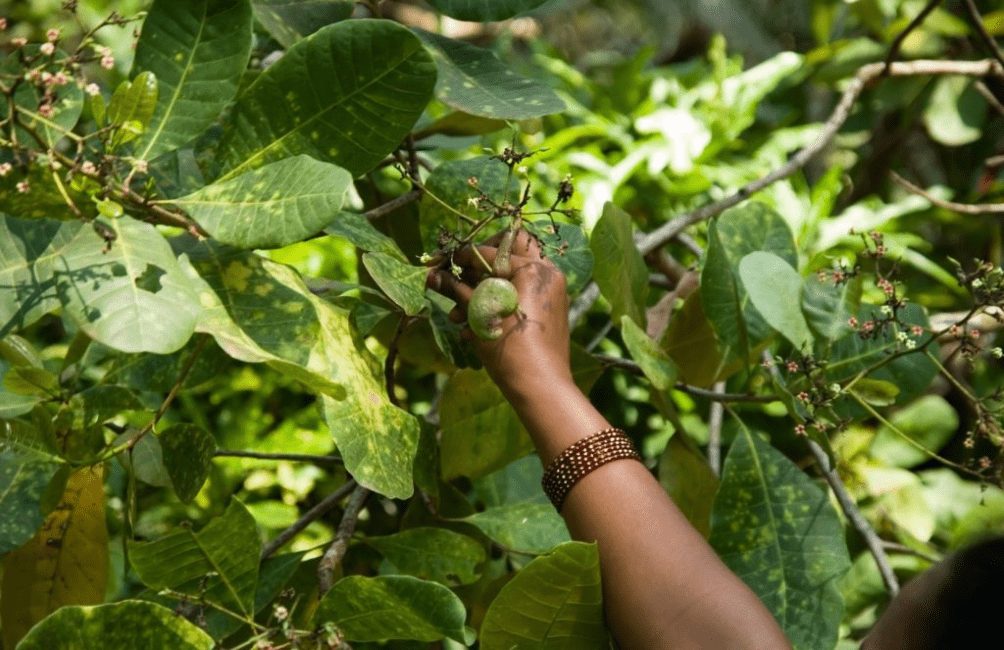
Cashew plants begin to bear economically valuable crops in the fourth year after planting. The first crop is usually small but increases gradually up to the tenth year, when the plants reach mature production. Flowering is usually abundant, but only about 10% of flowers set fruit.
As the fruits near maturity, weeds in the orchard should be slashed very low to facilitate fruit collection. Cashew fruits are not usually hand-harvested; instead, they are allowed to drop from the trees and are then collected. The nuts are separated from the apples and sun-dried until fully dry. The apples can be processed into soft drinks or alcoholic beverages through fermentation and distillation.
Read Also: The Cashew Fruit: Economic Importance, Uses, and By-Products
Processing Methods
1. Farmer Processing: Small quantities of nuts are dried and placed in hot wood ash for up to 30 minutes, then cracked on a stone. For larger quantities, nuts are roasted in a clay pot over a wood fire, which releases CNS oil from the shells, facilitating roasting. The roasted nuts are then cracked and picked.
2. Commercial Processing: Industrial processing follows the same principles as farmer processing but uses specialized machines. These machines typically include nut cleaning chambers, grading chambers, seed grading systems, and bagging units. As labor becomes more expensive, processing plants are being modified to meet the needs of the cashew industry.
Major Diseases and Pests
Cashew plants are relatively disease-resistant, with mature trees being very hardy. However, young seedlings are susceptible to:
1. Seedling Wilt: Caused by Fusarium spp., encouraged by overwatering. Control by reducing watering and spraying with fungicides.
2. Leaf Scabs: Affects both nursery and field plants, caused by various fungi. Control by spraying with copper fungicides.
3. Immature Fruit Drop: More of a physiological problem than a pathological one. Apply balanced fertilizer rich in potassium (K).
4. Fruit Rot: Caused by excessive moisture. Avoid high-rainfall areas for cashew cultivation.
Major pests include:
1. Longhorn Beetle: Control by killing adults and larvae.
2. Fruit Piercing Moth: Control by killing adults and larvae.
3. Thrips, Flower Beetles, Leaf Rollers, Variegated Locust, and Whiteflies: Control by spraying with appropriate insecticides such as Roger or Gamalin 20.
In summary, you should now be familiar with the taxonomy, origin, distribution, ecology, and structure of the cashew plant, as well as the methods for germinating cashew seeds, propagation, and seedling care. This article has also covered the uses, chemical composition of the nut and apple, and the control of diseases and pests affecting cashew plants.
Read Also: How to Make Your Own Organic Pesticides
Frequently Asked Questions
We will update this section soon.
🌱 Take Your Farming Further With Agric4Profits
Based on what you just read, here are free resources and products from Agric4Profits that can help your farm right now:
- 🛒 Visit Our Marketplace — Organic neem oil, bio-pesticides, seeds and farming products
- 📚 Read Premium Content — Advanced guides for serious and profitable farming
- 🎓 Join Our Free Academy — Structured free training for farmers across Africa
- 🔧 Use Our Free Farm Tools — Profit calculators, feed formulation, pest identifier and more
- 💬 Join Our Farming Community — Connect with farmers across all 54 African countries
- ❓ Ask a Farming Question — Get answers from experienced farmers and agricultural experts
Please cite this content in academic work, research, or publications.