


Fishes are among the most diverse vertebrates on earth, and their habits differ sharply according to temperature, salinity, and body structure. Because of that variety, classification helps students and farmers compare species more accurately.
Some fish live comfortably in rivers, while others thrive in seas, cold waters, or tropical environments. Their skeletons also differ, with some species being jawless, some cartilaginous, and others fully bony. Practical planning starts here.
A. Water Source
Fish can be grouped by water they inhabit and the temperature their bodies tolerate. This distinction shapes survival, feeding behaviour, breeding success, and commercial value. Aquaculture basics support that decision.
i. Tropical fish: Tropical fish live in warm waters, whether fresh or salty, and they perform best where temperature remains stable. Many ornamental and food species from the tropics fit this category naturally.
ii. Cold water fish: Cold water fish need lower temperatures and become stressed when heat rises too much. They may be freshwater or marine species, but their metabolism and oxygen demand suit cooler environments.
🌿 Go Organic on Your Farm: Instead of harmful chemical pesticides and fertilisers, try our organic farming products — including neem oil spray, bio-pesticides, natural plant treatments, organic seeds and seedlings, suckers, and many more organic products that are safe for your health, your family, your soil and your harvest. Shop Now →
Salinity and climate usually work together, because a species adapted to warm estuaries may not thrive in icy streams. Farmers therefore match stock carefully to local water conditions from the start.
Tropical freshwater species often include catfish, tilapia, and many ornamental varieties that tolerate managed ponds. They grow well where warmth, feed, and water quality remain consistent. Culture systems shape success.
Tropical marine species include many reef and coastal fishes that depend on saltwater stability. Their maintenance requires strong aeration, dependable seawater supply, and more careful monitoring of stress. Management discipline matters.
vi. Cold freshwater species: Cold freshwater species are more common in temperate lakes and mountain streams. Their management often depends on oxygen-rich water, lower stocking density, and protection from sudden heat.
🔧 Free Farm Tool Available: Use our free Agric4Profits Farm Tools to calculate your farm profits, formulate feeds, identify pests and diseases on both your crops and animal farms, plan your planting and harvesting season, including many more farm tasks to get free expert advice and recommendations — completely free, no registration required. Access Free Tools →
vii. Cold marine species: Cold marine species live in cool oceans and often show slower growth than tropical fish. They remain important in commercial fisheries because their flesh, oil, and market demand are valuable.
B. Type of Water Body

Fish are also grouped by the water body where they spend most of their lives. This approach separates freshwater, marine, and transitional species, and it helps explain feeding habits and movement patterns. Pond design matters.
i. Freshwater fish: Freshwater fish live in rivers, streams, lakes, and ponds where salt concentration remains low. They are often easier to rear in inland aquaculture systems because their environment is simpler to control.
ii. Marine fish: Marine fish inhabit seas and oceans, where salinity is high and water movement is constant. They usually demand stronger infrastructure, better aeration, and more careful handling during transport.
Some species move between fresh and salty water during growth or migration. These fish show that classification must sometimes reflect life history, not only habitat. Water preparation is crucial in practice.
💬 Have a Farming Question? Join thousands of farmers across Africa on the Agric4Profits Community — ask questions, share experiences and connect with agricultural experts. It is completely free. Ask Your Question Now →
Habitat classification helps farmers choose species that suit climate and water source. It also helps researchers compare feeding strategies, disease resistance, and market suitability across aquatic systems. Species selection becomes easier.
Good aquaculture planning begins with water type, because pond freshwater fish and marine species require different stocking strategies. The same principle is discussed in tilapia production and related management guides.
Species choice becomes easier when the farmer studies water source before buying seed. That is why Careful screening remains central to profitable aquaculture decisions and prevents costly waste later on.
vii. Farm systems: Freshwater systems usually support ponds, tanks, and cages with controlled feeding. In contrast, saltwater systems often need coastal access, stronger tanks, and careful salinity management, especially in intensive operations.
Read Also: Guide to Fisheries and Fish Production
C. Basis of Body Skeleton
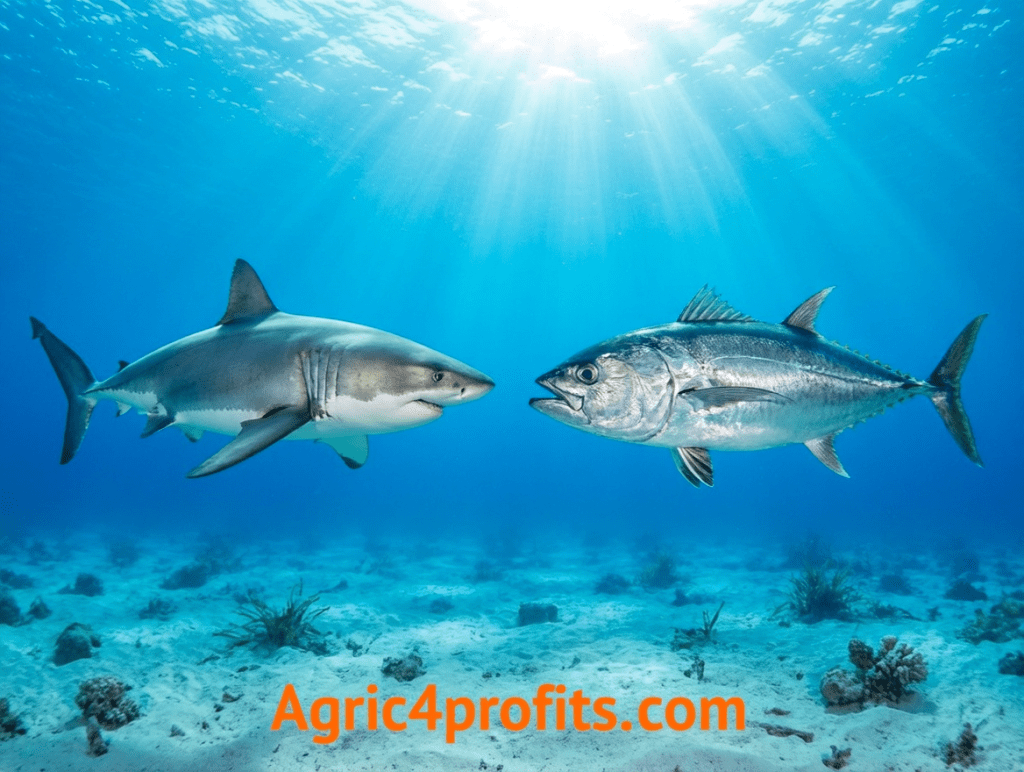
Body skeleton also classifies fishes because it reveals evolutionary history and functional differences. Some fishes have no jaws, while others possess cartilage or bone in a true internal skeleton. Fisheries classification begins here.
Jawless fish are the oldest living groups and include forms that lack biting jaws entirely. They survive with simple mouth structures adapted for suction, rasping, or scavenging in aquatic habitats. Resource objectives also matter.
ii. Evolutionary significance: Their importance is not only biological but also educational, because they show how vertebrate feeding structures developed over time. That makes them useful in zoology, anatomy, and fisheries science.
Lampreys are jawless fishes with a circular sucking mouth lined with teeth. They attach to other fish, feed by suction, and spend part of life in freshwater before migrating to coastal waters.
📖 Want to Go Deeper on This Topic?
Our expert agricultural ebooks cover poultry, fish farming, different crops production, snail farming, organic farming, mushrooms, sheep, cattle, flowers, pig farming, goat farming, agribusiness, etc. in practical step-by-step detail — written by agricultural professionals for African farmers.
Browse All Farming Ebooks →Their bodies lack paired fins and true scales, yet they have a cartilaginous support system and unusual sensory features. They differ sharply from most vertebrates. Enhancement studies often compare them.
Hagfish are primitive marine vertebrates that produce large amounts of slime as a defense. They live on the seabed, feed on dead or weakened animals, and tolerate slow, low-energy lifestyles. Stock pressure affects them.
vi. Hagfish behaviour: Their behaviour is useful to study because they show how scavenging fish survive in deep or dim environments. Their feeding style and body form make them unlike most modern commercial species.
vii. Research value: Jawless fishes help researchers trace vertebrate ancestry and compare feeding adaptations across groups. For practical context, readers can compare their uniqueness with development strategies used in fisheries education.
Cartilaginous fishes belong to the class Chondrichthyes and include sharks, rays, skates, and chimaeras. Their skeleton is made of cartilage rather than bone, giving the group distinct movement and support features. Management rules are essential.
D. Cartilaginous Fish

i. Skeleton type: A cartilaginous skeleton is lighter than bone and may be strengthened by calcification. This structure supports active swimming and makes many species powerful predators in marine environments.
These fishes usually have jaws, paired fins, and a ventral mouth that helps them seize prey efficiently. Their bodies are adapted for steady swimming and directional control. Conservation traditions remain relevant.
Their senses are highly refined, especially in detecting movement, vibration, and chemical signals. Such adaptations allow sharks and rays to locate food with impressive precision in open water. Enforcement systems still matter.
iv. Skin and teeth: Their skin bears placoid scales, and their teeth are replaced repeatedly through life. These traits protect the body and help maintain a sharp feeding surface throughout adulthood.
The class includes Elasmobranchii, which covers sharks, rays, and skates, and Holocephali, which includes chimaeras. Sawfishes, electric rays, and common rays are often discussed separately. Species choice stays important carefully today.
The class includes Elasmobranchii, which covers sharks, rays, and skates, and Holocephali, which includes chimaeras. Sawfishes, electric rays, and common rays are often discussed separately. Species choice stays important carefully.
vii. Fisheries relevance: Cartilaginous fish are important to fisheries, conservation, and ecological balance, but many species are vulnerable to overfishing. Similar resource concerns also appear in commercial species studies.
E. Bony Fish
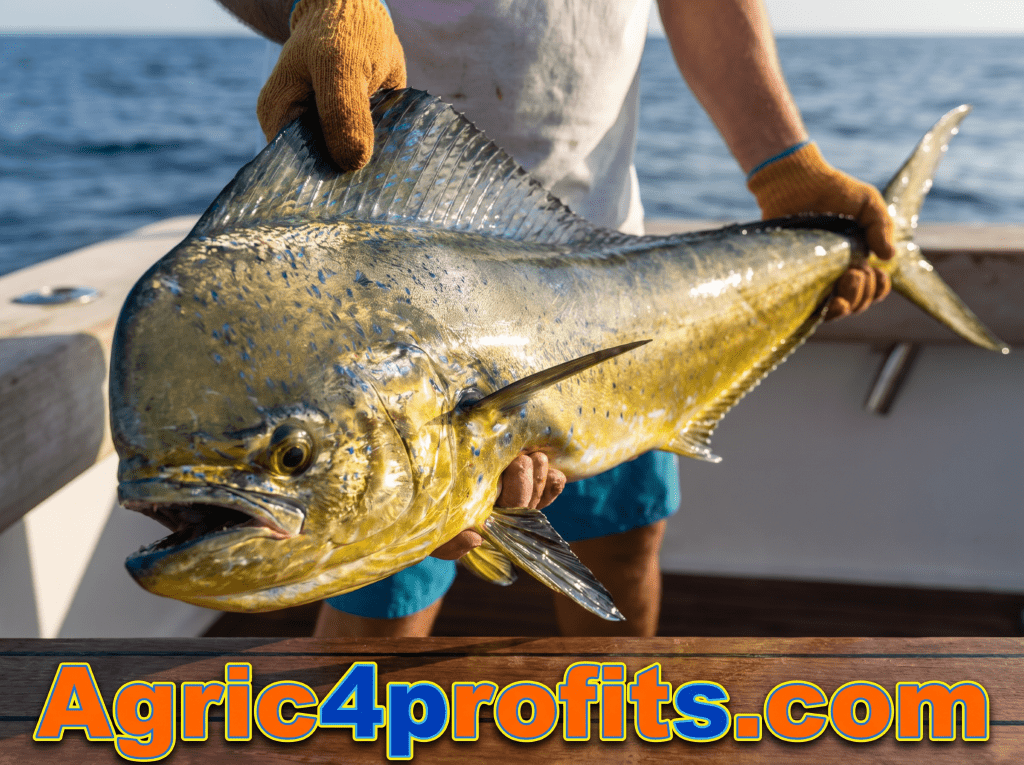
Bony fishes belong to the class Osteichthyes and represent the largest living group of vertebrates. They combine a bony skeleton with gills, paired fins, scales, and efficient swimming abilities. Commercial species dominate.
i. Core features: Their internal bone structure supports growth, movement, and shape control better than cartilage alone. Most species also have jaws, paired nostrils, and one or two gill openings for breathing.
Bony fishes occupy freshwater, marine, and brackish habitats, which explains their enormous diversity. They form the backbone of global fisheries and remain central to food security and aquaculture. Production needs are clear.
iii. Subclass Dipnoi: Lungfish belong to Dipnoi and can breathe air through a specialised organ connected to the oesophagus. Their body form helps them survive in seasonal or oxygen-poor waters. Practical husbandry is useful.
iv. Subclass Crossopterygii: Crossopterygian fishes, such as coelacanths, possess fleshy paired fins with internal skeletal elements. They are rare, yet they remain important in studies of vertebrate evolution. Growth management is related closely.
v. Subclass Actinopterygii: Actinopterygii includes most living bony fishes and is recognised by rayed fins. Catfish, tilapia, carp, trout, and many commercial species belong here. Cultivation methods vary widely in practice.
vi. Commercial importance: Their abundance makes them central to diets, trade, and pond culture. Readers studying species choice can compare them with farm routines and practical planning more easily in farms.
vii. Production links: Bony fish dominate aquaculture because they grow predictably and adapt well to managed systems. That is why feasibility planning often begins with this group in practice today.
Read Also: Aquaculture (Aqua farming) as a Fisheries Technique and Types of Aquaculture
Summary on Classification and Types of Fish
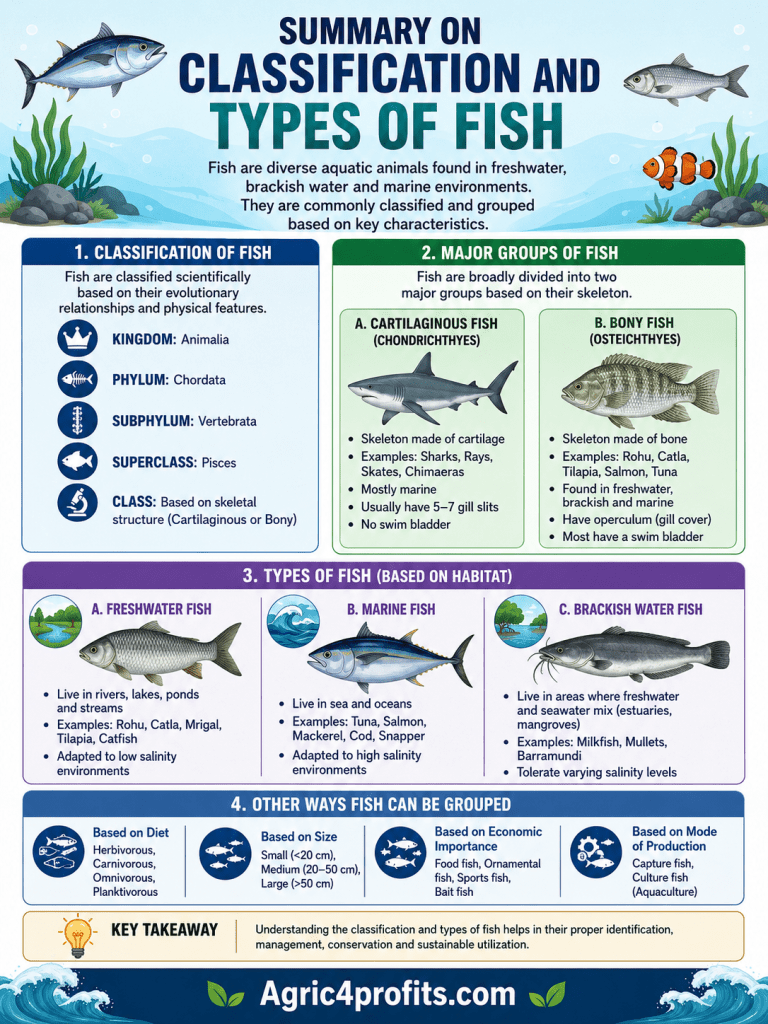
| Section | Main idea | Key takeaway |
| A. Water Source | Fish are grouped as tropical or cold-water species based on temperature needs. | Choose species that match the local climate and water stability. |
| B. Type of Water Body | Freshwater, marine, and transitional fishes live in different habitats. | Always match stock to the water source before production starts. |
| C. Basis of Body Skeleton | Fish may be jawless, cartilaginous, or bony. | Skeleton type helps explain feeding, movement, and evolution. |
| D. Cartilaginous Fish | Sharks, rays, skates, and chimaeras have cartilage-based skeletons. | They are important predators and need careful conservation. |
| E. Bony Fish | Bony fishes dominate aquaculture and commercial food supply. | They remain the most important group in farm production. |
Frequently Asked Questions About Classification and Types of Fish
1. Why does fish classification matter for students and farmers?
Classification saves time and money because it prevents species from being placed in unsuitable systems. When the habitat fits the fish, growth, survival, and harvest quality usually improve in practice.
2. What is the difference between freshwater and marine fish?
Freshwater fish live in rivers, lakes, streams, and ponds where salt remains very low. Marine fish live in seas and oceans, so their management needs stronger salinity control and infrastructure.
3. What are lampreys and hagfish?
Lampreys and hagfish are jawless fishes, which means they do not have the jaw structure seen in most other vertebrates. Their form shows a very early stage in fish evolution.
4. Why are cartilaginous fishes important?
Cartilaginous fishes are important because their skeleton, reproduction, and body design differ sharply from bony fishes in ways that affect feeding, movement, survival, and ecological balance in marine waters overall.
5. Why do bony fishes dominate aquaculture?
Bony fishes dominate aquaculture because they grow well, adapt to many systems, and include many familiar food species. Their diversity makes them the main focus of commercial fish production worldwide.
6. How does temperature affect fish classification?
Temperature affects fish classification because some species prefer warm tropical water while others need cooler conditions. A species that thrives in one climate may fail quickly in another environment today.
Do you have any questions, suggestions, or contributions? If so, please feel free to use the comment box below to share your thoughts. We also encourage you to kindly share this information with others who might benefit from it. Since we can’t reach everyone at once, we truly appreciate your help in spreading the word. Thank you very much for your support and for sharing!
Read Also: What You Should Know Before Venturing Into Fruit Farming
🌱 Take Your Farming Further With Agric4Profits
Based on what you just read, here are free resources and products from Agric4Profits that can help your farm right now:
- 🛒 Visit Our Marketplace — Organic neem oil, bio-pesticides, seeds and farming products
- 📚 Read Premium Content — Advanced guides for serious and profitable farming
- 🎓 Join Our Free Academy — Structured free training for farmers across Africa
- 🔧 Use Our Free Farm Tools — Profit calculators, feed formulation, pest identifier and more
- 💬 Join Our Farming Community — Connect with farmers across all 54 African countries
- ❓ Ask a Farming Question — Get answers from experienced farmers and agricultural experts
Please cite this content in academic work, research, or publications.