


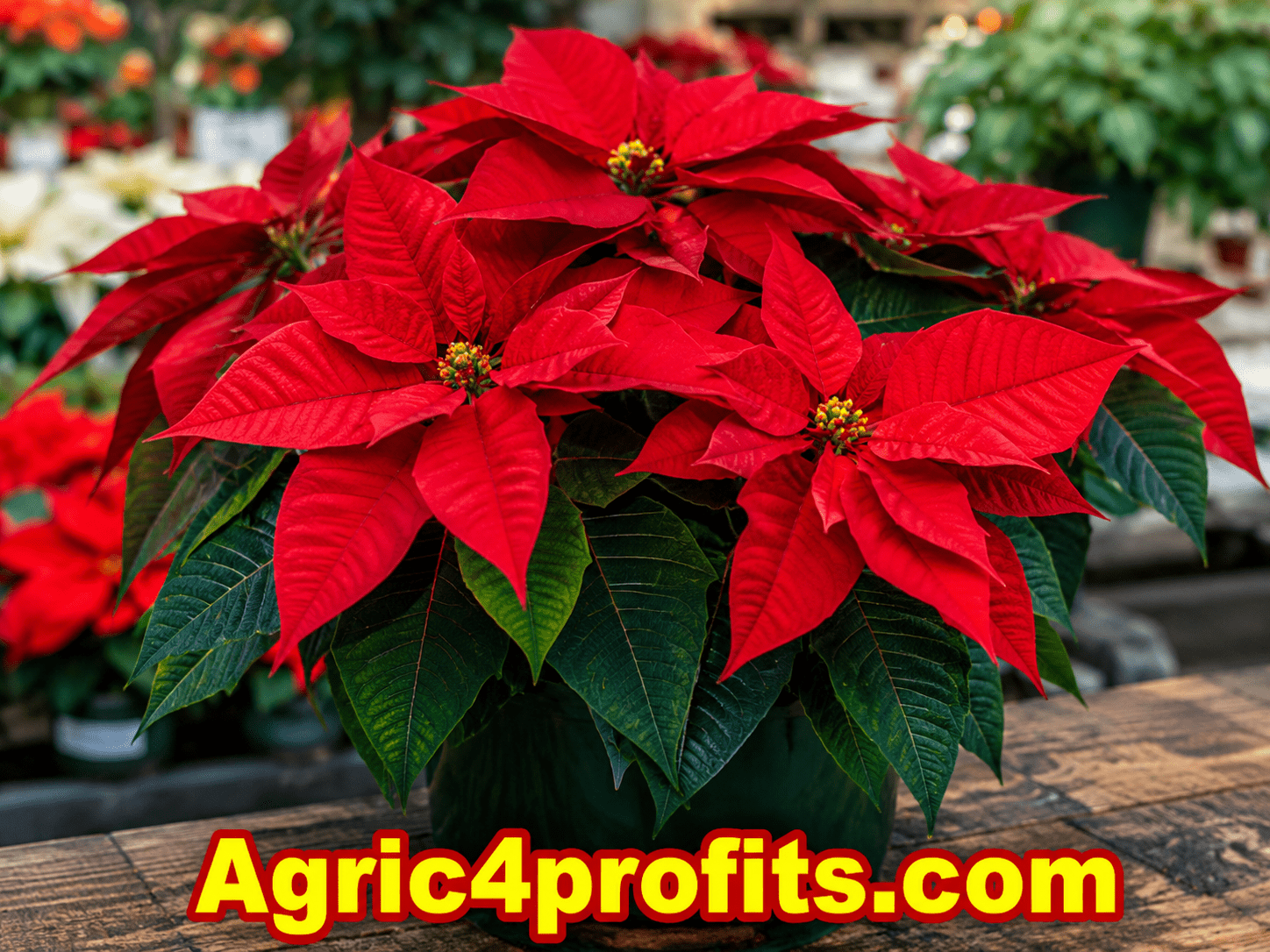
Poinsettia flowers, scientifically known as Euphorbia pulcherrima, are among the world's most recognizable holiday plants, admired for colorful bracts, attractive foliage, cultural symbolism, and their ability to brighten indoor spaces.
Native to Mexico and parts of Central America, poinsettias thrive naturally in warm climates, while cultivated plants are commonly grown in containers, greenhouses, gardens, nurseries, and decorative commercial settings.
Although commonly called flowers, the colorful red, pink, white, cream, and bi-colored structures are actually bracts, which are modified leaves surrounding the plant's small, yellow true flowers.
The plant became closely associated with Christmas after its introduction to the United States and later commercial development, making poinsettias a familiar feature of seasonal displays around the world.
Despite persistent misconceptions, poinsettias are not considered highly poisonous to people or pets, although their milky latex sap may irritate skin and cause mild gastrointestinal discomfort if swallowed.
Poinsettias also have historical importance because Indigenous peoples in Mexico used the plant for traditional purposes, including dye production and medicinal practices, long before modern Christmas traditions developed.
🌿 Go Organic on Your Farm: Instead of harmful chemical pesticides and fertilisers, try our organic farming products — including neem oil spray, bio-pesticides, natural plant treatments, organic seeds and seedlings, suckers, and many more organic products that are safe for your health, your family, your soil and your harvest. Shop Now →
Today, poinsettias are appreciated for decoration, gifting, indoor landscaping, seasonal displays, commercial floriculture, botanical breeding, and their strong connection with Christmas celebrations and cultural storytelling.
Their popularity demonstrates how a plant can combine horticultural value, cultural history, visual appeal, and commercial importance, making poinsettias interesting to gardeners, florists, collectors, and ornamental plant producers.
For readers interested in ornamental cultivation generally, learning about flower plants and their growing requirements provides useful background for understanding how different species respond to environmental conditions.
Poinsettias also fit within the broader field of horticulture, where flowers contribute aesthetic, ecological, cultural, and commercial value, as explained in the role flowers play in horticulture and ornamental landscaping.
🔧 Free Farm Tool Available: Use our free Agric4Profits Farm Tools to calculate your farm profits, formulate feeds, identify pests and diseases on both your crops and animal farms, plan your planting and harvesting season, including many more farm tasks to get free expert advice and recommendations — completely free, no registration required. Access Free Tools →
Read Also: How to Raise Ruminant Animals for Fattening and Reproduction together
History and Significance of Poinsettia Flowers
The history and significance of poinsettia flowers are deeply connected with Indigenous traditions, Mexican culture, religious storytelling, plant exploration, horticultural development, and the modern commercialization of seasonal ornamental plants.
Poinsettia flowers, Euphorbia pulcherrima, have a long history in Mexico, where the Aztecs knew the plant as Cuetlaxochitl and valued its striking appearance and useful properties.
The Aztecs used poinsettia bracts to produce colorful dyes for textiles and other materials, while the plant's milky sap featured in traditional practices and historical medicinal applications.
These early uses show that poinsettias were valued for more than beauty, reflecting the broader importance of plants within Indigenous societies for practical, cultural, artistic, and ceremonial purposes.
💬 Have a Farming Question? Join thousands of farmers across Africa on the Agric4Profits Community — ask questions, share experiences and connect with agricultural experts. It is completely free. Ask Your Question Now →
During the Spanish colonial period, poinsettias became connected with Christian Christmas traditions in Mexico, particularly because the red bracts could be interpreted as symbols associated with religious celebrations.
The plant later became closely linked with Christmas through Mexican traditions surrounding Nochebuena, or Christmas Eve, when poinsettias became prominent decorations in homes, churches, and public celebrations.
Joel Roberts Poinsett, the first United States minister to Mexico, encountered the plant during the 1820s and sent cuttings to his home in South Carolina, helping introduce poinsettias into American horticulture.
As cultivation expanded, nurseries and horticulturists selected plants with improved growth, stronger branching, attractive bracts, and varied colors, gradually transforming poinsettias into commercially important seasonal ornamentals.
The Ecke family later played an important role in commercializing poinsettias in California, developing propagation and marketing practices that helped establish the plant as a major Christmas decoration.
Poinsettias now appear in red, pink, white, cream, marble, and other combinations, reflecting decades of breeding and selection that expanded consumer choices beyond the traditional bright red forms.
The history of poinsettias therefore reflects the development of floriculture, where ornamental plants are cultivated, marketed, arranged, and distributed for decorative and commercial purposes across different regions.
Readers interested in the commercial side of ornamental plants can explore the opportunities and challenges within Nigeria's floriculture industry for additional information.
The importance of poinsettias also becomes clearer when compared with other commercially valuable blooms, including cut flowers cultivated for commercial and export markets across the horticultural industry.
📖 Want to Go Deeper on This Topic?
Our expert agricultural ebooks cover poultry, fish farming, different crops production, snail farming, organic farming, mushrooms, sheep, cattle, flowers, pig farming, goat farming, agribusiness, etc. in practical step-by-step detail — written by agricultural professionals for African farmers.
Browse All Farming Ebooks →Because their colors strongly influence seasonal decoration, poinsettias remain especially important during Christmas, when flowers and ornamental plants are widely used to create welcoming, festive, and meaningful environments.
For broader seasonal context, information about Christmas flowers and their cultural significance helps explain why poinsettias have become such recognizable symbols during holiday celebrations.
National Poinsettia Day is observed annually on December 12 in the United States, providing an opportunity to recognize the plant's history, cultural importance, horticultural development, and continuing popularity.
Across generations, poinsettias have remained associated with generosity, celebration, warmth, and renewal, allowing a plant originally valued in Mexico to become a familiar holiday symbol worldwide.
Uses of Poinsettia Flowers
Poinsettia flowers have several practical, decorative, cultural, and commercial uses that extend beyond their popularity during Christmas, making them valuable ornamental plants for homes and businesses.
1. Ornamental decorations: Poinsettias are widely used in homes, offices, churches, shopping centers, hotels, gardens, and public spaces because their colorful bracts create attractive seasonal displays.
2. Holiday centerpieces: Poinsettias work effectively in table arrangements, wreaths, entrance displays, mantel decorations, and festive groupings where their contrasting green foliage and bright bracts provide visual interest.
3. Gift-giving: Poinsettias are frequently presented as holiday gifts because their seasonal symbolism, attractive appearance, and container-friendly growth make them convenient choices for friends, relatives, coworkers, and hosts.
4. Indoor landscaping: Healthy poinsettias can brighten indoor environments during and after the holiday season, particularly when placed where sufficient light, appropriate temperatures, and careful watering can be maintained.
5. Cultural displays: Poinsettias are incorporated into Christmas ceremonies, nativity decorations, religious settings, and community celebrations, where their traditional associations reinforce the visual identity of the festive period.
6. Traditional dye use: Historically, Indigenous people in Mexico used the plant's colorful bracts for dyeing purposes, demonstrating an important cultural application that existed before modern ornamental production expanded.
7. Botanical research: Poinsettias remain important subjects for plant breeding and horticultural research, particularly studies involving compact growth, color diversity, branching, disease management, production efficiency, and post-harvest quality.
8. Commercial floriculture: Poinsettias create seasonal income opportunities for nurseries, greenhouse producers, garden centers, wholesalers, florists, and retailers involved in ornamental plant production and distribution.
9. Landscaping: In suitable warm climates, poinsettias can contribute seasonal color to outdoor landscapes, mixed ornamental plantings, borders, containers, and garden displays when temperature conditions remain favorable.
10. Symbolic expression: Poinsettias commonly represent celebration, goodwill, generosity, hope, and seasonal joy, although specific meanings can differ according to cultural traditions, personal interpretation, and local customs.
The broader value of flowering ornamentals is discussed in this guide to the diversity and uses of flowers, which provides useful context for understanding poinsettias.
Other cultivated flowers offer different forms, colors, and maintenance requirements, and comparisons with red rose cultivation and care can help gardeners appreciate these differences.
Similarly, understanding another familiar ornamental such as marigold flowers and their cultivation characteristics can broaden practical knowledge about growing flowering plants successfully.
Although poinsettias have strong seasonal associations, their uses demonstrate that ornamental plants can provide year-round horticultural, cultural, commercial, educational, and aesthetic value when cultivated appropriately.
Read Also: Fattening Ruminants? Find out the Best Sex to Raise
Complete Growing and Care of Poinsettia Flowers
Growing poinsettias successfully requires careful attention to plant selection, light, temperature, watering, humidity, nutrition, pruning, soil, pest management, and seasonal protection throughout the plant's development.
1. Selecting the right poinsettia: Choose healthy plants with strong stems, well-developed foliage, colorful bracts, and compact growth, while avoiding specimens showing severe wilting, extensive leaf loss, or obvious disease symptoms.
2. Providing suitable light: Poinsettias perform best with bright, indirect light indoors, although gentle morning sunlight can be beneficial when plants are protected from intense heat and scorching.
3. Managing temperature: Maintain warm conditions around 65°F to 75°F during daytime whenever possible, and protect plants from cold drafts, sudden temperature changes, and temperatures below 50°F.
4. Watering carefully: Check the growing medium regularly and water when the surface begins drying, then allow excess water to drain completely to reduce the risk of root problems.
5. Avoiding waterlogging: Containers should always have drainage holes because standing water around roots can reduce oxygen availability, encourage root deterioration, and create favorable conditions for disease development.
6. Maintaining humidity: Moderate humidity supports healthy poinsettia growth, especially indoors, and growers can improve dry conditions by using a humidifier or positioning the plant near suitable sources of moisture.
7. Fertilizing appropriately: During active growth, apply a balanced water-soluble fertilizer according to label instructions, avoiding excessive feeding because unnecessary nutrients can damage roots or encourage weak, unbalanced growth.
8. Pruning correctly: After the main flowering display declines, carefully trim or pinch new shoots to encourage branching, compact growth, and a fuller plant structure for future development.
9. Choosing suitable soil: Use a fertile, well-aerated, well-drained potting mixture that retains enough moisture for healthy growth without remaining saturated around the roots for extended periods.
10. Preventing cold injury: Keep poinsettias away from open doors, cold windows, strong air-conditioning outlets, and other drafty locations that can expose tender foliage to damaging temperature fluctuations.
11. Protecting from frost: Outdoor poinsettias require frost protection because prolonged exposure to low temperatures can cause serious damage, especially when plants have been grown in warm protected environments.
12. Monitoring pests: Inspect leaves, stems, and growing areas frequently for whiteflies, aphids, spider mites, and other pests, paying particular attention to leaf undersides and newly developing tissues.
Routine inspection is a central part of successful ornamental production, and growers can learn more about caring for flowers at home or commercially for additional practical guidance.
Pest prevention also benefits from good sanitation, observation, spacing, and timely intervention, principles discussed in practical flower cultivation techniques.
Gardeners seeking additional guidance on maintaining outdoor spaces can also review landscape maintenance practices for horticultural settings, including useful principles for pruning and plant care.
Other flowering plants require different environmental conditions, so growers should avoid applying identical routines to every species without considering cultivar characteristics, climate, soil, water availability, and seasonal growth patterns.
For comparison, seasonal flower guides such as December flowers and their growing characteristics can help gardeners understand how flowering periods influence care and display planning.
Likewise, broader information about blooming flowers and their care requirements reinforces the importance of matching irrigation, light, soil, nutrition, and maintenance practices with each plant's needs.
Poinsettias do not normally require frequent repotting, but transplantation becomes appropriate when roots become crowded, the plant outgrows its container, or the existing growing medium no longer drains effectively.
When repotting, select a slightly larger container with drainage holes and use fresh, porous growing medium, handling roots carefully to minimize unnecessary stress and physical injury during transplantation.
After the holiday season, continue regular watering, adequate light, balanced feeding, and appropriate pruning because poinsettias can remain attractive for months when their environmental and nutritional needs are consistently maintained.
Reflowering poinsettias may require careful seasonal management, particularly controlled light exposure during autumn, because day length influences the development and coloration of their distinctive bracts.
Poinsettias generally prefer stable conditions, so sudden changes in temperature, watering, light, or humidity should be minimized whenever possible to support continuous growth and reduce avoidable plant stress.
While poinsettias are not regarded as highly toxic, their milky sap can irritate skin and may cause discomfort if swallowed, making handwashing and sensible placement around children and pets advisable.
By applying these cultivation principles consistently, gardeners can keep poinsettias attractive beyond Christmas while gaining practical experience with ornamental plant management, container gardening, seasonal maintenance, and indoor plant care.
Summary on Poinsettia Flowers (Euphorbia Pulcherrima): Complete Growing and Care Guide
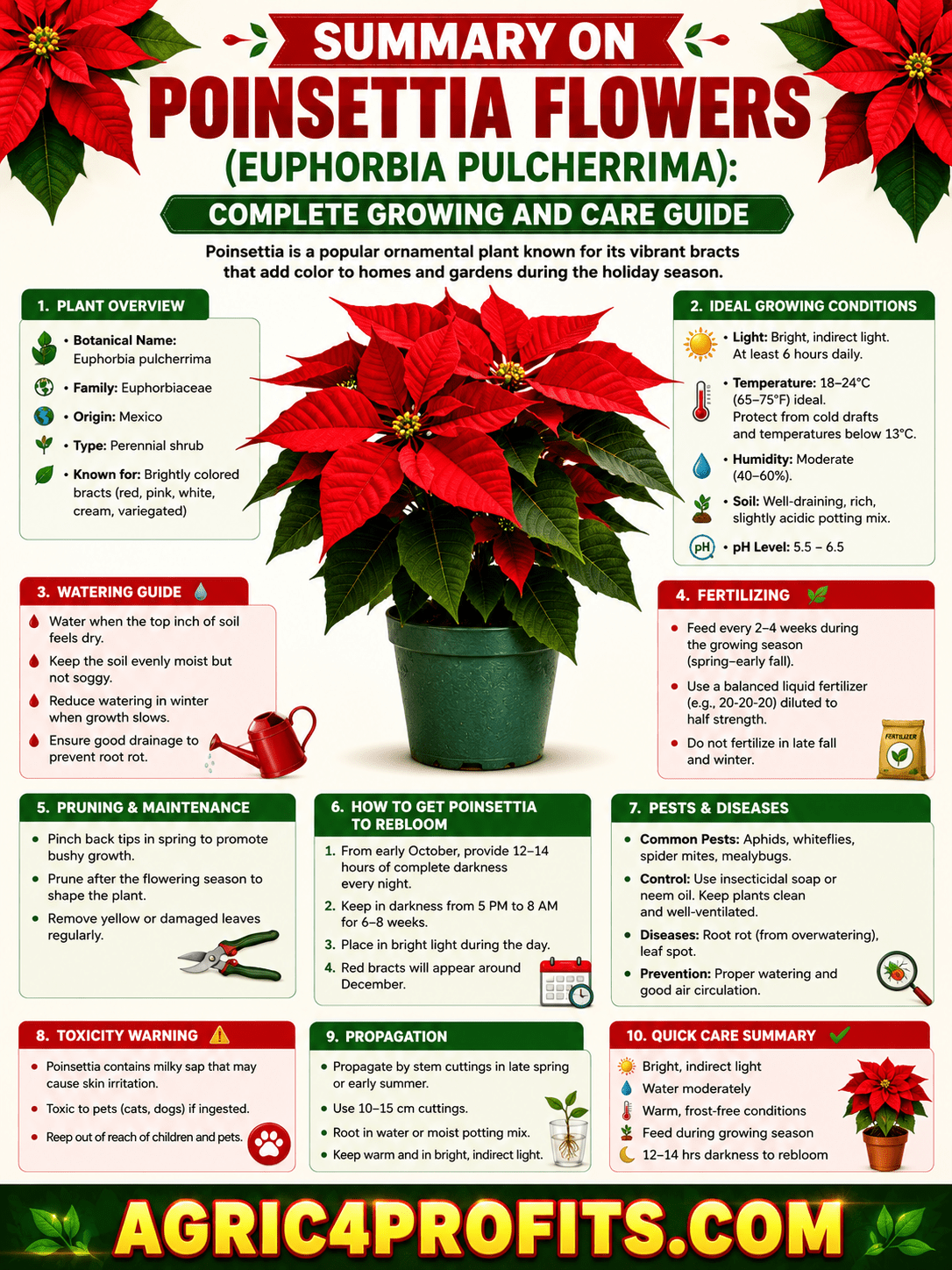
| Topic | Summary |
|---|---|
| Scientific Name | Euphorbia pulcherrima |
| Origin | Mexico and parts of Central America |
| Distinctive Feature | Colorful bracts surrounding small yellow true flowers |
| Common Colors | Red, pink, white, cream, marble, and bi-colored forms |
| Historical Uses | Traditional dye production, cultural practices, and historical medicinal applications |
| Main Seasonal Association | Christmas and other holiday celebrations |
| Major Uses | Decoration, gifting, landscaping, floriculture, cultural displays, and botanical breeding |
| Light Requirement | Bright, indirect light with protection from intense scorching conditions |
| Temperature | Warm conditions, generally around 65°F to 75°F during daytime |
| Watering | Water when the growing medium begins drying and allow excess water to drain |
| Soil | Fertile, porous, well-aerated, and well-draining potting medium |
| Common Pests | Whiteflies, aphids, spider mites, and other occasional ornamental plant pests |
| Pruning | Trim or pinch suitable new growth to encourage branching and compact form |
| Safety | Sap may irritate skin and cause mild discomfort if swallowed; sensible handling is recommended |
Frequently Asked Questions About Poinsettia Flowers (Euphorbia Pulcherrima): Complete Growing and Care Guide
1. What is the scientific name of poinsettia flowers?
The scientific name of the poinsettia is Euphorbia pulcherrima, a flowering plant species within the Euphorbiaceae family that is widely cultivated as a popular ornamental plant.
2. Are poinsettia flowers actually flowers?
The colorful structures commonly called poinsettia flowers are actually bracts, or modified leaves, while the plant's true flowers are the small yellow structures located centrally among them.
3. Where did poinsettia flowers originate?
Poinsettias originated mainly in Mexico and parts of Central America, where they grow naturally in warm environments and have long-standing cultural and historical significance.
4. Why are poinsettias associated with Christmas?
Poinsettias became associated with Christmas through Mexican traditions, Christian celebrations, their seasonal appearance, and later commercial marketing that established them as familiar holiday decorations worldwide.
5. What colors do poinsettia bracts come in?
Poinsettia cultivars can produce red, pink, white, cream, marble, and bi-colored bracts, giving growers and decorators many options for seasonal arrangements and ornamental displays.
6. How much light does a poinsettia need?
Poinsettias generally perform well in bright, indirect light indoors, although gentle morning sunlight can be beneficial when plants are protected from intense afternoon heat.
7. How often should a poinsettia be watered?
Watering frequency depends on temperature, humidity, container size, and growing medium, but plants should generally be watered when the surface begins drying while avoiding prolonged saturation.
8. Are poinsettias poisonous to humans and pets?
Poinsettias are not considered highly toxic, although their milky sap can irritate skin and ingestion may cause mild discomfort, so children and pets should not chew the plant.
9. Can poinsettias be grown after Christmas?
Yes, poinsettias can continue growing after Christmas when provided with suitable light, warmth, watering, nutrition, pruning, and seasonal management throughout the following months.
10. What pests commonly affect poinsettias?
Common pests include whiteflies, aphids, spider mites, and other sap-feeding insects, making regular inspection important so infestations can be detected early and managed appropriately.
Do you have any questions, suggestions, or contributions? If so, please feel free to use the comment box below to share your thoughts. We also encourage you to kindly share this information with others who might benefit from it. Since we can’t reach everyone at once, we truly appreciate your help in spreading the word. Thank you very much for your support and for sharing!
Read Also: Recycling Benefits: Environmental and Economic Recycling Benefits
🌱 Take Your Farming Further With Agric4Profits
Based on what you just read, here are free resources and products from Agric4Profits that can help your farm right now:
- 🛒 Visit Our Marketplace — Organic neem oil, bio-pesticides, seeds and farming products
- 📚 Read Premium Content — Advanced guides for serious and profitable farming
- 🎓 Join Our Free Academy — Structured free training for farmers across Africa
- 🔧 Use Our Free Farm Tools — Profit calculators, feed formulation, pest identifier and more
- 💬 Join Our Farming Community — Connect with farmers across all 54 African countries
- ❓ Ask a Farming Question — Get answers from experienced farmers and agricultural experts
Please cite this content in academic work, research, or publications.