


Stroke is a medical emergency that happens when blood flow to part of the brain stops or drops sharply. The brain begins to lose oxygen quickly, so every minute matters.
Many people still search for home remedies, but stroke does not respond safely to improvised mixtures or delayed care. The right response is to recognise the signs early and get emergency help immediately.
Fast treatment can reduce brain damage, lower the risk of death, and improve recovery. That is why families, friends, and communities should learn the warning signs and act without hesitation.
This article explains what stroke means, how to spot the symptoms, what to do at once, and how hospitals usually treat patients. It also shares practical ways to reduce future risk.
Keep in mind that some symptoms can disappear after a few minutes. Even then, the person still needs urgent medical attention, because a temporary episode may be a warning sign of a bigger stroke.
Understanding Stroke
An ischaemic stroke happens when a clot blocks blood flow to the brain, while a haemorrhagic stroke happens when a vessel bursts and bleeds into the surrounding brain tissue suddenly.
🌿 Go Organic on Your Farm: Instead of harmful chemical pesticides and fertilisers, try our organic farming products — including neem oil spray, bio-pesticides, natural plant treatments, organic seeds and seedlings, suckers, and many more organic products that are safe for your health, your family, your soil and your harvest. Shop Now →
Both types can injure brain cells within minutes, which is why waiting at home is dangerous. The earlier the hospital team starts care, the better the chance of a stronger recovery.
People often notice weakness, confusion, or speech changes before they understand that a stroke is unfolding. Those early clues are worth acting on, even if the person seems to improve briefly.
Stroke can affect movement, language, vision, balance, memory, swallowing, and other daily functions. The exact effects depend on which part of the brain lost blood supply and how long the interruption lasted.
Because symptoms vary, it helps to think of stroke as a sudden neurological emergency rather than a single pattern. Any sudden change in function should be treated with caution and urgency.
🔧 Free Farm Tool Available: Use our free Agric4Profits Farm Tools to calculate your farm profits, formulate feeds, identify pests and diseases on both your crops and animal farms, plan your planting and harvesting season, including many more farm tasks to get free expert advice and recommendations — completely free, no registration required. Access Free Tools →
Families should also know that a transient ischaemic attack, or TIA, can look like a stroke. Even though symptoms may clear, medical evaluation remains essential because future stroke risk may be high.
Do not assume a person is simply tired, embarrassed, or dehydrated when the signs appear suddenly. Quick recognition often determines whether treatment arrives in time to limit damage and disability.
Health workers use scans and examinations to confirm the type of stroke. That diagnosis matters, because the medicines and procedures used for a clot are different from those used for bleeding.
Recognising Stroke Symptoms
The fastest way to spot stroke is to remember that symptoms usually appear suddenly. They may start in one moment and worsen within minutes, so families should stay alert and react quickly.
1. Face drooping: One side of the face may sag suddenly, and the person may struggle to smile evenly or keep the mouth level while speaking, resting, or drinking water.
💬 Have a Farming Question? Join thousands of farmers across Africa on the Agric4Profits Community — ask questions, share experiences and connect with agricultural experts. It is completely free. Ask Your Question Now →
2. Arm weakness: One arm may feel weak, heavy, numb, or unable to stay lifted. This sign often appears together with problems on one side of the body and should never be ignored.
3. Speech difficulty: The person may slur words, sound confused, or struggle to understand simple questions. Any sudden change in speech deserves immediate emergency medical attention from trained professionals.
4. Vision or balance problems: A stroke can blur sight, cause loss of vision in one or both eyes, or make the person dizzy and unsteady when walking properly across a room.
5. Severe headache: A sudden, intense headache without a clear cause may point to a bleeding stroke, especially when it comes with nausea, vomiting, collapse, or unusual weakness.
Some people also feel confusion, numbness, memory problems, or difficulty swallowing. These warning signs can appear alone or together, so do not wait for every symptom to show up fully.
If you suspect a stroke, note the time when the first symptom started. That detail helps emergency staff decide which treatments may still be safe, appropriate, and most effective now.
Read Also: 6 Factors that made Snail Farming a Highly Lucrative Business
What To Do Straight Away

The first step is simple: call emergency services immediately and say that stroke is suspected. Do not wait for symptoms to vanish, because a brief improvement does not make the situation safe.
Keep the person calm, seated, and safe while help is on the way. Do not give food, drink, alcohol, or medicine unless a clinician or dispatcher specifically instructs you to do so.
📖 Want to Go Deeper on This Topic?
Our expert agricultural ebooks cover poultry, fish farming, different crops production, snail farming, organic farming, mushrooms, sheep, cattle, flowers, pig farming, goat farming, agribusiness, etc. in practical step-by-step detail — written by agricultural professionals for African farmers.
Browse All Farming Ebooks →If the person is unconscious but breathing, place them on their side and watch the airway. If breathing stops, begin CPR only if you are trained and emergency staff instruct you.
In the hospital, doctors usually perform a scan to identify whether the stroke is caused by a clot or bleeding. That result determines whether clot-busting treatment or other procedures are appropriate.
For an ischaemic stroke, treatment may include medicines that dissolve clots or procedures that remove them. These interventions work best when given quickly after symptom onset, under specialist supervision in hospital.
For a haemorrhagic stroke, treatment focuses on controlling bleeding, reducing pressure, and protecting the brain. Some patients need surgery or intensive monitoring, depending on the size and location of the bleed.
Recovery often continues after the emergency phase through physiotherapy, speech therapy, occupational therapy, and follow-up visits. Progress may be slow, but steady rehabilitation can restore important abilities over time carefully.
Good recovery also depends on daily habits. Readers can build healthier meals around sweet potatoes, okra, and other nutrient-dense foods while following medical advice and keeping portions sensible at home.
Read Also: Top 9 Foods & Drinks That Can Be Inflammatory
Lowering The Risk After Recovery
After a stroke, prevention becomes part of treatment. Doctors often review blood pressure, blood sugar, cholesterol, smoking, diet, and movement habits to reduce the chance of another event safely and steadily.
High blood pressure is one of the strongest stroke risk factors. Taking prescribed medicine, checking readings at home, and attending follow-up visits can make a major difference over time consistently.
People should also manage diabetes, avoid tobacco, limit alcohol, and stay active within medical advice. Small changes, repeated consistently, often produce better results than dramatic short-lived efforts for lasting change.
Families that want healthier meals can start with **sweet potatoes**, which fit easily into many simple diets and provide useful energy for everyday living after illness and recovery at home.
Another useful option is **okra**, a familiar food that can support balanced meals when prepared with less oil and too much salt in home cooking for families and carers too.
Some readers also like learning from **medicinal plants**, especially when they want to understand how traditional ingredients appear in broader nutrition discussions and everyday wellness ideas for better habits and routines.
Households that think carefully about food sources may benefit from **animal husbandry**, because good management often begins with clean housing, sound feeding, and steady supervision each day for reliable results.
Likewise, **livestock production** shows how organisation and routine can support safer, more reliable food systems for families and communities over time at home and in the future every day together.
Practical guides on **farm planning** remind readers that structure and care usually reduce avoidable losses across many projects in practice and daily life for households and small teams everywhere always.
Finally, **catfish planning** and **balanced feeds** reinforce discipline and consistency in everyday food production, household routines, and long-term care decisions for practical living and better planning each day always carefully.
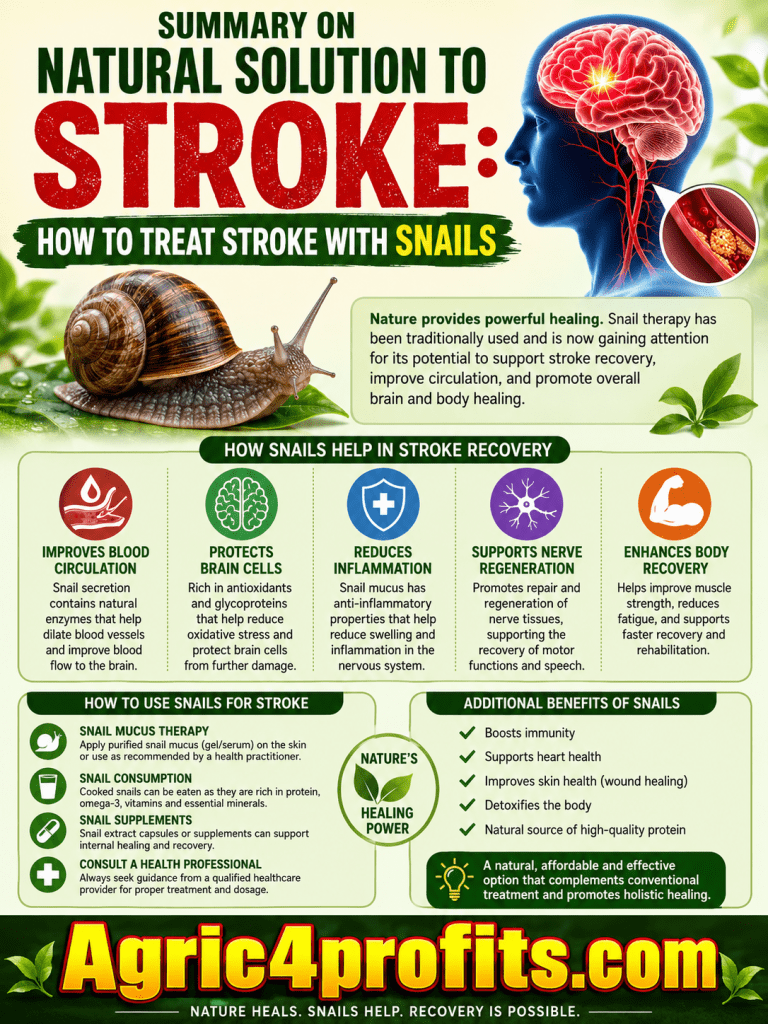
Summary on Natural Solution to Stroke: How to Treat Stroke with Snails
| Aspect | Summary |
|---|---|
| What stroke is | A sudden loss of blood flow to the brain, or bleeding inside the brain, that needs urgent care. |
| Main warning signs | Face drooping, arm weakness, speech problems, vision changes, balance issues, and severe headache. |
| Immediate response | Call emergency services, keep the person safe, note the time, and avoid food, drink, or medicine. |
| Hospital treatment | Doctors use scans, clot-removal treatment, bleeding control, monitoring, and rehabilitation. |
| Prevention | Control blood pressure, manage diabetes, avoid tobacco, stay active, and follow medical advice. |
Frequently Asked Questions About Stroke and Emergency Response
1. What is the first thing to do when stroke is suspected?
Call emergency services immediately and say that a stroke may be happening. Time matters, so do not wait for the symptoms to pass, and let the dispatcher guide you while help is on the way.
2. Can a stroke be treated at home?
No. Stroke needs urgent hospital care. Home remedies cannot replace scans, specialist treatment, close monitoring, and the emergency decisions that doctors make once they know the stroke type fully and correctly.
3. What are the common warning signs?
Common signs include face drooping, arm weakness, speech difficulty, sudden vision problems, balance trouble, and a severe headache. They may appear together or separately, and either pattern needs urgent action.
4. Does a short-lasting symptom still matter?
Yes. A symptom that disappears may be a transient ischaemic attack, which is still a medical emergency and needs immediate evaluation because it can warn of a larger stroke soon after.
5. What treatment do hospitals usually give?
Treatment depends on the stroke type. Doctors may use clot-dissolving medicine, clot removal, bleeding control, or surgery, followed by rehabilitation, monitoring, and careful follow-up in hospital and afterwards at home.
6. How can a person lower the risk of another stroke?
Control blood pressure, manage diabetes, avoid smoking, limit alcohol, stay active, and keep follow-up appointments with the healthcare team. Consistent routines lower risk and support recovery over the long term.
Do you have any questions, suggestions, or contributions? If so, please feel free to use the comment box below to share your thoughts. We also encourage you to kindly share this information with others who might benefit from it. Since we can’t reach everyone at once, we truly appreciate your help in spreading the word. Thank you very much for your support and for sharing!
Read Also: Food Preservation Methods
🌱 Take Your Farming Further With Agric4Profits
Based on what you just read, here are free resources and products from Agric4Profits that can help your farm right now:
- 🛒 Visit Our Marketplace — Organic neem oil, bio-pesticides, seeds and farming products
- 📚 Read Premium Content — Advanced guides for serious and profitable farming
- 🎓 Join Our Free Academy — Structured free training for farmers across Africa
- 🔧 Use Our Free Farm Tools — Profit calculators, feed formulation, pest identifier and more
- 💬 Join Our Farming Community — Connect with farmers across all 54 African countries
- ❓ Ask a Farming Question — Get answers from experienced farmers and agricultural experts
Please cite this content in academic work, research, or publications.
It has been an amazing article but has the clinical been a success
Can water from snail treat stroke at any stage