


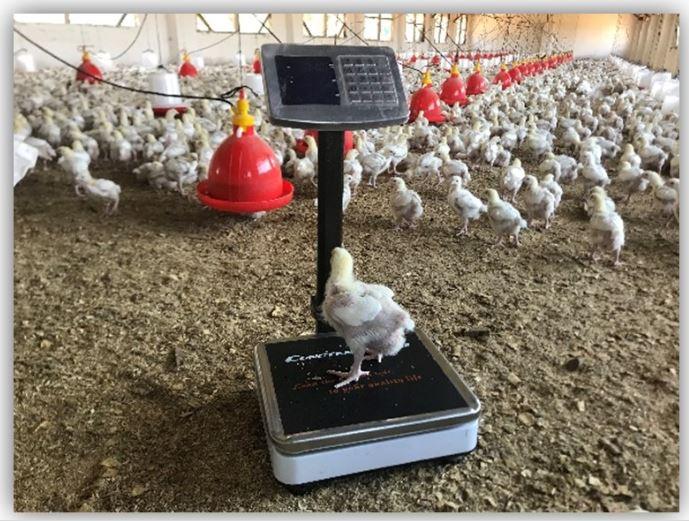
Monitoring the average weights of your flock from day one is one of the most important management tools in poultry farming. This makes digital weighing scales essential equipment for all commercial poultry operations. Not optional. Essential.
Weight monitoring gives you real data about how your birds are performing. You can spot problems early. You can make informed decisions about feed adjustments. You can predict when birds will reach market weight. Without this information, you’re basically guessing and hoping things work out.
The exact determination of bird weights is a decisive factor for economic success, especially in broiler growing. But it’s not just about broilers. Anyone keeping broiler breeders, pullets, or layers needs to check weight development closely too. Too high or too low weights always hurt production results.
When weights fall outside the target range, you’re not taking full advantage of the birds’ genetic potential. Modern breeds are engineered to perform optimally at specific weights and growth rates. Miss those targets and you leave money on the table. Your feed conversion suffers. Your production drops. Your profits shrink.
About 10% of the flock should be measured from different points of the house randomly. This sampling approach gives you a reliable picture of the whole flock’s condition without the time and stress of weighing every single bird.
Here’s what weight monitoring does for your operation. In the early stages of a flock’s life, weekly weighing helps you find the average weight and uniformity of the flock. This data drives key management decisions. Young birds being extremely beyond the average weight in the guide might indicate danger. Overweight young birds often develop health problems later.
For layers, weekly measuring is not advised during active laying, especially on very hot days. The stress can reduce production. But you should weigh when there’s an unexplained reduction in production. Weight loss often explains production drops.
The best weights for egg production in layers fall between 1.6kg and 2.0kg. Don’t expect birds below 1.5kg to lay consistently. Those above 2.2kg are tending toward obesity, which comes with issues like prolapse and reduced production.
During disease, stress, or changes in feed quality and quantity, a bird can lose 50g to 100g per week. This drops them to a weight where they can’t lay eggs. This has been the cause of many serious production declines that confuse farmers who don’t track weights.
Continuously weighing your farm animals provides an up-to-date overview of the growth process and insight into animal activity daily. Keeping records of flock weight and feed consumption helps you spot problems early. Weight loss or decreased feed consumption are two major signs of disease. You can also see when meat birds have reached uneconomical rates of feed consumption.
Read Also: How to Construct Your Poultry Pen
1. Basic Weight Monitoring Principles
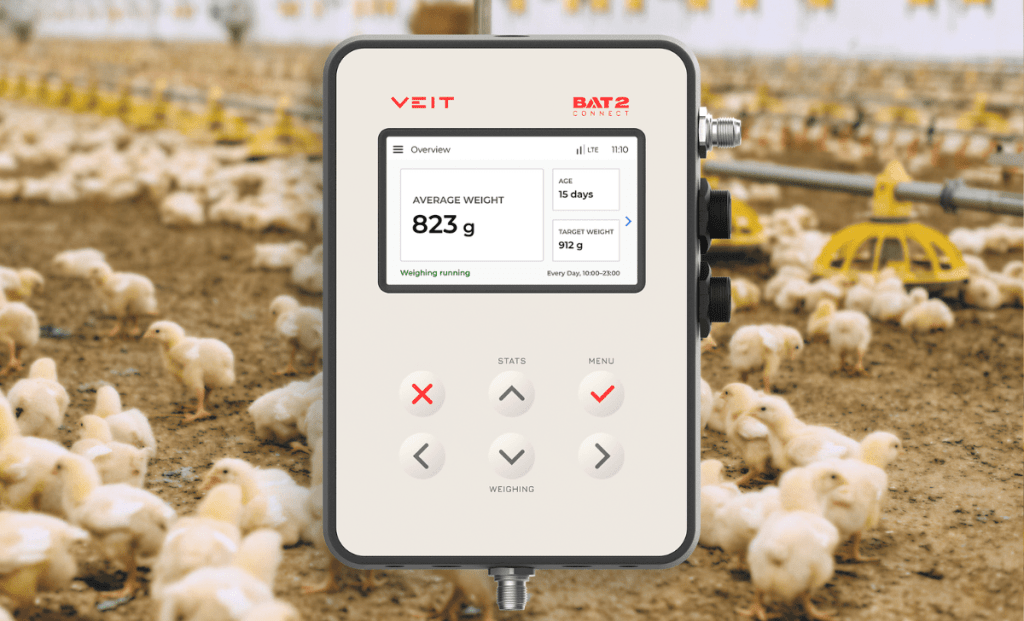
Understanding why and how to monitor weights properly sets the foundation for good flock management. The principles apply whether you’re raising broilers, layers, or breeders.
A. Sampling Methods
The easiest way to weigh a live chicken is to place it headfirst in a sheet metal cone. Adjust the scale for the weight of the cone, or subtract its weight from the scale reading. This method keeps birds calm and gives accurate readings.
It’s not necessary to weigh all the chickens. A sample of five or ten percent of what appear to be average-size birds will do. The key is random selection from different parts of the house. Don’t just grab the birds closest to you or the easiest to catch.
B. Critical Weight Guidelines for Layers
I. Optimal laying weight: Between 1.6kg and 2.0kg for consistent egg production and good shell quality
ii. Underweight threshold: Birds below 1.5kg struggle to produce eggs reliably and may not lay at all
iii. Overweight risk: Birds above 2.2kg approach obesity, increasing risk of prolapse, fatty liver syndrome, and reduced production
iv. Weight loss impact: Loss of 50-100g per week from disease, stress, or poor feed can drop birds below productive weight
v. Production correlation: Unexplained production drops often correlate with weight loss that wasn’t monitored
C. Monitoring Frequency
I. Early stages: Weekly weighing for chicks and young birds helps track average weight and uniformity for key management decisions
ii. Growing period: Continue weekly weighing through the growing phase to ensure birds stay on target growth curves
iii. Active layers: Avoid weekly weighing during peak production, especially in hot weather, as it causes stress that reduces laying
iv. Problem investigation: Weigh immediately when you see an unexplained production reduction, regardless of the normal schedule
v. Broiler finishing: Daily or every-other-day weighing in the final weeks helps hit exact target weights for market
2. Why Weigh Broilers?
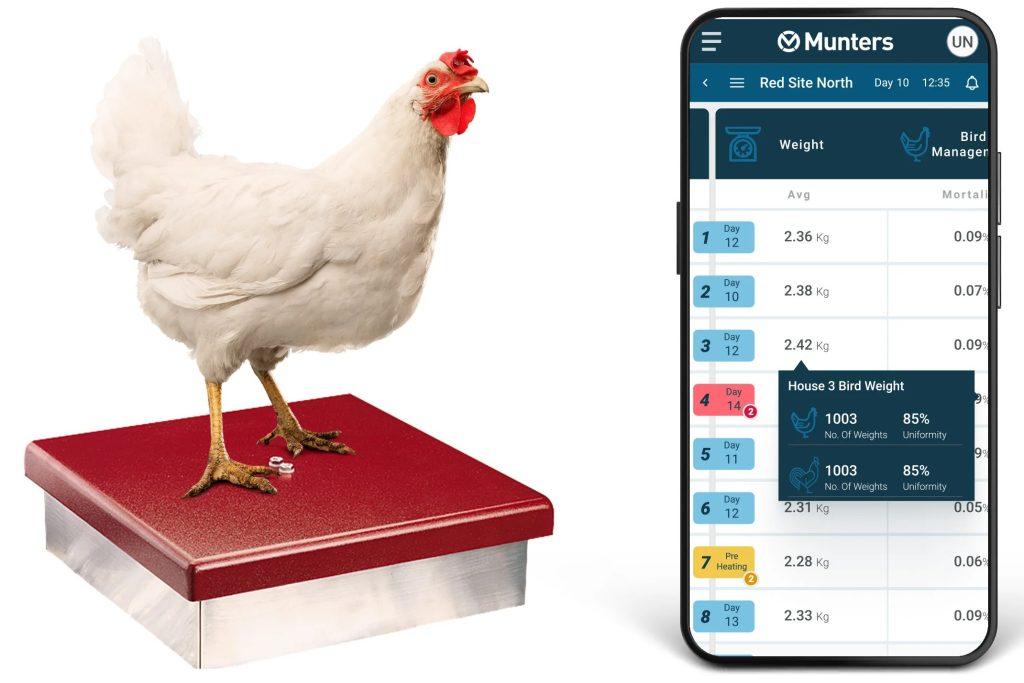
Broiler production requires precision. Markets demand specific weights. Missing the target by even a few percentage points affects your profitability. On-farm weighing helps you meet these requirements.
A. Spot Weighings
These are occasional weighings that give a snapshot picture of the situation at the time they’re taken. They may be used in the last week or two just to check that your broilers will be near the final target weight.
Spot weighings can also take place at intervals through the crop to check that weight for age is in line with the breeder’s target for that age. In other words, to see if they’re growing along the growth curve recommended by the breed company supplying the birds.
The logic is simple. If you can keep them on or close to this prescribed growth curve all the time, they WILL be on target weight at kill. The growth curve exists because it works. Follow it and you get predictable results.
B. Regular Daily Weighings
If you can weigh birds every day, you not only see if they’re on the target weight for that day, but you can also see that the daily Live Weight Gain (LWG) is on target. Any fall off in daily LWG can give an early sign of impending disease or of a management problem.
This early warning system is the real value of daily weighing. You catch problems when you can still fix them. Wait until birds are obviously sick or growth has stalled for days, and you’ve already lost money.
Read Also: How Poultry Farm Odors can be Tackled
3. How to Weigh Broilers
Two main approaches exist for weighing broilers. Each has advantages and limitations. Your choice depends on the operation size, budget, and how precise you need to be.
A. Hand Weighing
Young broilers can be weighed in groups of 10, 20, 40, etc., depending on their age and the size of the container you use to weigh them in. This is normally slung or suspended from a mechanical scale from the ceiling.
This method is reasonably quick and doesn’t stress the birds too much. We only need to know the average weight, so weighing the container full of birds, then subtract the weight of the container empty, and divide by the number of birds in the container, gives you the average weight.
If you do this multiple times in different parts of the house, you get a series of average weights. Taking the average of these gives you the best estimate of the house average.
Bigger broilers need to be weighed individually. Some people put a loop of cord around their two feet and suspend them upside down from a scale hung from the ceiling. Broilers don’t like this and struggle and flap, making it difficult to read the scale properly. It’s also very stressful to the birds and takes them time to get over the trauma before they start growing normally again.
Open-ended weighing cones on the market hang from the scale. You put a bird into this head first, and the sides of the cone stop their wingsfrom flapping. This is much better for bird welfare and accuracy.
Practical problems with hand weighing:
I. Bird stress: The procedure is stressful to birds and slows their growth temporarily
ii. Labor intensity: It’s time-consuming and labor-intensive, not suitable for large-scale production
Statistical problems with hand weighing:
I. Weight distribution: All birds in the flock don’t weigh the same. Normally about two-thirds of birds are within 10% of the flock average, with about one-sixth being more than 10% better than average and one-sixth being more than 10% worse than average
ii. Sample size requirements: If you only weighed just one bird at random, then clearly, 2/3 of the time your estimate would be only within 10% of the true flock average. This isn’t good enough, so you must weigh more
iii. Catcher bias: Catchers tend to catch heavier birds because smaller ones get away. So the estimate of the flock average may be too optimistic
B. How Many to Weigh
Your estimate of the house average improves the more you weigh. For example, if you weigh 100 birds at random, you will get an average within 1% of the true house average about 2/3 of the time. The table below shows how accuracy improves with sample size.
The trade-off is between accuracy and labor. Weighing more birds gives better data but takes more time. Most operations find a balance that gives adequate accuracy without excessive labor cost.
C. Automatic Bird Weighing
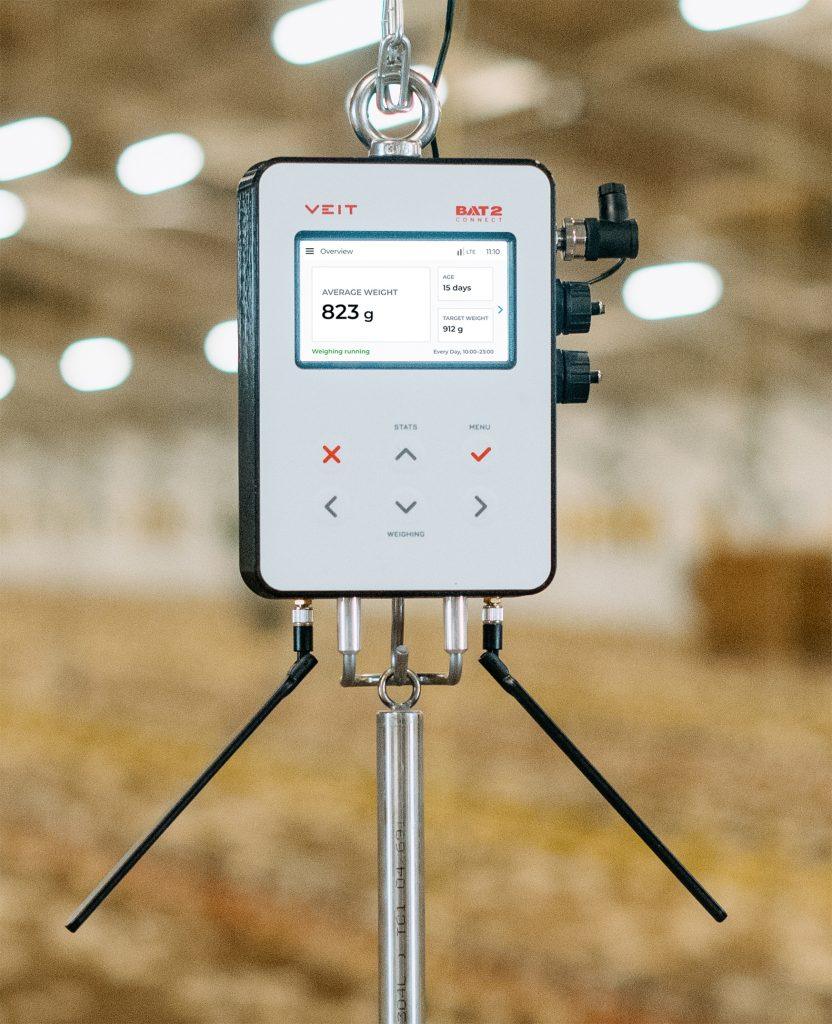
Automatic systems solve many of the problems with manual weighing. They’re expensive upfront but pay for themselves in large operations through better data and reduced labor.
1. Advantages of automatic weighing:
i. No bird stress: Some scales are attractive to birds because they like to hop up to a higher level
ii. Daily weights: Can get weights every day without additional labor
iii. Large sample size: Large numbers are weighed, so the estimate of the house average is good
iv. Better statistics: Better mathematics can be built into the software to estimate the true average better
v. Remote monitoring: Data can be observed on the control box in the broiler house or on a computer in your office via a cable linked to multiple control boxes in different broiler houses
vi. Visual data: These weights can be shown as graphs comparing actual daily weights to the breed target growth curve, percentage deviation from each day’s target, and daily LWG compared to the breed target
vii. Remote access: Data and graphs can be accessed via modem from a remote computer, say in the farmer’s house or company head office
viii. System integration: Can be incorporated into management and nutrition control systems for profit optimization
2. Disadvantages of automatic weighing:
i. Capital cost: There’s a capital cost of installation, though maintenance cost can be low
D. Types of Automatic Weighers
Platform weighers: These are normally metal boxes placed on the litter and linked by cable to a control box in the broiler house. They weigh one bird at a time and are self-taring when no birds are on the scale. In other words, the empty weight of the scale is zeroed each time to allow for the buildup of muck on the scale.
When a bird gets on the scale, it records a higher weight. It allows for oscillation in the recorded weight, and when the weight is stable, it will be recorded if it meets certain criteria. The weight has to be within a set percentage of the expected weight for that day. If not (for example, if two or more birds go on at the same time), the weight is discarded as not valid. These scales can give reasonably accurate estimates of average weight.
1. Disadvantages of platform weighers:
i. Empty scale requirement: The scale has to be empty of birds before the next bird weight is recorded. So if several birds stay on the scale for some time, no weighings are possible before they ALL get off
ii. Environmental exposure: The load cell and electronic equipment in the platform weigher itself are near the litter where buildup of dampness and ammonia may take place. Over time, this can get into the electronics and cause failure
iii. Cable damage risk: A cable has to lead from the scale to the control box. At least part of this is on or under the litter and can be damaged by birds or otherwise
Hanging scales: These work on a different principle. They comprise a larger, 50 cm round platform suspended via load cell and electronics from the ceiling. The platform is fixed in the center which enables birds to get on and off from all directions. Many birds can be on the platform at the same time, depending on their size.
A weight is recorded when a bird gets OFF the scale. As before, a stable weight has to be recorded before and after the bird gets off, and the weight has to be within a prescribed bandwidth. So if two birds get off together, no weight is recorded. Buildup of muck on the scale doesn’t matter, as it’s the difference in weight that is recorded.
2. Advantages of hanging scales:
i. More valid weights: Produces more valid recorded weights than floor scales so the estimated average is better
ii. Bird attraction: Broilers like to hop up to a higher level, so the scale is occupied most of the time
iii. Protected electronics: The electronic and load cell are in the ceiling, well out of wet and ammonia, and stay in place between crops
iv. Cable protection: Cables are permanently fixed from the load cell and electronics back to the control box, out of reach of birds and much less likely to be damaged
Disadvantages of hanging scales:
i. Ceiling requirements: Total weight on the scale can be high, so a really secure fixing to the ceiling is required. A flimsy screw hook can be pulled out
ii. Higher capital cost: The capital cost may be higher than platform scales
Current Use and Future of Broiler Scales
Hundreds of automatic scales are now in use in Europe and America. Major companies are examining the various options and some are buying in volume. The technology has proven itself in commercial conditions.
We will need to get broilers to market age at more exact weights (at least to within 2% of the target) to meet supermarket and consumer demand. To do this, we will need better management control of broiler growing.
Whatever the industry, you cannot exercise management control if you don’t have accurate management information. Knowing what your broilers weigh on a day-to-day basis is essential if you want to get them to market age at the best, most cost-effective way.
If you see deviations from the proper growth curve starting to develop, you have the opportunity to do something about it quickly enough to get them back on the correct growth curve again. Without this information, you may not even know there’s a problem until it may be too late to do anything about it.
Summary on Poultry Bird Weight Monitoring
| Aspect | Key Points |
|---|---|
| Importance | Essential management tool for economic success; monitors genetic potential utilization |
| Sample Size | About 10% of the flock from different house locations randomly selected |
| Layer Optimal Weight | 1.6kg to 2.0kg for best egg production |
| Layer Weight Limits | Below 1.5kg won’t lay; above 2.2kg risks obesity and prolapse |
| Weight Loss Impact | 50-100g weekly loss from disease/stress drops birds below productive weight |
| Early Stage Monitoring | Weekly weighing for average weight and uniformity; drives key decisions |
| Active Layer Caution | Avoid weekly weighing during peak production to prevent stress |
| Manual Weighing Method | Headfirst in sheet metal cone or weighing container; sample 5-10% of flock |
| Spot Weighings | Occasional snapshots to verify on-track growth against breed curve |
| Daily Weighings | Track daily LWG; early warning system for disease or management problems |
| Hand Weighing Drawbacks | Stressful to birds, labor-intensive, catcher bias toward heavier birds |
| Sample Accuracy | 100 birds gives ±1% accuracy; more birds = better estimate |
| Platform Weighers | Floor-based, self-tareing, one bird at a time; prone to environmental damage |
| Hanging Scales | Ceiling-mounted, multiple birds, records on exit; better accuracy and durability |
| Future Requirements | Markets demand ±2% of target weight; requires daily monitoring and data |
Frequently Asked Questions About Poultry Bird Weight Monitoring
1. Why is weight monitoring so important for poultry farming?
Weight is the single best indicator of flock health and performance. It tells you if birds are growing on target, if they’re getting proper nutrition, if disease is affecting them, and when they’ll reach market weight. Without weight data, you’re managing blind. You can’t optimize feed costs, predict production, or catch problems early. Modern genetics performs optimally at specific weights. Miss those targets and you lose money on every bird.
2. How many birds do I really need to weigh to get accurate data?
It depends on how accurate you need to be. Weighing 50 birds gives you within 1.4% ofthe true average 2/3 of the time. Weighing 100 birds improves this to within 1% accuracy. For most commercial operations, 50-100 birds (about 10% of smaller flocks or a fixed number for larger flocks) provides adequate accuracy without excessive labor. The key is random selection from different house locations to avoid bias.
3. Why can’t I weigh my laying hens weekly during peak production?
The stress from catching and weighing reduces egg production temporarily, especially in hot weather when birds are already stressed. Each handling event causes stress that takes birds a day or two to recover from. During peak production, this stress directly translates to lost eggs. Only weigh laying birds when there’s an unexplained production reduction that needs investigation. The weight data you gain isn’t worth the production you lose during normal operations.
4. What should I do if my birds are overweight for their age?
First, verify it’s not a weighing error by sampling more birds. If confirmed, reduce feed quality slightly or implement feed restriction. Overweight young birds often develop leg problems, heart issues, and poor feed conversion later. For broilers, overweight birds may reach market weight too early while still undersized, or they may have excessive fat. For layers, overweight pullets often develop into obese hens with prolapse and production problems.
5. How much weight loss is too much for laying hens?
Loss of 50-100g per week is significant and indicates a serious problem. This amount of loss typically drops birds below productive weight (1.5kg minimum). Causes include disease, heat stress, feed quality issues, water problems, or overcrowding. Investigate immediately. Check feed consumption, water intake, bird behavior, and droppings. Test feed quality. Look for disease symptoms. Address the cause quickly because prolonged weight loss means prolonged production loss.
6. Are automatic weighing systems worth the investment?
For large commercial operations, absolutely. They pay for themselves through better management decisions, reduced labor, and hitting target weights more precisely. For smaller farms (under 5,000 birds), manual weighing may be more cost-effective. The break-even point depends on labor costs, production scale, and how critical precision is for your market. Automatic systems shine when you need daily data on multiple houses or when labor is expensive.
7. What’s the difference between platform and hanging automatic scales?
Platform scales sit on the litter, weigh one bird at a time when it steps on, and are self-tareing. They’re cheaper but the electronics are exposed to moisture and ammonia, cables can be damaged, and they record fewer valid weights. Hanging scales suspend from the ceiling, allow multiple birds, record weight when birds step off, and have protected electronics. They cost more but are more accurate, durable, and produce more data. Most large operations prefer hanging scales despite the higher upfront cost.
8. Why do catchers create bias in manual weighing?
Smaller, quicker birds are harder to catch. Catchers naturally end up with more heavy birds in their samples because those birds move more slowly and are easier to grab. This makes your flock’s average appear higher than it really is. The bias can be 5-10% optimistic. To reduce it, use experienced catchers who know how to grab birds randomly, or weigh from multiple sections of the house to average out the bias.
9. How do I use weight data to predict market readiness?
Compare current weights to the breed company’s target growth curve for your bird’s age. If birds are on curve, calculate days to target market weight at current growth rate. If they’re above or below the curve, adjust feed or management to get them back on track. Daily weighing shows if the daily LWG is on target. Any sustained drop in daily LWG means you’ll miss market windows. The earlier you catch deviations, the easier they are to correct.
10. What’s the future of weight monitoring technology?
Markets increasingly demand precise weights (within 2% of target), which requires daily monitoring and real-time data. Integration with feed management systems allows automatic adjustment of rations based on growth rates. Remote monitoring via cloud systems lets companies oversee multiple farms. Artificial intelligence programs can predict outcomes and suggest interventions. The technology exists and is being adopted by major producers. Small farms will eventually access similar tools through lower-cost versions or cooperative systems.
Do you have any questions, suggestions, or contributions? If so, please feel free to use the comment box below to share your thoughts. We also encourage you to kindly share this information with others who might benefit from it. Since we can’t reach everyone at once, we truly appreciate your help in spreading the word. Thank you very much for your support and for sharing!
Read Also: Anatomy of Fishes: Female Fish and their Reproductive Strategies