


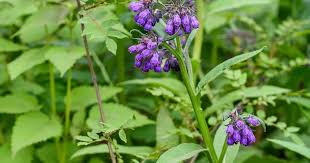
Comfrey, scientifically known as Symphytum officinale, is part of the larger genus Symphytum, which is widely utilized in herbal medicine. The plant is primarily found in northern Europe, and the blossoms can be any hue from white to purple.
Comfrey is 2 to 5 feet tall, prefers moist soil, and features a thick, hairy stem. Its flowers are thickly clustered, dull purple, blue, or pale. The oblong leaves have various appearances based on when they’re on the stalk.
While top leaves are broad throughout and narrow just at the ends, bottom leaves are broad there at the base and taper at the ends. The root is black on the outside and fleshy white on the interior, which is juice-filled.
This species is also referred to as true comfrey or common comfrey to distinguish it from other Symphytum species.
Locally, it is common on ditches and riverbanks throughout Ireland and Britain. It exists abroad as an invasive plant and occasionally as a weed, especially in North America.
Comfrey has a high risk of causing liver damage, hence it is not recommended for internal usage or long-term topical application.
Preparations for comfrey are created using the plant’s leaves or other portions that are cultivated above ground. The toxic pyrrolizidine alkaloids are more prevalent in young leaves than in older leaves.
It’s interesting to note that there is some controversy around the safety of utilizing comfrey because some of its volatile chemical constituents have the potential to be harmful to humans if taken inappropriately.
Since there have been some historic suggestions for internal usage when done properly, most people solely advise the topical application of comfrey.
Comfrey contains a high amount of certain alkaloids, making it contentious and potentially poisonous when used improperly. Because these alkaloids are so strong when taken, many medical practitioners advise against using them internally and only sparingly topically.
Check with a skilled herbalist or medical expert before using any new herbal medicine, as some of the side effects of its high alkaloid concentration can affect the wellness of your liver.
Despite the fact that many organic chemicals in comfrey can be applied topically in a variety of salves and lotions to provide their benefits, this is not always the case.
Allantoin, inulin, tannins, saponins, and advantageous proteins are a few of the more peculiar chemicals that can be found in it.
Since comfrey contains potentially harmful chemicals when consumed, many people have shied away from using it topically. However, there is no known risk associated with doing so.
West Asia, Europe, and North America all have damp grasslands where the perennial herb comfrey grows. The resilient plant can reach a height of 1-3 feet (0.3–0.9 m). It is a herbaceous perennial with broad, hairy leaves and a black, turnip-like root.
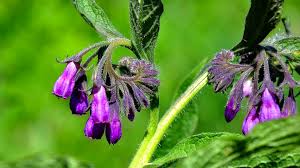
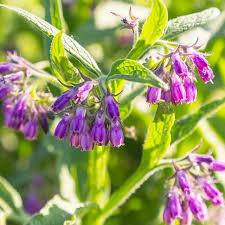
The margins of the leaves on the stem continue all the way to the base. The branching, hairy stems. It blooms with tiny bell-shaped flowers between May and June, usually in shades of cream, white, pink, or purple. They begin as coils and subsequently uncoil.
Read Also: 6 Health Benefits of Black Currant (Ribes nigrum L)
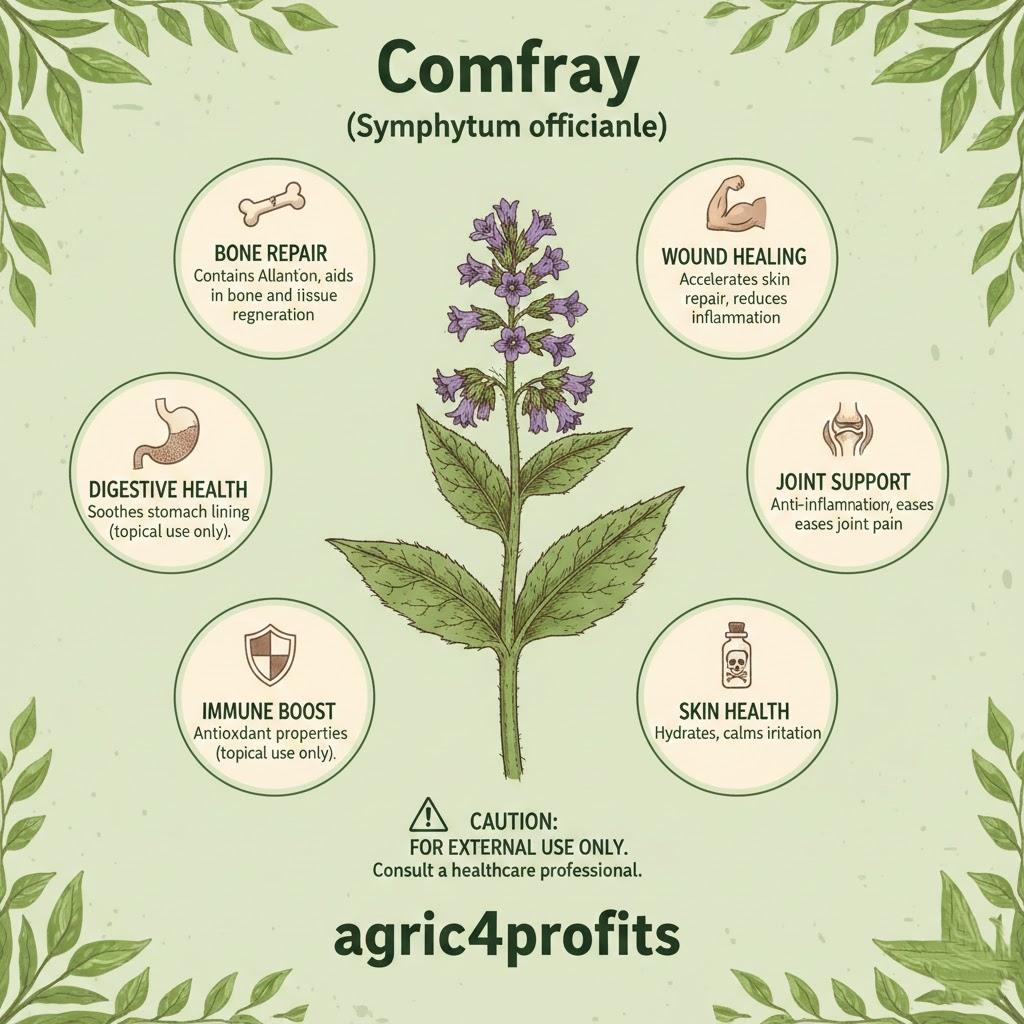
8 Health Benefits of Comfrey (Symphytum officinale)
1. Wound Healing
Comfrey can help with rashes and skin irritations when applied topically. Comfrey mixtures and salves are the best options for hastening the wound healing process due to their strong antioxidant and vitamin C content.
While vitamin C’s role in the production of collagen makes it important to create new cells for healing, antioxidants also aid in the removal of foreign substances from the body and avoid cell death.
2. Helps Reduce Pain
Administering comfrey salves and moisturizers to such places will instantly relieve pain whether you have any kind of severe pain in your body, are healing from an injury, or are recovering from surgery.
Comfrey’s chemical compounds and antioxidants are excellent analgesics for aches and pains. Analgesic properties in herbs are especially valuable.
3. Anti-inflammatory
The numerous chemical compounds in comfrey, such as saponins and tannins, act as anti-inflammatory components in a manner similar to that of the analgesic compounds in comfrey.
Use comfrey creams as often as needed if you have gout, arthritis, or any other inflammatory condition. However, because the moisturizer is so powerful, you can get away with using fewer oils and creams.
4. Boosts Immune System
Comfrey has a significant amount of vitamin C, and ascorbic acid plays a key part in the body’s synthesis of white plasma cells, which serve as the body’s first line of pathogen defense.
Jaundice and other immunological and vitamin deficits can be improved by strengthening your immune function, even with topical therapies.
Read Also: 6 Amazing Health Benefits of Basil (Ocimum basilicum)
5. Improves Bone Growth And Health
Knitbone is one of the names given to this herbal treatment since it can hasten the healing of wounds, including shattered bones. Additionally, it has enough calcium, an essential component of bone formation.
Comfrey’s special blend of organic components promotes the body’s more effective uptake and utilization of these minerals, which can promote the rebuilding of bone minerals.
6. Anti-cancer Benefits
Comfrey may have anti-cancerous properties due to the antioxidants that are present in it. Antioxidants actively seek out free radicals, the harmful byproducts of cellular metabolism, and remove them from the body to stop them from mutating or killing other cells.
Despite the fact that this study is still in its early phases, any developments in herbal chemotherapy drugs must be taken into consideration.
7. Respiratory Health
It must be emphasized once more that comfrey must not be swallowed, but even breathing it in or massaging it on the breast might have expectorant effects.
This plant can aid in clearing your cough and removing any congestion you may be feeling if your sinuses are congested or your respiratory tracts are congested.
If comfrey is taken, however, the phlegm and fluids won’t pick up bacteria and other microorganisms, prolonging or aggravating ailments!
8. Massive Skin Benefits
Comfrey can assist with symptom relief and irritation if you have anything from a severe case of eczema to a spider bite. This is the ideal treatment for itchy skin of all kinds, from psoriasis to acne, due to a blend of vitamin C, antioxidants, and anti-inflammatory substances.
Read Also: How to Grow Herbs and Spices in Urban Areas
Nutritional value of Comfrey
1. Calories: Comfrey leaves and roots are low in calories, with fresh leaves estimated at around 20-50 calories per 100 grams due to high water content (85-90%).
This low caloric density makes it negligible as an energy source but useful in traditional foraging or as a nutrient accumulator in permaculture contexts.
2. Protein: Leaves contain moderate crude protein levels, comparable to some legumes like soybean or lupine in dry matter basis (around 15-25% in dried leaves).
This provides plant-based protein potential, though not typically consumed in large quantities due to safety concerns.
3. Carbohydrates: Primarily from mucilage (polysaccharides up to 30% in roots) and fiber; leaves and roots offer structural carbs with low simple sugars.
These mucilaginous polysaccharides contribute to soothing properties rather than significant energy.
4. Fat: Very low fat content overall, with trace essential fatty acids.
Minimal contribution to dietary fat needs.
5. Dietary Fiber: High in mucilage and fiber from leaves and roots, supporting traditional soothing uses for GI tract.
Fiber aids in traditional digestive applications but is limited by toxicity risks.
6. Calcium: Accumulates high levels, especially in leaves (higher than many plants), along with phosphorus.
Supports bone health claims in traditional use as a mineral accumulator.
7. Potassium: Notably high accumulation in leaves and roots from deep taproot action.
Contributes to electrolyte balance and traditional nutrient-rich compost applications.
8. Phosphorus: Elevated levels in leaves, similar to or exceeding some forages.
Aids in bone and energy metabolism support traditionally.
9. Other Minerals: Includes traces of magnesium, copper, sulfur, selenium, and iron from soil accumulation.
These enhance overall mineral profile in permaculture but not for direct consumption.
10. Bioactive Compounds (Allantoin and Rosmarinic Acid): Allantoin (0.6–4.7% in roots) promotes cell growth; rosmarinic acid provides antioxidant effects.
These key non-nutritional compounds drive most claimed benefits beyond basic nutrition.
Scientific Evidence and Case Studies on Comfrey
1. Wound healing and tissue repair: Studies support allantoin’s role in promoting cell proliferation; clinical trials show topical comfrey extracts accelerate healing in abrasions and wounds (e.g., reviewed in Frost et al. 2013 scoping review).
2. Anti-inflammatory and analgesic effects: Petersen et al. (various years) and others demonstrated pyrrolizidine alkaloid-free extracts reduce inflammation in humans, with efficacy in arthritis and back pain via rosmarinic acid.
3. Pain relief in musculoskeletal conditions: Randomized trials (e.g., ankle distortions, back pain) found comfrey root ointment superior to placebo in reducing pain and swelling (e.g., Koll et al. 2000s studies; Predel et al. on ankle sprains).
4. Osteoarthritis and joint support: Clinical evidence from multiple RCTs shows topical comfrey relieves symptoms in degenerative arthritis and knee issues, with significant pain reduction.
5. Antioxidant properties: Trifan et al. (2018) identified salvianolic acids and other polyphenols in roots as potent antioxidants, contributing to overall bioactivity beyond toxic alkaloids.
6. Hepatotoxicity risks from PAs: Numerous reviews (e.g., Avila et al. 2020; LiverTox NCBI) confirm pyrrolizidine alkaloids cause liver damage, veno-occlusive disease; internal use linked to severe cases, leading to bans/restrictions.
7. Safety of topical use: Studies (e.g., Kuchta et al. 2020) show poor skin absorption of lycopsamine (a PA), supporting relative safety of short-term external low-PA preparations.
Summary of Comfrey
| Aspect | Key Points |
|---|---|
| Primary Components | Allantoin (cell proliferation), rosmarinic acid (anti-inflammatory/antioxidant), mucilage/polysaccharides (soothing), tannins, phenolic compounds, pyrrolizidine alkaloids (toxic), minerals (potassium, calcium, phosphorus) |
| Main Health Benefits | Topical wound healing, anti-inflammatory for bruises/sprains, pain relief in joints/muscles, potential bone support, skin soothing (eczema/psoriasis), traditional respiratory/GI aid (with caution) |
| Nutritional Profile | Low calorie/high water leaves; mineral accumulator (Ca, K, P); mucilage/fiber; protein in dried leaves; not consumed as food due to toxicity |
| Common Uses | Topical creams, salves, poultices, ointments for external application; avoid internal; low-PA varieties preferred; permaculture mulch/compost |
| Scientific Backing | Strong clinical evidence for topical pain/inflammation relief in musculoskeletal issues (RCTs); wound healing supported; antioxidants from polyphenols; limited for internal/respiratory; major concerns over PA hepatotoxicity limiting use |
| Considerations | Internal use unsafe due to liver toxicity/cancer risk from PAs; topical short-term/low-PA safer; avoid broken skin, pregnancy, liver issues; consult professionals; banned/restricted in many places for internal |
Frequently Asked Questions About Comfrey
1. What is comfrey (Symphytum officinale)?
Comfrey is a perennial herb with hairy leaves, bell-shaped flowers, and a deep taproot, traditionally used for healing but containing toxic compounds.
2. What are the main benefits of comfrey?
Topically, it may aid wound healing, reduce inflammation, relieve pain from sprains, bruises, and arthritis due to allantoin and rosmarinic acid.
3. Is comfrey safe to use internally?
No—internal use (teas, capsules) is unsafe due to pyrrolizidine alkaloids causing liver damage; many authorities ban or restrict it.
4. Can comfrey be applied to open wounds?
Avoid on broken or open skin, as it may increase absorption of toxins; use only on intact skin for short periods.
5. How does comfrey help with joint pain?
Topical preparations reduce swelling and pain in conditions like osteoarthritis or sprains, supported by clinical trials on anti-inflammatory effects.
6. What makes comfrey toxic?
Pyrrolizidine alkaloids (PAs) like lycopsamine can cause hepatotoxicity, veno-occlusive disease, and potential carcinogenicity when ingested or absorbed in large amounts.
7. Are there safe varieties of comfrey?
Low-PA or PA-free cultivars/extracts are used in some licensed products for topical safety; always check sources.
8. Can comfrey be used during pregnancy?
Avoid entirely, especially internal; topical may pose risks due to potential absorption—consult a doctor.
9. How is comfrey used traditionally vs modernly?
Traditionally internal/external for healing; modernly restricted to short-term topical ointments/creams with low-PA extracts.
10. Does comfrey have any nutritional value?
It accumulates minerals like potassium, calcium, phosphorus; leaves have protein/fiber in dry matter, but not recommended for eating due to toxicity risks.
Do you have any questions, suggestions, or contributions? If so, please feel free to use the comment box below to share your thoughts. We also encourage you to kindly share this information with others who might benefit from it. Since we can’t reach everyone at once, we truly appreciate your help in spreading the word. Thank you very much for your support and for sharing!
Disclaimer: This article is for educational and informational purposes only. The health benefits described are based on scientific research and traditional knowledge. They ayre not a substitute for professional medical advice, diagnosis, or treatment. Always consult a healthcare professional before using any herb or natural remedy for medical purposes.
Read Also: The Five (5) Chemical Properties of Soil