


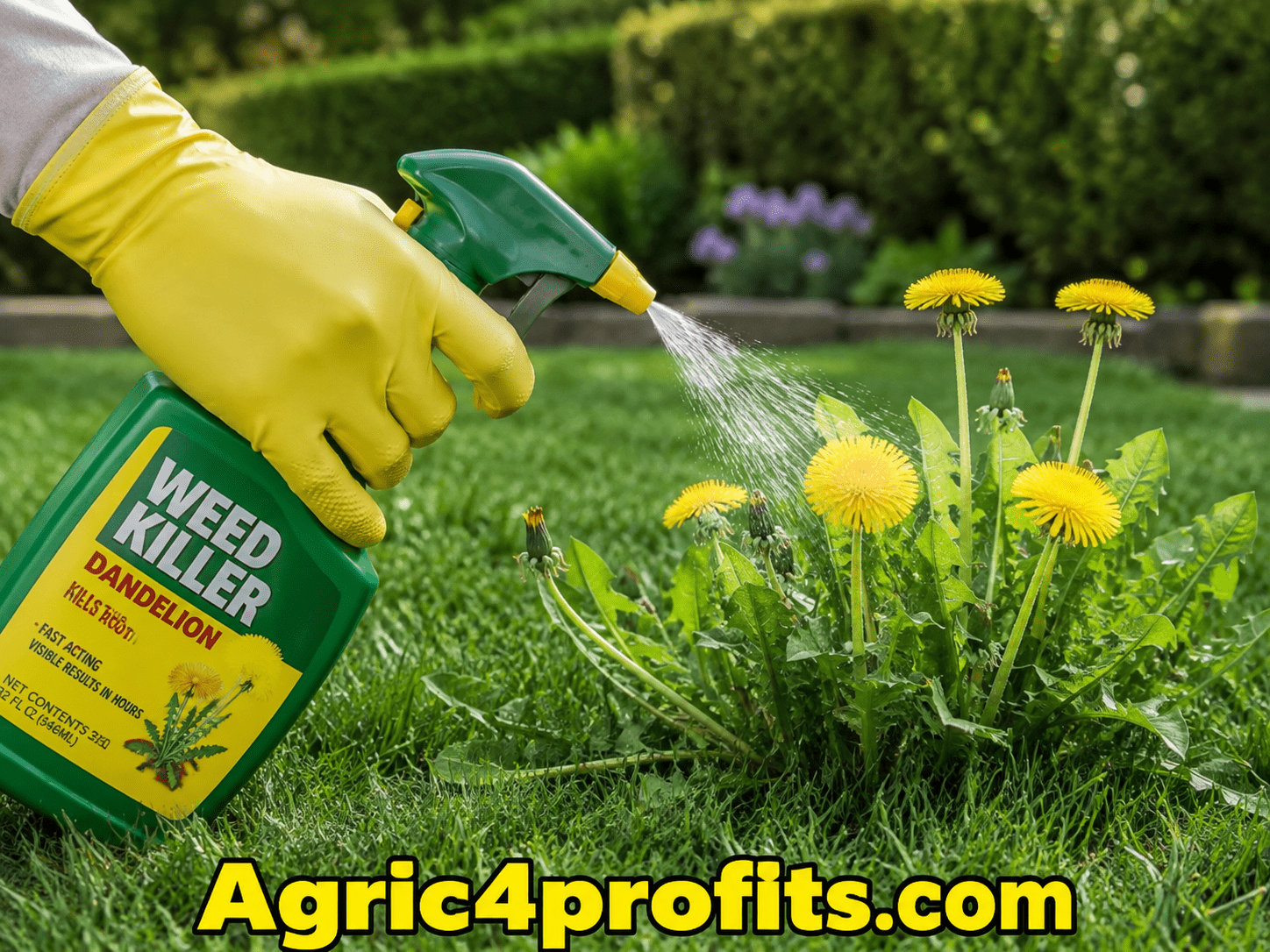
Dandelions, with their bright yellow flower heads and familiar puffball seeds, can appear charming in open spaces. However, their rapid spread may make them troublesome weeds in lawns, gardens, and landscaped areas.
A dandelion killer is a weed-control product designed to manage dandelions and other broadleaf weeds. Choosing the appropriate formulation can help protect desirable vegetation while reducing unwanted competition for moisture, nutrients, sunlight, and space.
Some dandelion killers contain glyphosate, while selective lawn products may contain ingredients such as 2,4-D, dicamba, or triclopyr. Each active ingredient has different uses, so always identify the product's label directions first.
Timing also influences treatment results because actively growing weeds generally respond better than stressed plants. Calm weather, suitable temperatures, and adequate dry periods can help reduce drift while allowing the product to work properly.
When applying a dandelion killer, inspect the affected area carefully and target individual plants where practical. Use the recommended sprayer, dilution, application rate, and protective equipment stated on the product label.
After treatment, allow sufficient time for visible symptoms to develop before disturbing the plants. Depending on the product and conditions, weeds may decline gradually, while survivors or newly emerging plants may require follow-up control.
🌿 Go Organic on Your Farm: Instead of harmful chemical pesticides and fertilisers, try our organic farming products — including neem oil spray, bio-pesticides, natural plant treatments, organic seeds and seedlings, suckers, and many more organic products that are safe for your health, your family, your soil and your harvest. Shop Now →
Long-term management should combine herbicide use with healthy lawn practices, including appropriate mowing, watering, feeding, and overseeding. Dense desirable vegetation can reduce open spaces where dandelions establish and spread repeatedly.
Product selection should consider the turf species, surrounding plants, application site, environmental conditions, and local regulations. Read the entire label carefully, especially directions concerning children, pets, protective clothing, storage, and re-entry periods.
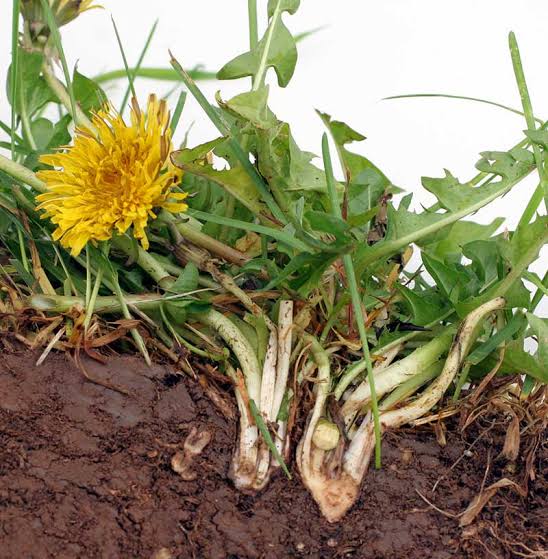
Because dandelions are perennial weeds capable of returning from persistent roots, one application may not provide permanent control. Consistent monitoring and integrated approaches are often more useful than depending entirely on chemical treatment.
Effective dandelion control therefore requires correct identification, suitable product selection, careful application, and continuing lawn maintenance. Used responsibly, weed-control treatments can support cleaner landscapes while minimizing unnecessary effects on desirable plants.
🔧 Free Farm Tool Available: Use our free Agric4Profits Farm Tools to calculate your farm profits, formulate feeds, identify pests and diseases on both your crops and animal farms, plan your planting and harvesting season, including many more farm tasks to get free expert advice and recommendations — completely free, no registration required. Access Free Tools →
When controlling dandelions and other unwanted vegetation, a sound understanding of weed management principles can improve decisions about prevention, monitoring, mechanical removal, and responsible herbicide use across gardens, lawns, and managed landscapes.
Another useful consideration is the wider pest-control strategy used in the garden. Learning how common plant pests and weeds fit within garden problems can encourage earlier identification and help prevent small infestations from becoming persistent problems.
Integrated pest management can also strengthen dandelion control because it emphasizes monitoring and combining compatible methods rather than relying on repeated applications. This approach can reduce unnecessary treatments while maintaining practical control.
A healthy landscape begins with appropriate maintenance and design. Good landscaping practices can improve the appearance of outdoor spaces while making routine weed monitoring, mowing, watering, pruning, and removal easier throughout the growing season.
Selecting suitable plants also matters because vigorous, well-adapted vegetation can occupy available growing space more effectively. Understanding how annual plants grow and compete can support better planning for mixed gardens and ornamental areas.
💬 Have a Farming Question? Join thousands of farmers across Africa on the Agric4Profits Community — ask questions, share experiences and connect with agricultural experts. It is completely free. Ask Your Question Now →
Water management is another important part of maintaining vigorous turf and garden plants. Appropriate watering supports desirable vegetation, while poor irrigation practices may stress plants and create conditions that complicate consistent landscape maintenance.
Where nutrient availability is poor, plants may struggle to compete effectively with weeds. Understanding soil nutrient availability can therefore help growers make better fertility decisions and encourage stronger desirable plant growth.
Regular sanitation, monitoring, and removal of damaged material can support healthier gardens. Broader pest and disease prevention practices also complement weed management by reducing other pressures that may weaken plants and complicate maintenance.
Plant health problems should be distinguished from weed pressure because symptoms can sometimes appear similar. Learning basic plant disease control methods helps growers investigate causes before deciding whether chemical treatment is actually necessary.
Successful lawn management depends on observing results after treatment. Keep records of where applications were made, note surviving plants, and evaluate conditions before repeating any control measure or changing the management approach.
Combining several appropriate control approaches is often more practical than relying on one technique alone. Reviewing different weed-management methods can help gardeners select suitable options for their particular landscape and weed pressure.
Read Also: Causes of Diseases in Farm Animals and How to Prevent Disease OutBreak
Effectiveness and Speed of Dandelion Killer
When controlling dandelions and other stubborn weeds, effectiveness and speed are important considerations. Understanding what influences treatment performance can help gardeners choose appropriate products, apply them correctly, and maintain realistic expectations about results.
1. Selecting the Right Product: The effectiveness of a dandelion killer largely depends on selecting the appropriate product for your specific needs. Choose one labeled for dandelions, broadleaf weeds, and the intended application site.
📖 Want to Go Deeper on This Topic?
Our expert agricultural ebooks cover poultry, fish farming, different crops production, snail farming, organic farming, mushrooms, sheep, cattle, flowers, pig farming, goat farming, agribusiness, etc. in practical step-by-step detail — written by agricultural professionals for African farmers.
Browse All Farming Ebooks →2. Active Ingredients: Active ingredients determine which weeds a product controls and how symptoms develop. Common ingredients include glyphosate, 2,4-D, dicamba, and triclopyr, but formulations and permitted uses differ between products.
3. Application Technique: Applying the dandelion killer correctly is vital for consistent effectiveness. Follow the manufacturer's directions regarding dilution, spray coverage, application rate, equipment, and timing to reduce missed plants and unintended damage.
4. Weed Growth Stage: The growth stage of dandelions can influence treatment results. Actively growing plants may respond more consistently than mature, dormant, drought-stressed, or otherwise weakened weeds under unfavorable conditions.
5. Weather Conditions: Weather conditions can influence how a dandelion killer performs and where it moves. Avoid spraying during conditions that increase drift or interfere with the product's labeled application requirements.
6. Patience and Follow-Up: Some products show visible symptoms within days, while complete decline may take longer. Inspect treated areas afterward, identify surviving plants, and apply an appropriate follow-up strategy when necessary.
Dandelion killers can work at different speeds depending on the active ingredient, plant growth stage, application technique, weather, and weed condition. Visible changes may appear gradually rather than immediately after treatment.
Best Dandelion Killer
Choosing a suitable dandelion killer depends on the treatment site, lawn type, target weeds, application requirements, environmental conditions, and current product availability. Product labels should always guide the final selection and application decision.
1. Roundup Weed & Grass Killer Concentrate Plus: Roundup Weed and Grass Killer products are commonly associated with glyphosate-based formulations. However, specific versions differ, so confirm whether the exact product is suitable for your intended lawn or landscape application.
2. Ortho Weed B Gon Weed Killer for Lawns: Ortho Weed B Gon products are designed for lawn weed control and may target broadleaf weeds such as dandelions. Always confirm current turf compatibility, application rates, and restrictions.
3. Scotts Turf Builder Weed and Feed: Scotts Turf Builder Weed and Feed products combine lawn feeding with weed control in some formulations. Their suitability depends on grass species, target weeds, application timing, and specific product directions.
4. Compare-N-Save Concentrate Grass and Weed Killer: Compare-N-Save products may be marketed for broad weed control, including difficult weeds. Because active ingredients and permitted uses differ, users should verify the current label before purchasing or applying any formulation.
5. Bonide Weed Beater Ultra: Bonide weed-control formulations may target broadleaf weeds in suitable turf settings. Their effectiveness, application requirements, and grass compatibility depend on the precise formulation and directions printed on its current label.
6. Bayer Advanced All-in-One Lawn Weed & Crabgrass Killer: Bayer lawn weed-control products have been marketed for broadleaf and other common lawn weeds. Check the exact formulation because product names, active ingredients, and permitted uses can change.
7. Gordon's Trimec Lawn Weed Killer: Gordon's Trimec formulations are associated with broadleaf weed management in turf. Before use, confirm the specific product's active ingredients, target weeds, turf compatibility, dilution requirements, and current application directions.
Rather than choosing a product solely by brand recognition, compare the active ingredient, target weeds, application site, turf compatibility, safety directions, and local registration status. This approach supports more informed and responsible product selection.
When selecting a dandelion killer, consider environmental concerns, nearby vegetation, children, pets, and local requirements. Product availability and regulations vary by location, so current labels should take priority over older recommendations.
Read Also: Cutworms: How to Identify and Get Rid of Cutworms
Dandelion Killer for Lawns
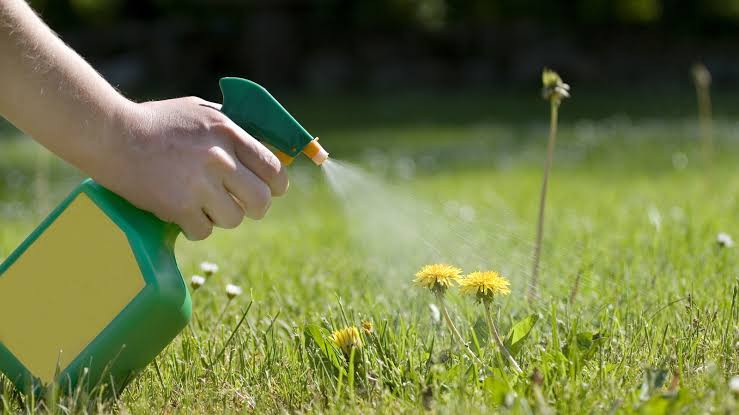
Dandelion control in lawns requires special attention because the desired grass should remain healthy while broadleaf weeds are suppressed. Selective products labeled for the specific turfgrass can reduce the risk of unnecessary grass injury.
1. Scotts Turf Builder Weed and Feed: This type of product combines lawn nutrition with weed control in selected formulations. It may help manage dandelions while supporting grass growth, provided the exact product suits the lawn and label.
2. Ortho Weed B Gon Weed Killer for Lawns: Ortho Weed B Gon formulations may selectively target broadleaf weeds, including dandelions, while leaving suitable turf relatively unaffected. Always follow the specified application rate and timing.
3. Bayer Advanced All-in-One Lawn Weed & Crabgrass Killer: Bayer lawn products may control several common weeds, including dandelions and crabgrass. Before application, verify that the specific formulation is labeled for the turf and weeds present.
4. Bonide Weed Beater Plus Crabgrass & Broadleaf Weed Killer: Bonide Weed Beater formulations can target broadleaf weeds in appropriate lawn settings. Use only according to the current label, including directions covering dilution, timing, coverage, and turf compatibility.
5. Gordon's Trimec Lawn Weed Killer: Gordon's Trimec products are associated with broadleaf weed control in turfgrass. Their use should follow current directions concerning target weeds, dilution, application rates, weather conditions, and suitable grass types.
Before treating a lawn, identify its grass type and inspect nearby ornamental plants, trees, vegetable beds, and water sources. These details can affect which products are suitable and where applications should be avoided.
Follow-up lawn care is equally important after treatment. Appropriate mowing, irrigation, fertility, and overseeding practices can encourage dense turf growth, leaving fewer open spaces for dandelion seedlings and other weeds to establish.
Preventive management can sometimes reduce the need for repeated chemical treatment. Regular observation, timely removal, healthy turf establishment, and integrated weed-management practices can help maintain acceptable weed levels over longer periods.
Dandelion Supplement
The term dandelion supplement refers to preparations made from dandelion plant material rather than weed-control products. These preparations can include capsules, tablets, liquid extracts, teas, and dried plant material marketed for various traditional uses.
Dandelion contains compounds that have attracted nutritional and traditional-medicine interest, including vitamins, minerals, antioxidants, and other phytochemicals. However, supplement claims should be evaluated carefully because traditional use does not automatically establish clinical effectiveness.
Traditional uses of dandelion include support for digestion and urine production, while some extracts have been investigated for antioxidant and anti-inflammatory properties. Evidence varies, and research findings should not be treated as guaranteed outcomes. Learn more about dandelion's traditional health uses in our related article.
1. Digestive Aid: Dandelion supplements are traditionally used to support digestion and urine production. However, these uses should be considered within the limits of available evidence rather than treated as established medical treatment for digestive conditions.
2. Antioxidant and Anti-Inflammatory Effects: Dandelion contains flavonoids and phenolic compounds with antioxidant activity in laboratory studies. These properties are scientifically interesting, but laboratory findings do not automatically demonstrate equivalent benefits in human health.
3. Weight Loss Support: Some animal studies have investigated dandelion extracts in relation to body weight and fat metabolism. Such findings are preliminary and should not be interpreted as proof of effective human weight-loss treatment.
4. Traditional Uses: Dandelion has traditional uses that include supporting digestion, urine production, and certain skin-related applications. Traditional use remains different from clinically proven treatment, so consumers should consider evidence and professional guidance.
Dandelion preparations may interact with medicines or cause allergic reactions in susceptible individuals. People taking medications or managing health conditions should seek qualified professional advice before introducing supplements into their regular routine.
When purchasing supplements, consider reputable manufacturers, clear ingredient information, appropriate quality controls, and transparent dosage directions. Choosing products with credible testing practices may help consumers make more informed decisions about supplement quality.
Dandelion supplements should complement rather than replace a balanced diet, healthy lifestyle, and appropriate medical care. Their use belongs to a different purpose from dandelion weed control, even though both involve the same plant.
Understanding the difference between a dandelion supplement and a dandelion killer is especially important because one concerns plant-derived dietary products, while the other concerns weed-management chemicals designed for outdoor vegetation.
Summary on Dandelion Killer: All You Need To Know About
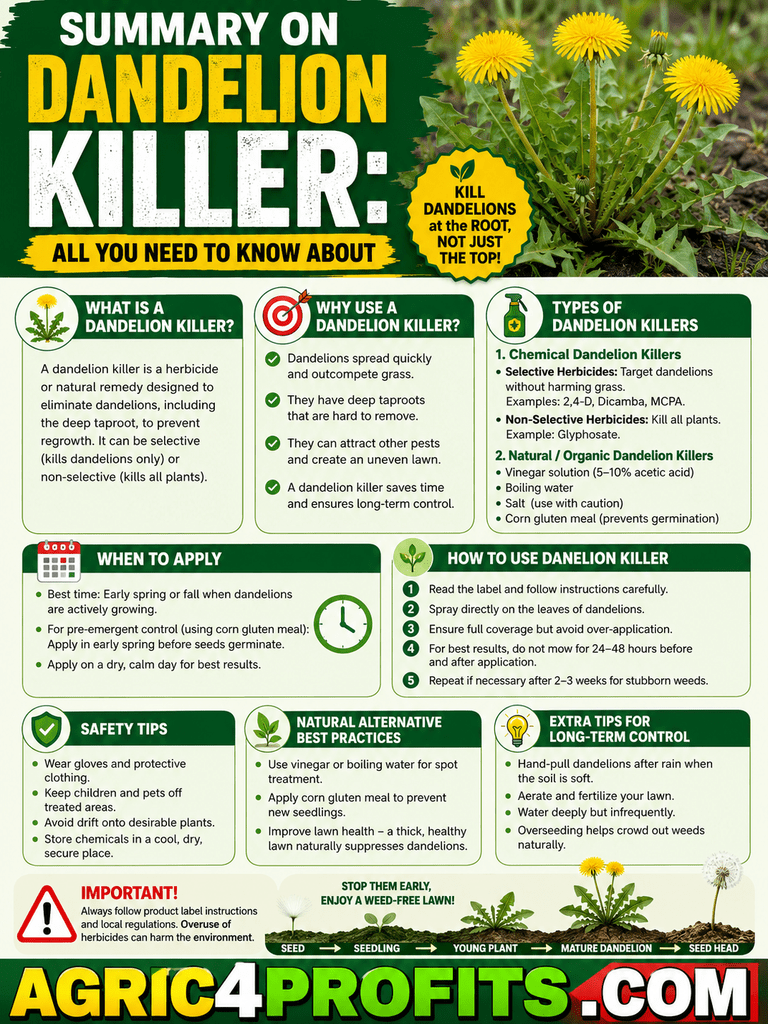
| Topic | Summary |
|---|---|
| Dandelion killer | A product used to control dandelions and other weeds, with suitability depending on formulation and application site. |
| Active ingredients | Common ingredients may include glyphosate, 2,4-D, dicamba, or triclopyr, depending on the product. |
| Application timing | Results are influenced by active weed growth, weather, plant condition, and the product label. |
| Application method | Accurate dilution, coverage, equipment, timing, and careful targeting improve treatment consistency. |
| Weather | Calm conditions and adherence to product weather restrictions can reduce drift and application problems. |
| Lawn control | Choose products specifically labeled for the grass species and weeds present to reduce turf injury. |
| Prevention | Healthy turf, proper watering, mowing, fertility, overseeding, monitoring, and weed management can reduce reinfestation. |
| Dandelion supplements | These are plant-derived preparations used for dietary or traditional purposes and are completely different from weed killers. |
| Safety | Always follow product labels and seek qualified advice concerning pesticide exposure, medications, allergies, or other health concerns. |
Frequently Asked Questions About Dandelion Killer: All You Need To Know About
1. What is a dandelion killer?
Dandelion killers are products formulated to control dandelions, commonly perennial broadleaf weeds. Some formulations are selective for lawns, while others are non-selective, so the label should determine where and how each product is used.
2. When should dandelion killer be applied?
The best timing generally depends on active weed growth and the product label. Spring and fall may provide suitable conditions in many regions, but local weather, plant condition, and labeled restrictions should guide treatment.
3. Can dandelion killer be used on lawns?
Some dandelion killers can be used on lawns when specifically labeled for the turfgrass involved. Applying unsuitable products may injure desirable grass, so identify the turf species and follow application directions carefully.
4. Does every dandelion killer contain glyphosate?
Glyphosate is a broad-spectrum herbicide used in some weed-control products, but not every dandelion killer contains it. Check the active ingredient statement because formulations and intended uses vary substantially between products.
5. How long does dandelion killer take to work?
Visible results vary with the active ingredient, weed maturity, weather, plant stress, and application quality. Some products show symptoms within days, while complete decline can take longer under less favorable conditions.
6. Will dandelion killer permanently remove dandelions?
Dandelion control is not always permanent because perennial plants can regenerate and new seeds can arrive from surrounding areas. Combining treatment with monitoring, removal, healthy turf, and preventive weed management improves long-term control.
7. What is the difference between a dandelion supplement and a dandelion killer?
Dandelion supplements are preparations made from the plant for dietary or traditional uses, whereas dandelion killers are weed-control products. They should never be confused, substituted for one another, or used interchangeably for any purpose.
8. Can dandelion supplements interact with medicines?
Yes, dandelion supplements may interact with medicines or cause allergic reactions in susceptible people. Anyone taking medication or managing a health condition should consult a qualified healthcare professional before using such supplements regularly.
Do you have any questions, suggestions, or contributions? If so, please feel free to use the comment box below to share your thoughts. We also encourage you to kindly share this information with others who might benefit from it. Since we can’t reach everyone at once, we truly appreciate your help in spreading the word. Thank you very much for your support and for sharing!
Read Also: Climate Change and Its Impact on Agriculture
🌱 Take Your Farming Further With Agric4Profits
Based on what you just read, here are free resources and products from Agric4Profits that can help your farm right now:
- 🛒 Visit Our Marketplace — Organic neem oil, bio-pesticides, seeds and farming products
- 📚 Read Premium Content — Advanced guides for serious and profitable farming
- 🎓 Join Our Free Academy — Structured free training for farmers across Africa
- 🔧 Use Our Free Farm Tools — Profit calculators, feed formulation, pest identifier and more
- 💬 Join Our Farming Community — Connect with farmers across all 54 African countries
- ❓ Ask a Farming Question — Get answers from experienced farmers and agricultural experts
Please cite this content in academic work, research, or publications.